inglese Edizione
Filosofia
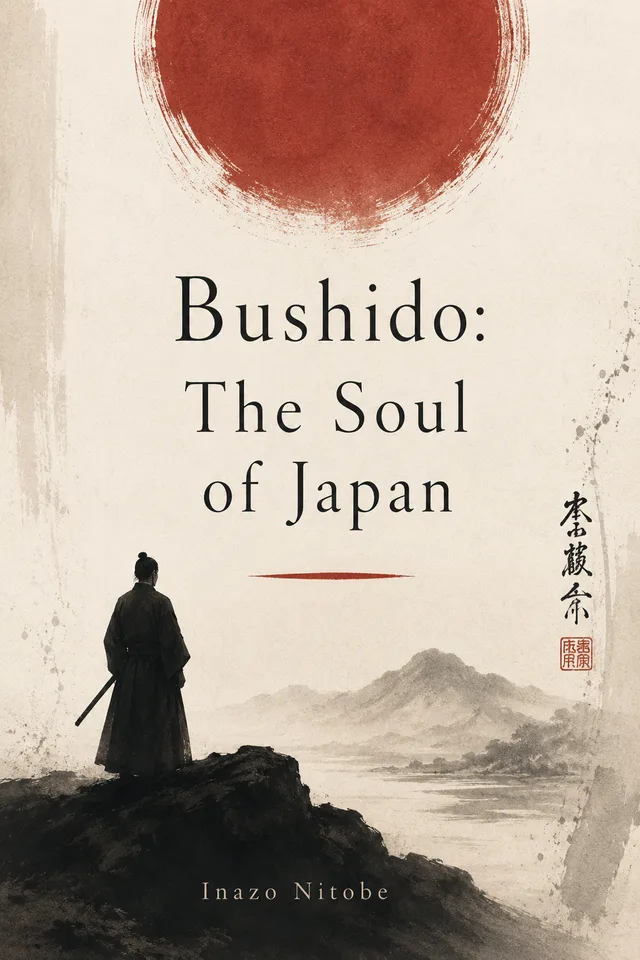
Bushido: The Soul of Japan
Edizione BooksWhale in inglese di Inazo Nitobe
Nitobe’s influential English account of samurai ethics, honor, courage, loyalty, and moral education.
- Anteprima
- Estratto dal testo preparato
- Formati
- Lettore online, EPUB, PDF
- Accesso
- Claim Libreria
Introduzione al libro
Bushido: The Soul of Japan
Bushido: The Soul of Japan presents samurai ideals to an international audience through ethics, history, religion, and comparative culture. Nitobe explores honor, courage, benevolence, self-control, loyalty, and the formation of character.
Edizione BooksWhale
Come è stata preparata
Questa edizione si basa su un testo di pubblico dominio ed è stata preparata da BooksWhale per la lettura digitale.
Base di pubblico dominio
Perché può essere condivisa
Inazo Nitobe died in 1933, and Bushido: The Soul of Japan was first published in English in 1900. These dates support the public-domain basis for this English original edition.
Leggi anteprima
Estratto dal testo preparato
Anteprima selezionata dal testo preparato per la lettura.
Capitolo in anteprimaFull textLeggi anteprima
Bushido: The Soul of Japan
新渡戸稲造
Capitolo in anteprimaBUSHIDO AS AN ETHICAL SYSTEM.Anteprima
Chivalry is a flower no less indigenous to the soil of Japan than its emblem, the cherry blossom; nor is it a dried-up specimen of an antique virtue preserved in the herbarium of our history. It is still a living object of power and beauty among us; and if it assumes no tangible shape or form, it not the less scents the moral atmosphere, and makes us aware that we are still under its potent spell. The conditions of society which brought it forth and nourished it have long disappeared; but as those far-off stars which once were and are not, still continue to shed their rays upon us, so the light of chivalry, which was a child of feudalism, still illuminates our moral path, surviving its mother institution. It is a pleasure to me to reflect upon this subject in the language of Burke, who uttered the well-known touching eulogy over the
neglected bier of its European prototype.
It argues a sad defect of information concerning the Far East, when so erudite a scholar as Dr. George Miller did not hesitate to affirm that chivalry, or any other similar institution, has never existed either among the nations of antiquity or among the modern Orientals. Such ignorance, however, is amply excusable, as the third edition of the good Doctor’s work appeared the same year that Commodore Perry was knocking at the portals of our exclusivism. More than a decade later, about the time that our feudalism was in the last throes of existence, Carl Marx, writing his “Capital,” called the attention of his readers to the peculiar advantage of studying the social and political institutions of feudalism, as then to be seen in living form only in Japan. I would likewise invite the Western historical and ethical student to the study
of chivalry in the Japan of the present.
Enticing as is a historical disquisition on the comparison between European and Japanese feudalism and chivalry, it is not the purpose of this paper to enter into it at length. My attempt is rather to relate, _firstly_, the origin and sources of our chivalry; _secondly_, its character and teaching; _thirdly_, its influence among the masses; and, _fourthly_, the continuity and permanence of its influence. Of these several points, the first will be only brief and cursory, or else I should have to take my readers into the devious paths of our national history; the second will be dwelt upon at greater length, as being most likely to interest students of International Ethics and Comparative Ethology in our ways of thought and action; and the rest will be dealt
with as corollaries.
The Japanese word which I have roughly rendered Chivalry, is, in the original, more expressive than Horsemanship. _Bu-shi-do_ means literally Military-Knight-Ways—the ways which fighting nobles should observe in their daily life as well as in their vocation; in a word, the “Precepts of Knighthood,” the _noblesse oblige_ of the warrior class. Having thus given its literal significance, I may be allowed henceforth to use the word in the original. The use of the original term is also advisable for this reason, that a teaching so circumscribed and unique, engendering a cast of mind and character so peculiar, so local, must wear the badge of its singularity on its face; then, some words have a national _timbre_ so expressive of race characteristics that the best of translators can do them but scant justice, not to say positive injustice and grievance. Who can improve by translation what the German “_Gemüth_” signifies, or who does not feel the difference between the two words verbally so closely allied as the English _gentleman_ and the French
_gentilhomme_?
Bushido, then, is the code of moral principles which the knights were required or instructed to observe. It is not a written code; at best it consists of a few maxims handed down from mouth to mouth or coming from the pen of some well-known warrior or savant. More frequently it is a code unuttered and unwritten, possessing all the more the powerful sanction of veritable deed, and of a law written on the fleshly tablets of the heart. It was founded not on the creation of one brain, however able, or on the life of a single personage, however renowned. It was an organic growth of decades and centuries of military career. It, perhaps, fills the same position in the history of ethics that the English Constitution does in political history; yet it has had nothing to compare with the Magna Charta or the Habeas Corpus Act. True, early in the seventeenth century Military Statutes (_Buké Hatto_) were promulgated; but their thirteen short articles were taken up mostly with marriages, castles, leagues, etc., and didactic regulations were but meagerly touched upon. We cannot, therefore, point out any definite time and place and say, “Here is its fountain head.” Only as it attains consciousness in the feudal age, its origin, in respect to time, may be identified with feudalism. But feudalism itself is woven of many threads, and Bushido shares its intricate nature. As in England the political institutions of feudalism may be said to date from the Norman Conquest, so we may say that in Japan its rise was simultaneous with the ascendency of Yoritomo, late in the twelfth century. As, however, in England, we find the social elements of feudalism far back in the period previous to William the Conqueror, so, too, the germs of feudalism in Japan had been long existent before the period I have mentioned.
Capitolo in anteprimaSOURCES OF BUSHIDO,Anteprima
of which I may begin with Buddhism. It furnished a sense of calm trust in Fate, a quiet submission to the inevitable, that stoic composure in sight of danger or calamity, that disdain of life and friendliness with death. A foremost teacher of swordsmanship, when he saw his pupil master the utmost of his art, told him, “Beyond this my instruction must give way to Zen teaching.” “Zen” is the Japanese equivalent for the Dhyâna, which “represents human effort to reach through meditation zones of thought beyond the range of verbal expression.” Its method is contemplation, and its purport, as far as I understand it, to be convinced of a principle that underlies all phenomena, and, if it can, of the Absolute itself, and thus to put oneself in harmony with this Absolute. Thus defined, the teaching was more than the dogma of a sect, and whoever attains to the perception of the Absolute raises himself above mundane things and awakes, “to a new Heaven and a new Earth.”
What Buddhism failed to give, Shintoism offered in abundance. Such loyalty to the sovereign, such reverence for ancestral memory, and such filial piety as are not taught by any other creed, were inculcated by the Shinto doctrines, imparting passivity to the otherwise arrogant character of the samurai. Shinto theology has no place for the dogma of “original sin.” On the contrary, it believes in the innate goodness and God-like purity of the human soul, adoring it as the adytum from which divine oracles are proclaimed. Everybody has observed that the Shinto shrines are conspicuously devoid of objects and instruments of worship, and that a plain mirror hung in the sanctuary forms the essential part of its furnishing. The presence of this article is easy to explain: it typifies the human heart, which, when perfectly placid and clear, reflects the very image of the Deity. When you stand, therefore, in front of the shrine to worship, you see your own image reflected on its shining surface, and the act of worship is tantamount to the old Delphic injunction, “Know Thyself.” But self-knowledge does not imply, either in the Greek or Japanese teaching, knowledge of the physical part of man, not his anatomy or his psycho-physics; knowledge was to be of a moral kind, the introspection of our moral nature. Mommsen, comparing the Greek and the Roman, says that when the former worshiped he raised his eyes to heaven, for his prayer was contemplation, while the latter veiled his head, for his was reflection. Essentially like the Roman conception of religion, our reflection brought into prominence not so much the moral as the national consciousness of the individual. Its nature-worship endeared the country to our inmost souls, while its ancestor-worship, tracing from lineage to lineage, made the Imperial family the fountain-head of the whole nation. To us the country is more than land and soil from which to mine gold or to reap grain—it is the sacred abode of the gods, the spirits of our forefathers: to us the Emperor is more than the Arch Constable of a _Rechtsstaat_, or even the Patron of a _Culturstaat_—he is the bodily representative of Heaven on earth, blending in his person its power and its mercy. If what M. Boutmy says is true of English royalty—that it “is not only the image of authority, but the author and symbol of national unity,” as I believe it to be, doubly and trebly may this be affirmed of royalty in
Japan.
The tenets of Shintoism cover the two predominating features of the emotional life of our race—Patriotism and Loyalty. Arthur May Knapp very truly says: “In Hebrew literature it is often difficult to tell whether the writer is speaking of God or of the Commonwealth; of heaven or of Jerusalem; of the Messiah or of the nation itself.” A similar confusion may be noticed in the nomenclature of our national faith. I said confusion, because it will be so deemed by a logical intellect on account of its verbal ambiguity; still, being a framework of national instinct and race feelings, Shintoism never pretends to a systematic philosophy or a rational theology. This religion—or, is it not more correct to say, the race emotions which this religion expressed?—thoroughly imbued Bushido with loyalty to the sovereign and love of country. These acted more as impulses than as doctrines; for Shintoism, unlike the Mediæval Christian Church, prescribed to its votaries scarcely any _credenda_, furnishing them at the same time with
Indice
In questa edizione
- 01Full text
- 02BUSHIDO AS AN ETHICAL SYSTEM.
- 03SOURCES OF BUSHIDO,
- 04RECTITUDE OR JUSTICE,
- 05COURAGE, THE SPIRIT OF DARING
- 06AND BEARING,
- 07BENEVOLENCE, THE FEELING OF
- 08DISTRESS,
- 09POLITENESS,
- 10VERACITY OR TRUTHFULNESS,
- 11HONOR,
- 12THE DUTY OF LOYALTY,
- 13EDUCATION AND TRAINING OF
- 14A SAMURAI,
- 15part of the enemy’s body as will make him numb and incapable of
- 16part by the fact that feudal warfare was not carried on with scientific
- 17SELF-CONTROL,
- 18part;” “He that is born must die;” “It is foolish to count the years of
- 19THE INSTITUTIONS OF SUICIDE
- 20AND REDRESS,
- 21THE SWORD THE SOUL OF THE
- 22SAMURAI,
- 23THE TRAINING AND POSITION OF
- 24WOMAN.
- 25part of the household contrivance for hospitality. Domesticity guided
- 26THE INFLUENCE OF BUSHIDO
- 27part played by bushi in the social progress, as far as it went, of our
- 28IS BUSHIDO STILL ALIVE?
- 29THE FUTURE OF BUSHIDO,
Disponibilità lingue
Altre lingue
Altre edizioni linguistiche non sono ancora pubblicate. Qui appariranno quando disponibili.
Richiedi un'altra lingua