inglese Edizione
Filosofia
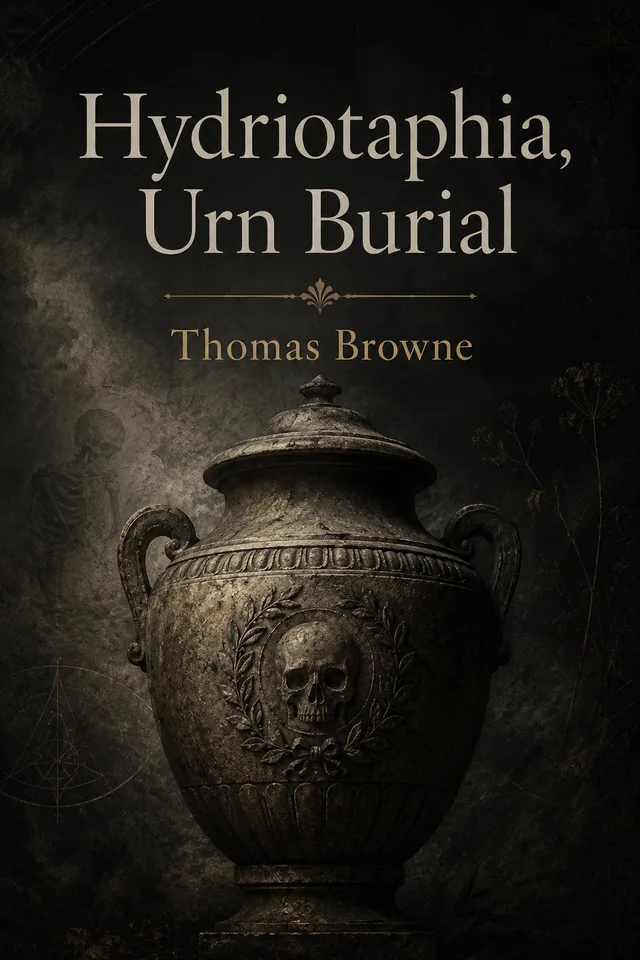
Hydriotaphia, Urn Burial
Edizione BooksWhale in inglese di Thomas Browne
A meditative prose classic on burial, mortality, memory, antiquity, and the fragile ambition of human fame.
- Anteprima
- Estratto dal testo preparato
- Formati
- Lettore online, EPUB, PDF
- Accesso
- Claim Libreria
Introduzione al libro
Hydriotaphia, Urn Burial
Hydriotaphia, Urn Burial is Thomas Browne’s richly patterned English meditation on ancient burial customs, death, memory, and the vanity of earthly reputation. This BooksWhale public-domain edition presents a baroque prose masterpiece for readers of philosophy, literary style, and seventeenth-century reflection.
Edizione BooksWhale
Come è stata preparata
Questa edizione si basa su un testo di pubblico dominio ed è stata preparata da BooksWhale per la lettura digitale.
Base di pubblico dominio
Perché può essere condivisa
Thomas Browne died in 1682, and Hydriotaphia, Urn Burial was first published in 1658. These dates support the public-domain basis for this English original edition.
Leggi anteprima
Estratto dal testo preparato
Anteprima selezionata dal testo preparato per la lettura.
Capitolo in anteprimaFull textLeggi anteprima
Hydriotaphia, Urn Burial
Thomas Browne
HYDRIOTAPHIA, URN BURIAL
HYDRIOTAPHIA.
URN BURIAL; OR, A DISCOURSE OF THE SEPULCHRAL URNS LATELY FOUND IN NORFOLK.
TO MY WORTHY AND HONOURED FRIEND,
THOMAS LE GROS,
OF CROSTWICK, ESQUIRE.
WHEN the general pyre was out, and the last valediction over, men took a lasting adieu of their interred friends, little expecting the curiosity of future ages should comment upon their ashes; and, having no old experience of the duration of their relicks, held no opinion of such after-considerations.
But who knows the fate of his bones, or how often he is to be buried? Who hath the oracle of his ashes, or whither they are to be scattered? The relicks of many lie like the ruins of Pompey’s, in all parts of the earth; and when they arrive at your hands these may seem to have wandered far, who, in a direct and meridian travel, have but few miles of known earth between yourself and the pole.
“Pompeios juvenes Asia atque Europa, sed ipsum terrâ tegit Libyos.”
Little directly but sea, between your house and Greenland.
That the bones of Theseus should be seen again in Athens was not beyond conjecture and hopeful expectation: but that these should arise so opportunely to serve yourself was an hit of fate, and honour beyond prediction.
Brought back by Cimon Plutarch.
We cannot but wish these urns might have the effect of theatrical vessels and great Hippodrome urns in Rome, to resound the acclamations and honour due unto you. But these are sad and sepulchral pitchers, which have no joyful voices; silently expressing old mortality, the ruins of forgotten times, and can only speak with life, how long in this corruptible frame some parts may be uncorrupted; yet able to outlast bones long unborn, and noblest pile among us.
The great urns at the Hippodrome at Rome, conceived to resound the voices of people at their shows.
We present not these as any strange sight or spectacle unknown to your eyes, who have beheld the best of urns and noblest variety of ashes; who are yourself no slender master of antiquities, and can daily command the view of so many imperial faces; which raiseth your thoughts unto old things and consideration of times before you, when even living men were antiquities; when the living might exceed the dead, and to depart this world could not be properly said to go unto the greater number. And so run up your thoughts upon the ancient of days, the antiquary’s truest object, unto whom the eldest parcels are young, and earth itself an infant, and without Egyptian account makes but small noise in thousands.
“Abiit ad plures.”
Which makes the world so many years old.
We were hinted by the occasion, not catched the opportunity to write of old things, or intrude upon the antiquary. We are coldly drawn unto discourses of antiquities, who have scarce time before us to comprehend new things, or make out learned novelties. But seeing they arose, as they lay almost in silence among us, at least in short account suddenly passed over, we were very unwilling they should die again, and be buried twice among us.
Beside, to preserve the living, and make the dead to live, to keep men out of their urns, and discourse of human fragments in them, is not impertinent unto our profession; whose study is life and death, who daily behold examples of mortality, and of all men least need artificial mementos, or coffins by our bedside, to mind us of our graves.
’Tis time to observe occurrences, and let nothing remarkable escape us: the supinity of elder days hath left so much in silence, or time hath so martyred the records, that the most industrious heads do find no easy work to erect a new Britannia.
’Tis opportune to look back upon old times, and contemplate our forefathers. Great examples grow thin, and to be fetched from the passed world. Simplicity flies away, and iniquity comes at long strides upon us. We have enough to do to make up ourselves from present and passed times, and the whole stage of things scarce serveth for our instruction. A complete piece of virtue must be made from the Centos of all ages, as all the beauties of Greece could make but one handsome Venus.
Capitolo in anteprimaCHAPTER I.Anteprima
IN the deep discovery of the subterranean world a shallow part would satisfy some inquirers; who, if two or three yards were open about the surface, would not care to rake the bowels of Potosi, and regions toward the centre. Nature hath furnished one part of the earth, and man another. The treasures of time lie high, in urns, coins, and monuments, scarce below the roots of some vegetables. Time hath endless rarities, and shows of all varieties; which reveals old things in heaven, makes new discoveries in earth, and even earth itself a discovery. That great antiquity America lay buried for thousands of years, and a large part of the earth is still in the urn unto us.
The rich mountain of Peru.
Though if Adam were made out of an extract of the earth, all parts might challenge a restitution, yet few have returned their bones far lower than they might receive them; not affecting the graves of giants, under hilly and heavy coverings, but content with less than their own depth, have wished their bones might lie soft, and the earth be light upon them. Even such as hope to rise again, would not be content with central interment, or so desperately to place their relicks as to lie beyond discovery; and in no way to be seen again; which happy contrivance hath made communication with our forefathers, and left unto our view some parts, which they never beheld themselves.
Though earth hath engrossed the name, yet water hath proved the smartest grave; which in forty days swallowed almost mankind, and the living creation; fishes not wholly escaping, except the salt ocean were handsomely contempered by a mixture of the fresh element.
Many have taken voluminous pains to determine the state of the soul upon disunion; but men have been most phantastical in the singular contrivances of their corporal dissolution: whilst the soberest nations have rested in two ways, of simple inhumation and burning.
That carnal interment or burying was of the elder date, the old examples of Abraham and the patriarchs are sufficient to illustrate; and were without competition, if it could be made out that Adam was buried near Damascus, or Mount Calvary, according to some tradition. God himself, that buried but one, was pleased to make choice of this way, collectible from Scripture expression, and the hot contest between Satan and the archangel about discovering the body of Moses. But the practice of burning was also of great antiquity, and of no slender extent. For (not to derive the same from Hercules) noble descriptions there are hereof in the Grecian funerals of Homer, in the formal obsequies of Patroclus and Achilles; and somewhat elder in the Theban war, and solemn combustion of Meneceus, and Archemorus, contemporary unto Jair the eighth judge of Israel. Confirmable also among the Trojans, from the funeral pyre of Hector, burnt before the gates of Troy: and the burning of Penthesilea the Amazonian queen: and long continuance of that practice, in the inward countries of Asia; while as low as the reign of Julian, we find that the king of Chionia burnt the body of his son, and interred the ashes in a silver urn.
Gumbrates, king of Chionia, a country near Persia.
The same practice extended also far west; and besides Herulians, Getes, and Thracians, was in use with most of the Celtæ, Sarmatians, Germans, Gauls, Danes, Swedes, Norwegians; not to omit some use thereof among Carthaginians and Americans. Of greater antiquity among the Romans than most opinion, or Pliny seems to allow: for (besides the old table laws of burning or burying within the city, of making the funeral fire with planed wood, or quenching the fire with wine), Manlius the consul burnt the body of his son: Numa, by special clause of his will, was not burnt but buried; and Remus was solemnly burned, according to the description of Ovid.
Capitolo in anteprimaCHAPTER II.Anteprima
THE solemnities, ceremonies, rites of their cremation or interment, so solemnly delivered by authors, we shall not disparage our reader to repeat. Only the last and lasting part in their urns, collected bones and ashes, we cannot wholly omit or decline that subject, which occasion lately presented, in some discovered among us.
In a field of Old Walsingham, not many months past, were digged up between forty and fifty urns, deposited in a dry and sandy soil, not a yard deep, nor far from one another.--Not all strictly of one figure, but most answering these described; some containing two pounds of bones, and teeth, with fresh impressions of their combustion; besides the extraneous substances, like pieces of small boxes, or combs handsomely wrought, handles of small brass instruments, brazen nippers, and in one some kind of opal.
Near the same plot of ground, for about six yards compass, were digged up coals and incinerated substances, which begat conjecture that this was the ustrina or place of burning their bodies, or some sacrificing place unto the Manes, which was properly below the surface of the ground, as the aræ and altars unto the gods and heroes above it.
That these were the urns of Romans from the common custom and place where they were found, is no obscure conjecture, not far from a Roman garrison, and but five miles from Brancaster, set down by ancient record under the name of Branodunum. And where the adjoining town, containing seven parishes, in no very different sound, but Saxon termination, still retains the name of Burnham, which being an early station, it is not improbable the neighbour parts were filled with habitations, either of Romans themselves, or Britons Romanized, which observed the Roman customs.
Nor is it improbable, that the Romans early possessed this country. For though we meet not with such strict particulars of these parts before the new institution of Constantine and military charge of the count of the Saxon shore, and that about the Saxon invasions, the Dalmatian horsemen were in the garrison of Brancaster; yet in the time of Claudius, Vespasian, and Severus, we find no less than three legions dispersed through the province of Britain. And as high as the reign of Claudius a great overthrow was given unto the Iceni, by the Roman lieutenant Ostorius. Not long after, the country was so molested, that, in hope of a better state, Prastaagus bequeathed his kingdom unto Nero and his daughters; and Boadicea, his queen, fought the last decisive battle with Paulinus. After which time, and conquest of Agricola, the lieutenant of Vespasian, probable it is, they wholly possessed this country; ordering it into garrisons or habitations best suitable with their securities. And so some Roman habitations not improbable in these parts, as high as the time of Vespasian, where the Saxons after seated, in whose thin-filled maps we yet find the name of Walsingham. Now if the Iceni were but Gammadims, Anconians, or men that lived in an angle, wedge, or elbow of Britain, according to the original etymology, this country will challenge the emphatical appellation, as most properly making the elbow or iken of Icenia.
That Britain was notably populous is undeniable, from that expression of Cæsar. That the Romans themselves were early in no small numbers--seventy thousand, with their associates, slain, by Boadicea, affords a sure account. And though not many Roman habitations are now known, yet some, by old works, rampiers, coins, and urns, do testify their possessions. Some urns have been found at Castor, some also about Southcreak, and, not many years past, no less than ten in a field at Buxton, not near any recorded garrison. Nor is it strange to find Roman coins of copper and silver among us; of Vespasian, Trajan, Adrian, Commodus, Antoninus, Severus, &c.; but the greater number of Dioclesian, Constantine, Constans, Valens, with many of Victorinus Posthumius, Tetricus, and the thirty tyrants in the reign of Gallienus; and some as high as Adrianus have been found about Thetford, or Sitomagus, mentioned in the Itinerary of Antoninus, as the way from Venta or Castor unto London. But the most frequent discovery is made at the two Castors by Norwich and Yarmouth at Burghcastle, and Brancaster.
Indice
In questa edizione
- 01Full text
- 02CHAPTER I.
- 03CHAPTER II.
- 04CHAPTER III.
- 05CHAPTER IV.
- 06CHAPTER V.
Disponibilità lingue
Altre lingue
Altre edizioni linguistiche non sono ancora pubblicate. Qui appariranno quando disponibili.
Richiedi un'altra lingua