inglese Edizione
Letteratura
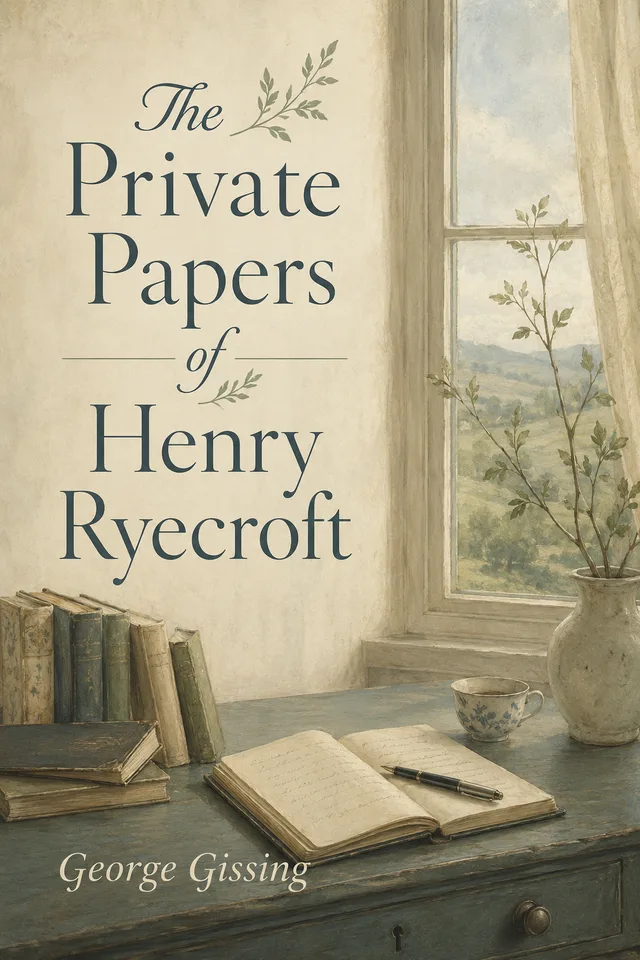
The Private Papers of Henry Ryecroft
Edizione BooksWhale in inglese di George Gissing
A reflective English classic of reading, solitude, aging, nature, memory, and literary retirement.
- Anteprima
- Estratto dal testo preparato
- Formati
- Lettore online, EPUB, PDF
- Accesso
- Claim Libreria
Introduzione al libro
The Private Papers of Henry Ryecroft
The Private Papers of Henry Ryecroft presents George Gissing’s meditative portrait of a literary man looking back on hardship, books, countryside, and quiet independence. This English original suits readers of essays, late Victorian literature, book culture, and reflective autobiographical fiction.
Edizione BooksWhale
Come è stata preparata
Questa edizione si basa su un testo di pubblico dominio ed è stata preparata da BooksWhale per la lettura digitale.
Base di pubblico dominio
Perché può essere condivisa
George Gissing died in 1903, and The Private Papers of Henry Ryecroft was first published in 1903. These dates support the public-domain basis for this English original edition.
Leggi anteprima
Estratto dal testo preparato
Anteprima selezionata dal testo preparato per la lettura.
Capitolo in anteprimaFull textLeggi anteprima
The Private Papers of Henry Ryecroft
George Gissing
THE PRIVATE PAPERS OF HENRY RYECROFT
Capitolo in anteprimaPREFACEAnteprima
The name of Henry Ryecroft never became familiar to what is called the reading public. A year ago obituary paragraphs in the literary papers gave such account of him as was thought needful: the date and place of his birth, the names of certain books he had written, an allusion to his work in the periodicals, the manner of his death. At the time it sufficed. Even those few who knew the man, and in a measure understood him, must have felt that his name called for no further celebration; like other mortals, he had lived and laboured; like other mortals, he had entered into his rest. To me, however, fell the duty of examining Ryecroft's papers; and having, in the exercise of my discretion, decided to print this little volume, I feel that it requires a word or two of biographical complement, just so much personal detail as may point the significance of the self-revelation here made.
When first I knew him, Ryecroft had reached his fortieth year; for twenty years he had lived by the pen. He was a struggling man, beset by poverty and other circumstances very unpropitious to mental work. Many forms of literature had he tried; in none had he been conspicuously successful;
yet now and then he had managed to earn a little more money than his actual needs demanded, and thus was enabled to see something of foreign countries. Naturally a man of independent and rather scornful outlook, he had suffered much from defeated ambition, from disillusions of many kinds, from subjection to grim necessity; the result of it, at the time of which I am speaking, was, certainly not a broken spirit, but a mind and temper so sternly disciplined, that, in ordinary intercourse with him, one did not know but that he led a calm, contented life. Only after several years of friendship was I able to form a just idea of what the man had gone through, or of his actual existence. Little by little Ryecroft had subdued himself to a modestly industrious routine. He did a great deal of mere hack-work; he reviewed, he translated, he wrote articles; at long intervals a volume appeared under his name. There were times, I have no doubt, when bitterness took hold upon him; not seldom he suffered in health, and probably as much from moral as from physical overstrain; but, on the whole, he earned his living very much as other men do, taking the day's toil as a matter of course, and rarely grumbling over it.
Time went on; things happened; but Ryecroft was still laborious and poor.
In moments of depression he spoke of his declining energies, and evidently suffered under a haunting fear of the future. The thought of dependence had always been intolerable to him; perhaps the only boast I at any time heard from his lips was that he had never incurred debt. It was a bitter thought that, after so long and hard a struggle with unkindly circumstance, he might end his life as one of the defeated.
A happier lot was in store for him. At the age of fifty, just when his health had begun to fail and his energies to show abatement, Ryecroft had the rare good fortune to find himself suddenly released from toil, and to enter upon a period of such tranquillity of mind and condition as he had never dared to hope. On the death of an acquaintance, more his friend than he imagined, the wayworn man of letters learnt with astonishment that there was bequeathed to him a life annuity of three hundred pounds.
Having only himself to support (he had been a widower for several years, and his daughter, an only child, was married), Ryecroft saw in this income something more than a competency. In a few weeks he quitted the London suburb where of late he had been living, and, turning to the part of England which he loved best, he presently established himself in a cottage near Exeter, where, with a rustic housekeeper to look after him, he was soon thoroughly at home. Now and then some friend went down into Devon to see him; those who had that pleasure will not forget the plain little house amid its half-wild garden, the cosy book-room with its fine view across the valley of the Exe to Haldon, the host's cordial, gleeful hospitality, rambles with him in lanes and meadows, long talks amid the stillness of the rural night. We hoped it would all last for many a year; it seemed, indeed, as though Ryecroft had only need of rest and calm to become a hale man. But already, though he did not know it, he was suffering from a disease of the heart, which cut short his life after little more than a lustrum of quiet contentment. It had always been his wish to die suddenly; he dreaded the thought of illness, chiefly because of the trouble it gave to others. On a summer evening, after a long walk in very hot weather, he lay down upon the sofa in his study, and there--as his calm face declared--passed from slumber into the great silence.
Capitolo in anteprimaI.Anteprima
For more than a week my pen has lain untouched. I have written nothing for seven whole days, not even a letter. Except during one or two bouts of illness, such a thing never happened in my life before. In my life;
the life, that is, which had to be supported by anxious toil; the life which was not lived for living's sake, as all life should be, but under the goad of fear. The earning of money should be a means to an end; for more than thirty years--I began to support myself at sixteen--I had to regard it as the end itself.
I could imagine that my old penholder feels reproachfully towards me. Has it not served me well? Why do I, in my happiness, let it lie there neglected, gathering dust? The same penholder that has lain against my forefinger day after day, for--how many years? Twenty, at least; I remember buying it at a shop in Tottenham Court Road. By the same token I bought that day a paper-weight, which cost me a whole shilling--an extravagance which made me tremble. The penholder shone with its new varnish, now it is plain brown wood from end to end. On my forefinger it has made a callosity.
Old companion, yet old enemy! How many a time have I taken it up, loathing the necessity, heavy in head and heart, my hand shaking, my eyes sick-dazzled! How I dreaded the white page I had to foul with ink! Above all, on days such as this, when the blue eyes of Spring laughed from between rosy clouds, when the sunlight shimmered upon my table and made me long, long all but to madness, for the scent of the flowering earth, for the green of hillside larches, for the singing of the skylark above the downs. There was a time--it seems further away than childhood--when I took up my pen with eagerness; if my hand trembled it was with hope.
But a hope that fooled me, for never a page of my writing deserved to live. I can say that now without bitterness. It was youthful error, and only the force of circumstance prolonged it. The world has done me no injustice; thank Heaven I have grown wise enough not to rail at it for this! And why should any man who writes, even if he write things immortal, nurse anger at the world's neglect? Who asked him to publish?
Who promised him a hearing? Who has broken faith with him? If my shoemaker turn me out an excellent pair of boots, and I, in some mood of cantankerous unreason, throw them back upon his hands, the man has just cause of complaint. But your poem, your novel, who bargained with you for it? If it is honest journeywork, yet lacks purchasers, at most you may call yourself a hapless tradesman. If it come from on high, with what decency do you fret and fume because it is not paid for in heavy cash? For the work of man's mind there is one test, and one alone, the judgment of generations yet unborn. If you have written a great book, the world to come will know of it. But you don't care for posthumous glory. You want to enjoy fame in a comfortable armchair. Ah, that is quite another thing. Have the courage of your desire. Admit yourself a merchant, and protest to gods and men that the merchandise you offer is of better quality than much which sells for a high price. You may be right, and indeed it is hard upon you that Fashion does not turn to your stall.
Indice
In questa edizione
- 01Full text
- 02PREFACE
- 03I.
- 04II.
- 05III.
- 06IV.
- 07V.
- 08VI.
- 09VII.
- 10VIII.
- 11IX.
- 12X.
- 13XI.
- 14XII.
- 15XIII.
- 16XIV.
- 17XV.
- 18XVI.
- 19XVII.
- 20XVIII.
- 21XIX.
- 22XX.
- 23XXI.
- 24XXII.
- 25XXIII.
- 26XXIV.
- 27XXV.
- 28I.
- 29II.
- 30III.
- 31IV.
- 32V.
- 33VI.
- 34VII.
- 35VIII.
- 36IX.
- 37X.
- 38XI.
- 39XII.
- 40XIII.
- 41XIV.
- 42XV.
- 43XVI.
- 44XVII.
- 45XVIII.
- 46XIX.
- 47XX.
- 48XXI.
- 49XXII.
- 50XXIII.
- 51XXIV.
- 52XXV.
- 53XXVI.
- 54XXVII.
- 55I.
- 56II.
- 57III.
- 58IV.
- 59V.
- 60VI.
- 61VII.
- 62VIII.
- 63IX.
- 64X.
- 65XI.
- 66XII.
- 67XIII.
- 68XIV.
- 69XV.
- 70XVI.
- 71XVII.
- 72XVIII.
- 73XIX.
- 74book I had written. It was early autumn. I chanced to hear some one speak of Naples--and only death would have held me back.
- 75XX.
- 76XXI.
- 77XXII.
- 78XXIII.
- 79XXIV.
- 80XXV.
- 81I.
- 82II.
- 83III.
- 84IV.
- 85V.
- 86VI.
- 87VII.
- 88VIII.
- 89IX.
- 90X.
- 91XI.
- 92XII.
- 93XIII.
- 94XIV.
- 95XV.
- 96XVI.
- 97XVII.
- 98XVIII.
- 99XIX.
- 100XX.
- 101XXI.
- 102XXII.
- 103XXIII.
- 104XXIV.
- 105XXV.
- 106XXVI.
Disponibilità lingue
Altre lingue
Altre edizioni linguistiche non sono ancora pubblicate. Qui appariranno quando disponibili.
Richiedi un'altra lingua