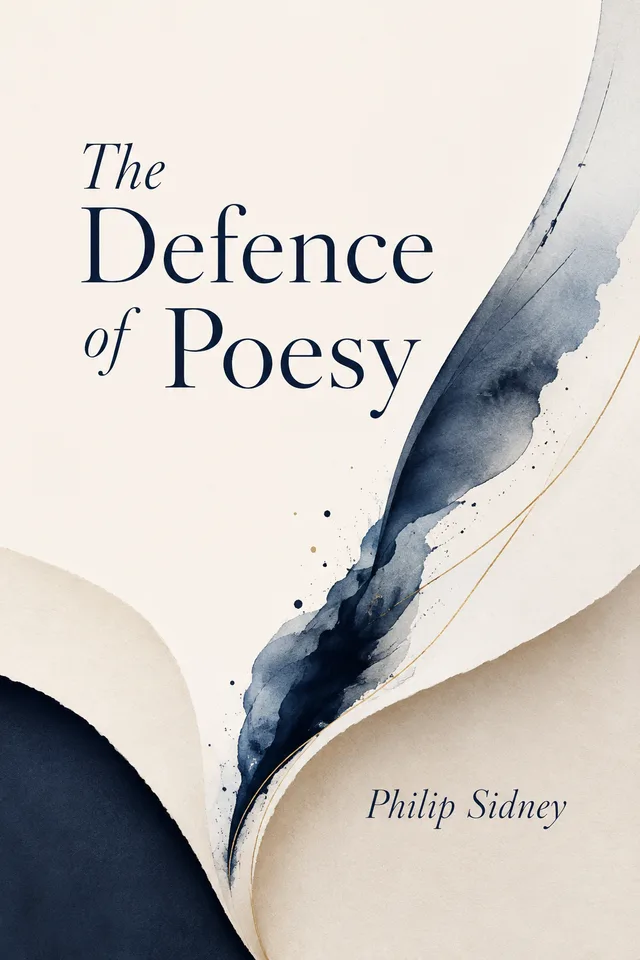
inglese Edizione
Arte
The Defence of Poesy
Edizione BooksWhale in inglese di Philip Sidney
A foundational English defense of poetry, imagination, learning, and literary art.
- Anteprima
- Estratto dal testo preparato
- Formati
- Lettore online, EPUB, PDF
- Accesso
- Claim Libreria
Introduzione al libro
The Defence of Poesy
The Defence of Poesy argues for poetry as a civilizing art that teaches, delights, and shapes moral understanding. This edition is suited to readers of literary criticism, Renaissance prose, poetics, rhetoric, and the history of art and education.
Edizione BooksWhale
Come è stata preparata
Questa edizione si basa su un testo di pubblico dominio ed è stata preparata da BooksWhale per la lettura digitale.
Base di pubblico dominio
Perché può essere condivisa
Philip Sidney died in 1586, and The Defence of Poesy was first published in 1595. These dates support the public-domain basis for the source text used in this English edition.
Leggi anteprima
Estratto dal testo preparato
Anteprima selezionata dal testo preparato per la lettura.
Capitolo in anteprimaFull textLeggi anteprima
The Defence of Poesy
Philip Sidney
WHEN the right virtuous Edward Wotton and I were at the Emperor’s court together, we gave ourselves to learn horsemanship of Gio. Pietro Pugliano; one that, with great commendation, had the place of an esquire in his stable; and he, according to the fertileness of the Italian wit, did not only afford us the demonstration of his practice, but sought to enrich our minds with the contemplation therein, which he thought most precious. But with none, I remember, mine ears were at any time more laden, than when (either angered with slow payment, or moved with our learner-like admiration) he exercised his speech in the praise of his faculty.
He said, soldiers were the noblest estate of mankind, and horsemen the noblest of soldiers. He said, they were the masters of war and ornaments of peace, speedy goers, and strong abiders, triumphers both in camps and courts; nay, to so unbelieved a point he proceeded, as that no earthly thing bred such wonder to a prince, as to be a good horseman; skill of government was but a “pedanteria” in comparison. Then would he add certain praises by telling what a peerless beast the horse was, the only serviceable courtier, without flattery, the beast of most beauty, faithfulness, courage, and such more, that if I had not been a piece of a logician before I came to him, I think he would have persuaded me to have wished myself a horse. But thus much, at least, with his no few words, he drove into me, that self love is better than any gilding, to make that seem gorgeous wherein ourselves be parties.
Wherein, if Pugliano’s strong affection and weak arguments will not satisfy you, I will give you a nearer example of myself, who, I know not by what mischance, in these my not old years and idlest times, having slipped into the title of a poet, am provoked to say something unto you in the defence of that my unelected vocation; which if I handle with more good will than good reasons, bear with me, since the scholar is to be pardoned that followeth the steps of his master.
And yet I must say, that as I have more just cause to make a pitiful defence of poor poetry, which, from almost the highest estimation of learning, is fallen to be the laughing-stock of children; so have I need to bring some more available proofs, since the former is by no man barred of his deserved credit, whereas the silly latter hath had even the names of philosophers used to the defacing of it, with great danger of civil war among the Muses.
At first, truly, to all them that, professing learning, inveigh against poetry, may justly be objected, that they go very near to ungratefulness to seek to deface that which, in the noblest nations and languages that are known, hath been the first light-giver to ignorance, and first nurse, whose milk by little and little enabled them to feed afterwards of tougher knowledges. And will you play the hedgehog, that being received into the den, drove out his host? or rather the vipers, that with their birth kill their parents?
Let learned Greece, in any of her manifold sciences, be able to show me one book before Musæus, Homer, and Hesiod, all three nothing else but poets. Nay, let any history he brought that can say any writers were there before them, if they were not men of the same skill, as Orpheus, Linus, and some others are named, who having been the first of that country that made pens deliverers of their knowledge to posterity, may justly challenge to be called their fathers in learning. For not only in time they had this priority (although in itself antiquity be venerable) but went before them as causes to draw with their charming sweetness the wild untamed wits to an admiration of knowledge. So as Amphion was said to move stones with his poetry to build Thebes, and Orpheus to be listened to by beasts, indeed, stony and beastly people, so among the Romans were Livius Andronicus, and Ennius; so in the Italian language, the first that made it to aspire to be a treasure-house of science, were the poets Dante, Boccace, and Petrarch; so in our English were Gower and Chaucer; after whom, encouraged and delighted with their excellent foregoing, others have followed to beautify our mother tongue, as well in the same kind as other arts.
Capitolo in anteprimaTWO PASTORALS,Anteprima
_Made by Sir Philip Sidney_, _upon his meeting with his two worthy friends and fellow poets_, _Sir Edward Dyer and M. Fulke Greville_.
JOIN mates in mirth to me,
Grant pleasure to our meeting;
Let Pan, our good god, see
How grateful is our greeting.
Join hearts and hands, so let it be,
Make but one mind in bodies three.
Ye hymns and singing skill
Of god Apollo’s giving,
Be pressed our reeds to fill
With sound of music living.
Join hearts and hands, so let it be,
Make but one mind in bodies three.
Sweet Orpheus’ harp, whose sound
The stedfast mountains moved,
Let there thy skill abound,
To join sweet friends beloved.
Join hearts and hands, so let it be,
Make but one mind in bodies three.
My two and I be met,
A happy blessed trinity,
As three more jointly set
In firmest band of unity.
Join hearts and hands, so let it be,
Make but one mind in bodies three.
Welcome my two to me,
The number best beloved,
Within my heart you be
In friendship unremoved.
Join hearts and hands, so let it be,
Make but one mind in bodies three.
Give leave your flocks to range,
Let us the while be playing;
Within the elmy grange,
Your flocks will not be straying.
Join hearts and hands, so let it be,
Make but one mind in bodies three.
Cause all the mirth you can,
Since I am now come hither,
Who never joy, but when
I am with you together.
Join hearts and hands, so let it be,
Make but one mind in bodies three.
Like lovers do their love,
So joy I in you seeing:
Let nothing me remove
From always with you being.
Join hearts and hands, so let it be,
Make but one mind in bodies three.
And as the turtle dove
To mate with whom he liveth,
Such comfort fervent love
Of you to my heart giveth.
Join hearts and hands, so let it be,
Make but one mind in bodies three.
Now joinéd be our hands,
Let them be ne’er asunder,
But link’d in binding bands
By metamorphosed wonder.
So should our severed bodies three
As one for ever joinéd be.
DISPRAISE OF A COURTLY LIFE.
WALKING in bright Phœbus’ blaze,
Where with heat oppressed I was,
I got to a shady wood,
Where green leaves did newly bud;
And of grass was plenty dwelling,
Decked with pied flowers sweetly smelling.
In this wood a man I met,
On lamenting wholly set;
Ruing change of wonted state,
Whence he was transforméd late,
Once to shepherds’ God retaining,
Now in servile court remaining.
There he wand’ring malecontent,
Up and down perpléxed went,
Daring not to tell to me,
Spake unto a senseless tree,
One among the rest electing,
These same words, or this affecting:
“My old mates I grieve to see
Void of me in field to be,
Where we once our lovely sheep
Lovingly like friends did keep;
Oft each other’s friendship proving,
Never striving, but in loving.
“But may love abiding be
In poor shepherds’ base degree?
It belongs to such alone
To whom art of love is known:
Seely shepherds are not witting
What in art of love is fitting.
“Nay, what need the art to those
To whom we our love disclose?
It is to be uséd then,
When we do but flatter men:
Friendship true, in heart assured,
Is by Nature’s gifts procured.
“Therefore shepherds, wanting skill,
Can Love’s duties best fulfil;
Since they know not how to feign,
Nor with love to cloak disdain,
Like the wiser sort, whose learning
Hides their inward will of harming.
“Well was I, while under shade
Oaten reeds me music made,
Striving with my mates in song;
Mixing mirth our songs among.
Greater was the shepherd’s treasure
Capitolo in anteprimaI.Anteprima
WHO hath e’er felt the change of love,
And known those pangs that losers prove,
May paint my face without seeing me,
And write the state how my fancies be,
The loathsome buds grown on Sorrow’s tree.
But who by hearsay speaks, and hath not fully felt
What kind of fires they be in which those spirits melt,
Shall guess, and fail, what doth displease,
Feeling my pulse, miss my disease.
Indice
In questa edizione
- 01Full text
- 02TWO PASTORALS,
- 03I.
- 04II.
- 05III.
- 06SONNETS
- 07II.
- 08I.
- 09II.
- 10III.
- 11IV.
- 12Part of my pain, me-seems, engravéd lies.
- 13Part of my life, the loathéd part to me,
- 14I.
- 15II.
- 16III.
- 17IV.
- 18V.
- 19VI.
- 20VII.
- 21SPLENDIDIS LONGUM VALEDICO NUGIS
Disponibilità lingue
Altre lingue
Altre edizioni linguistiche non sono ancora pubblicate. Qui appariranno quando disponibili.
Richiedi un'altra lingua