inglese Edizione
Militare
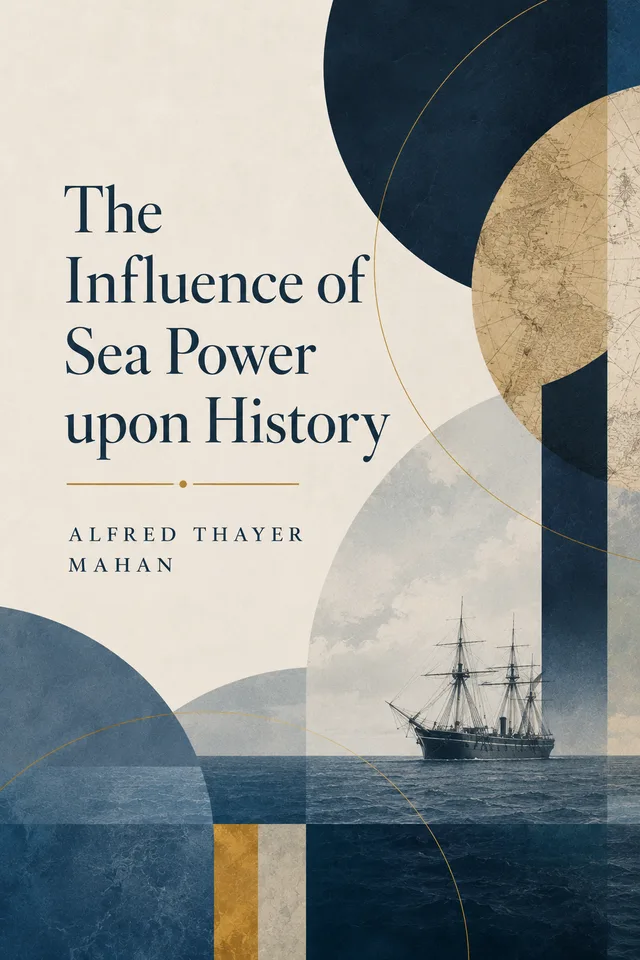
The Influence of Sea Power upon History
Edizione BooksWhale in inglese di Alfred Thayer Mahan
A classic study of naval power, strategy, trade routes, and global history.
- Anteprima
- Estratto dal testo preparato
- Formati
- Lettore online, EPUB, PDF
- Accesso
- Claim Libreria
Introduzione al libro
The Influence of Sea Power upon History
The Influence of Sea Power upon History argues for the strategic importance of navies, maritime commerce, geography, and command of the sea. Mahan’s book deeply influenced modern naval strategy.
Edizione BooksWhale
Come è stata preparata
Questa edizione si basa su un testo di pubblico dominio ed è stata preparata da BooksWhale per la lettura digitale.
Base di pubblico dominio
Perché può essere condivisa
Alfred Thayer Mahan died in 1914, and The Influence of Sea Power upon History was first published in 1890; these dates support the public-domain basis for this English edition.
Leggi anteprima
Estratto dal testo preparato
Anteprima selezionata dal testo preparato per la lettura.
Capitolo in anteprimaFull textLeggi anteprima
The Influence of Sea Power Upon History, 1660–1783
A. T. Mahan
Capitolo in anteprimaPrefaceAnteprima
The definite object proposed in this work is an examination of the general history of Europe and America with particular reference to the effect of sea power upon the course of that history. Historians generally have been unfamiliar with the conditions of the sea, having as to it neither special interest nor special knowledge; and the profound determining influence of maritime strength upon great issues has consequently been overlooked. This is even more true of particular occasions than of the general tendency of sea power. It is easy to say in a general way, that the use and control of the sea is and has been a great factor in the history of the world; it is more troublesome to seek out and show its exact bearing at a particular juncture. Yet, unless this be done, the acknowledgment of general importance remains vague and unsubstantial; not resting, as it should, upon a collection of special instances in which the precise effect has been made clear, by an analysis of the conditions at the given moments.
A curious exemplification of this tendency to slight the bearing of maritime power upon events may be drawn from two writers of that English nation which more than any other has owed its greatness to the sea. "Twice," says Arnold in his History of Rome, "Has there been witnessed the struggle of the highest individual genius against the resources and institutions of a great nation, and in both cases the nation was victorious. For seventeen years Hannibal strove against Rome, for sixteen years Napoleon strove against England; the efforts of the first ended in Zama, those of the second in Waterloo." Sir Edward Creasy, quoting this, adds: "One point, however, of the similitude between the two wars has scarcely been adequately dwelt on; that is, the remarkable parallel between the Roman general who finally defeated the great Carthaginian, and the English general who gave the last deadly overthrow to the French emperor. Scipio and Wellington both held for many years commands of high importance, but distant from the main theatres of warfare. The same country was the scene of the principal military career of each. It was in Spain that Scipio, like Wellington, successively encountered and overthrew nearly all the subordinate generals of the enemy before being opposed to the chief champion and conqueror himself. Both Scipio and Wellington restored their countrymen's confidence in arms when shaken by a series of reverses, and each of them closed a long and perilous war by a complete and overwhelming defeat of the chosen leader and the chosen veterans of the foe."
Neither of these Englishmen mentions the yet more striking coincidence, that in both cases the mastery of the sea rested with the victor. The Roman control of the water forced Hannibal to that long, perilous march through Gaul in which more than half his veteran troops wasted away; it enabled the elder Scipio, while sending his army from the Rhone on to Spain, to intercept Hannibal's communications, to return in person and face the invader at the Trebia. Throughout the war the legions passed by water, unmolested and unwearied, between Spain, which was Hannibal's base, and Italy, while the issue of the decisive battle of the Metaurus, hinging as it did upon the interior position of the Roman armies with reference to the forces of Hasdrubal and Hannibal, was ultimately due to the fact that the younger brother could not bring his succoring reinforcements by sea, but only by the land route through Gaul. Hence at the critical moment the two Carthaginian armies were separated by the length of Italy, and one was destroyed by the combined action of the Roman generals.
On the other hand, naval historians have troubled themselves little about the connection between general history and their own particular topic, limiting themselves generally to the duty of simple chroniclers of naval occurrences. This is less true of the French than of the English; the genius and training of the former people leading them to more careful inquiry into the causes of particular results and the mutual relation of events.
Capitolo in anteprimaDecember, 1889Anteprima
December, 1889
Indice
In questa edizione
- 01Full text
- 02Preface
- 03December, 1889
- 04Introductory
- 05CHAPTER I: DISCUSSION OF THE ELEMENTS OF SEA POWER
- 06CHAPTER II: STATE OF EUROPE IN 1660.--SECOND ANGLO-DUTCH WAR, 1665-1667.--SEA BATTLES OF LOWESTOFT AND OF THE FOUR DAYS
- 07CHAPTER III
- 08CHAPTER IV: ENGLISH REVOLUTION.--WAR OF THE LEAGUE OF AUGSBURG, 1688-1697.--SEA BATTLES OF BEACHY HEAD AND LA HOUGUE
- 09CHAPTER V: WAR OF THE SPANISH SUCCESSION, 1702-1713.--SEA BATTLE OF MALAGA
- 10CHAPTER VI
- 11CHAPTER VII
- 12CHAPTER VIII
- 13CHAPTER IX
- 14CHAPTER X
- 15CHAPTER XI: MARITIME WAR IN EUROPE, 1779-1782
- 16CHAPTER XII
- 17CHAPTER XIII
- 18CHAPTER XIV: CRITICAL DISCUSSION OF THE MARITIME WAR OF 1778
- 19List Of Illustrations
- 20List Of Maps
- 21Plans Of Naval Battles
- 22Sea Power Upon History
- 23Introductory
- 24Footnotes
- 25CHAPTER I: DISCUSSION OF THE ELEMENTS OF SEA POWER
- 26Footnotes
- 27CHAPTER II: STATE OF EUROPE IN 1660.--SECOND ANGLO-DUTCH WAR, 1665-1667. SEA BATTLES OF LOWESTOFT AND OF THE FOUR DAYS
- 28Footnotes
- 29CHAPTER III
- 30Footnotes
- 31CHAPTER IV: ENGLISH REVOLUTION.--WAR OF THE LEAGUE OF AUGSBURG, 1688-1697.--SEA BATTLES OF BEACHY HEAD AND LA HOUGUE
- 32Footnotes
- 33CHAPTER V: WAR OF THE SPANISH SUCCESSION, 1702-1713.--SEA BATTLE OF MALAGA
- 34Footnotes
- 35CHAPTER VI
- 36Footnotes
- 37CHAPTER VII
- 38Footnotes
- 39CHAPTER VIII
- 40Footnotes
- 41CHAPTER IX
- 42Footnotes
- 43CHAPTER X
- 44Footnotes
- 45CHAPTER XI: MARITIME WAR IN EUROPE, 1779-1782
- 46Footnotes
- 47CHAPTER XII
- 48Footnotes
- 49CHAPTER XIII
- 50Footnotes
- 51CHAPTER XIV: CRITICAL DISCUSSION OF THE MARITIME WAR OF 1778
- 52Footnotes
Disponibilità lingue
Altre lingue
Altre edizioni linguistiche non sono ancora pubblicate. Qui appariranno quando disponibili.
Richiedi un'altra lingua