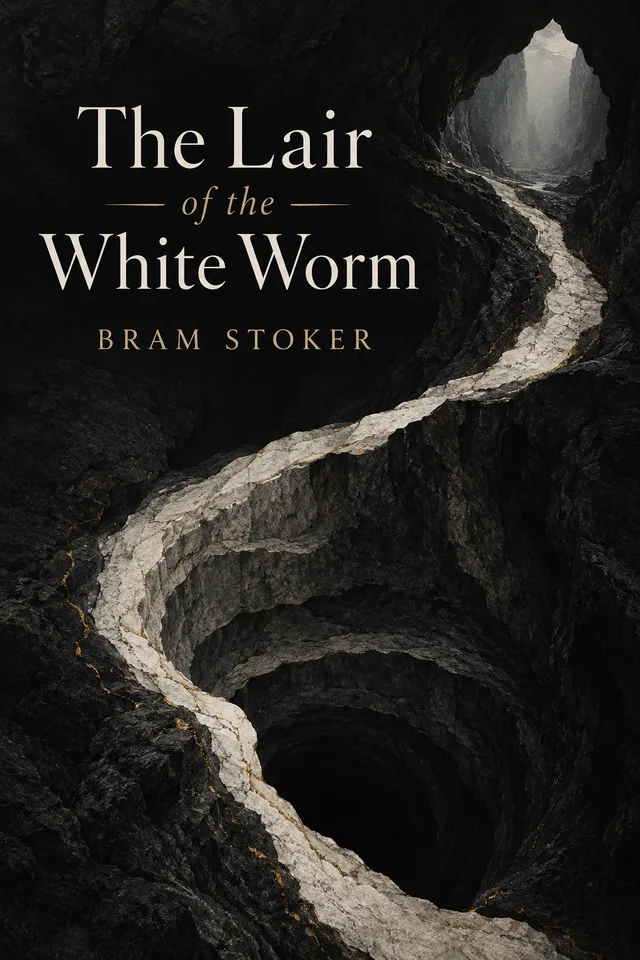
inglese Edizione
Letteratura
The Lair of the White Worm
Edizione BooksWhale in inglese di Bram Stoker
The Lair of the White Worm explores ancient evil, monstrous folklore, inheritance, and a cursed landscape.
- Anteprima
- Estratto dal testo preparato
- Formati
- Lettore online, EPUB, PDF
- Accesso
- Claim Libreria
Introduzione al libro
The Lair of the White Worm
Bram Stoker builds the work around ancient evil, monstrous folklore, inheritance, and a cursed landscape, making its period, characters, arguments, and images vivid for modern readers.
Edizione BooksWhale
Come è stata preparata
Questa edizione si basa su un testo di pubblico dominio ed è stata preparata da BooksWhale per la lettura digitale.
Base di pubblico dominio
Perché può essere condivisa
The original work is public-domain source material; this edition uses the original text.
Leggi anteprima
Estratto dal testo preparato
Anteprima selezionata dal testo preparato per la lettura.
Capitolo in anteprimaFull textLeggi anteprima
The Lair of the White Worm
Abraham Stoker
To my friend Bertha Nicoll with affectionate esteem.
Capitolo in anteprimaCHAPTER I—ADAM SALTON ARRIVESAnteprima
Adam Salton sauntered into the Empire Club, Sydney, and found awaiting him a letter from his grand-uncle. He had first heard from the old gentleman less than a year before, when Richard Salton had claimed kinship, stating that he had been unable to write earlier, as he had found it very difficult to trace his grand-nephew’s address. Adam was delighted and replied cordially; he had often heard his father speak of the older branch of the family with whom his people had long lost touch. Some interesting correspondence had ensued. Adam eagerly opened the letter which had only just arrived, and conveyed a cordial invitation to stop with his grand-uncle at Lesser Hill, for as long a time as he could spare.
“Indeed,” Richard Salton went on, “I am in hopes that you will make your permanent home here. You see, my dear boy, you and I are all that remain of our race, and it is but fitting that you should succeed me when the time comes. In this year of grace, 1860, I am close on eighty years of age, and though we have been a long-lived race, the span of life cannot be prolonged beyond reasonable bounds. I am prepared to like you, and to make your home with me as happy as you could wish. So do come at once on receipt of this, and find the welcome I am waiting to give you. I send, in case such may make matters easy for you, a banker’s draft for £200. Come soon, so that we may both of us enjoy many happy days together. If you are able to give me the pleasure of seeing you, send me as soon as you can a letter telling me when to expect you. Then when you arrive at Plymouth or Southampton or whatever port you are bound for, wait on board, and I will meet you at the earliest hour possible.”
Old Mr. Salton was delighted when Adam’s reply arrived and sent a groom hot-foot to his crony, Sir Nathaniel de Salis, to inform him that his grand-nephew was due at Southampton on the twelfth of June.
Mr. Salton gave instructions to have ready a carriage early on the important day, to start for Stafford, where he would catch the 11.40 a.m. train. He would stay that night with his grand-nephew, either on the ship, which would be a new experience for him, or, if his guest should prefer it, at a hotel. In either case they would start in the early morning for home. He had given instructions to his bailiff to send the postillion carriage on to Southampton, to be ready for their journey home, and to arrange for relays of his own horses to be sent on at once. He intended that his grand-nephew, who had been all his life in Australia, should see something of rural England on the drive. He had plenty of young horses of his own breeding and breaking, and could depend on a journey memorable to the young man. The luggage would be sent on by rail to Stafford, where one of his carts would meet it. Mr. Salton, during the journey to Southampton, often wondered if his grand-nephew was as much excited as he was at the idea of meeting so near a relation for the first time; and it was with an effort that he controlled himself. The endless railway lines and switches round the Southampton Docks fired his anxiety afresh.
As the train drew up on the dockside, he was getting his hand traps together, when the carriage door was wrenched open and a young man jumped in.
“How are you, uncle? I recognised you from the photo you sent me! I wanted to meet you as soon as I could, but everything is so strange to me that I didn’t quite know what to do. However, here I am. I am glad to see you, sir. I have been dreaming of this happiness for thousands of miles; now I find that the reality beats all the dreaming!” As he spoke the old man and the young one were heartily wringing each other’s hands.
Capitolo in anteprimaCHAPTER II—THE CASWALLS OF CASTRA REGISAnteprima
Mr. Salton had all his life been an early riser, and necessarily an early waker. But early as he woke on the next morning—and although there was an excuse for not prolonging sleep in the constant whirr and rattle of the “donkey” engine winches of the great ship—he met the eyes of Adam fixed on him from his berth. His grand-nephew had given him the sofa, occupying the lower berth himself. The old man, despite his great strength and normal activity, was somewhat tired by his long journey of the day before, and the prolonged and exciting interview which followed it. So he was glad to lie still and rest his body, whilst his mind was actively exercised in taking in all he could of his strange surroundings. Adam, too, after the pastoral habit to which he had been bred, woke with the dawn, and was ready to enter on the experiences of the new day whenever it might suit his elder companion. It was little wonder, then, that, so soon as each realised the other’s readiness, they simultaneously jumped up and began to dress. The steward had by previous instructions early breakfast prepared, and it was not long before they went down the gangway on shore in search of the carriage.
They found Mr. Salton’s bailiff looking out for them on the dock, and he brought them at once to where the carriage was waiting in the street. Richard Salton pointed out with pride to his young companion the suitability of the vehicle for every need of travel. To it were harnessed four useful horses, with a postillion to each pair.
“See,” said the old man proudly, “how it has all the luxuries of useful travel—silence and isolation as well as speed. There is nothing to obstruct the view of those travelling and no one to overhear what they may say. I have used that trap for a quarter of a century, and I never saw one more suitable for travel. You shall test it shortly. We are going to drive through the heart of England; and as we go I’ll tell you what I was speaking of last night. Our route is to be by Salisbury, Bath, Bristol, Cheltenham, Worcester, Stafford; and so home.”
Adam remained silent a few minutes, during which he seemed all eyes, for he perpetually ranged the whole circle of the horizon.
“Has our journey to-day, sir,” he asked, “any special relation to what you said last night that you wanted to tell me?”
“Not directly; but indirectly, everything.”
“Won’t you tell me now—I see we cannot be overheard—and if anything strikes you as we go along, just run it in. I shall understand.”
So old Salton spoke:
“To begin at the beginning, Adam. That lecture of yours on ‘The Romans in Britain,’ a report of which you posted to me, set me thinking—in addition to telling me your tastes. I wrote to you at once and asked you to come home, for it struck me that if you were fond of historical research—as seemed a fact—this was exactly the place for you, in addition to its being the home of your own forbears. If you could learn so much of the British Romans so far away in New South Wales, where there cannot be even a tradition of them, what might you not make of the same amount of study on the very spot. Where we are going is in the real heart of the old kingdom of Mercia, where there are traces of all the various nationalities which made up the conglomerate which became Britain.”
“I rather gathered that you had some more definite—more personal reason for my hurrying. After all, history can keep—except in the making!”
“Quite right, my boy. I had a reason such as you very wisely guessed. I was anxious for you to be here when a rather important phase of our local history occurred.”
Indice
In questa edizione
- 01Full text
- 02CHAPTER I—ADAM SALTON ARRIVES
- 03CHAPTER II—THE CASWALLS OF CASTRA REGIS
- 04CHAPTER III—DIANA’S GROVE
- 05CHAPTER IV—THE LADY ARABELLA MARCH
- 06CHAPTER V—THE WHITE WORM
- 07CHAPTER VI—HAWK AND PIGEON
- 08CHAPTER VII—OOLANGA
- 09CHAPTER VIII—SURVIVALS
- 10CHAPTER IX—SMELLING DEATH
- 11CHAPTER X—THE KITE
- 12CHAPTER XI—MESMER’S CHEST
- 13CHAPTER XII—THE CHEST OPENED
- 14CHAPTER XIII—OOLANGA’S HALLUCINATIONS
- 15CHAPTER XIV—BATTLE RENEWED
- 16CHAPTER XV—ON THE TRACK
- 17CHAPTER XVI—A VISIT OF SYMPATHY
- 18CHAPTER XVII—THE MYSTERY OF “THE GROVE”
- 19CHAPTER XVIII—EXIT OOLANGA
- 20CHAPTER XIX—AN ENEMY IN THE DARK
- 21CHAPTER XX—METABOLISM
- 22CHAPTER XXI—GREEN LIGHT
- 23CHAPTER XXII—AT CLOSE QUARTERS
- 24CHAPTER XXIII—IN THE ENEMY’S HOUSE
- 25CHAPTER XXIV—A STARTLING PROPOSITION
- 26CHAPTER XXV—THE LAST BATTLE
- 27CHAPTER XXVI—FACE TO FACE
- 28CHAPTER XXVII—ON THE TURRET ROOF
- 29CHAPTER XXVIII—THE BREAKING OF THE STORM
Disponibilità lingue
Altre lingue
Altre edizioni linguistiche non sono ancora pubblicate. Qui appariranno quando disponibili.
Richiedi un'altra lingua