inglese Edizione
Letteratura
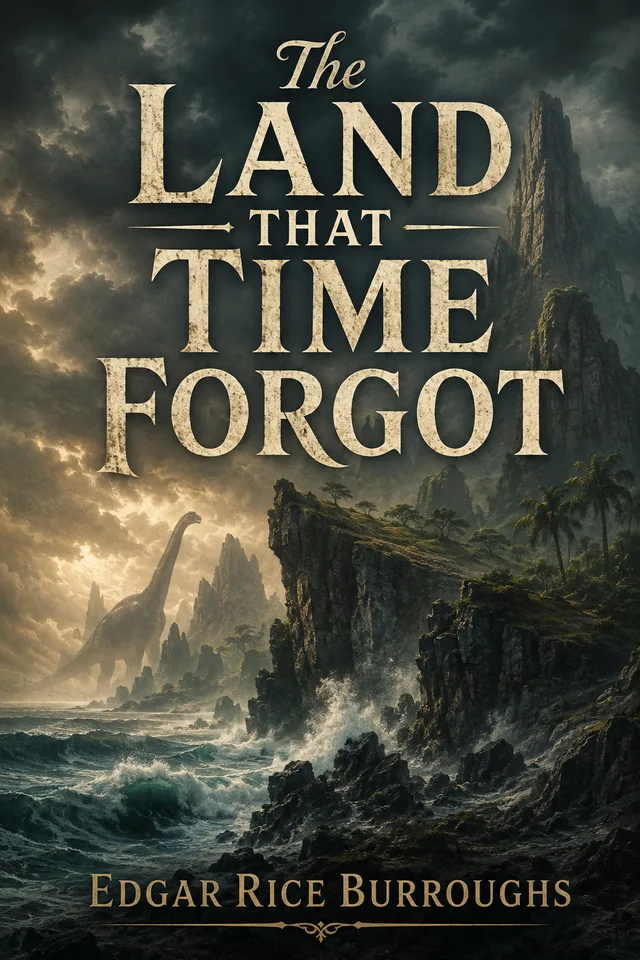
The Land That Time Forgot
Edizione BooksWhale in inglese di Edgar Rice Burroughs
A classic literature work on lost-world adventure, survival, prehistoric danger, exploration, and pulp imagination.
- Anteprima
- Estratto dal testo preparato
- Formati
- Lettore online, EPUB, PDF
- Accesso
- Claim Libreria
Introduzione al libro
The Land That Time Forgot
The Land That Time Forgot is a public-domain English classic by Edgar Rice Burroughs, centered on lost-world adventure, survival, prehistoric danger, exploration, and pulp imagination. This BooksWhale edition highlights the original text for readers interested in classic literature, historical context, and searchable online reading.
Edizione BooksWhale
Come è stata preparata
Questa edizione si basa su un testo di pubblico dominio ed è stata preparata da BooksWhale per la lettura digitale.
Base di pubblico dominio
Perché può essere condivisa
Edgar Rice Burroughs died in 1950, and The Land That Time Forgot was first published in 1918. These dates support the public-domain basis for this English original edition.
Leggi anteprima
Estratto dal testo preparato
Anteprima selezionata dal testo preparato per la lettura.
Capitolo in anteprimaFull textLeggi anteprima
The Land That Time Forgot
Edgar Rice Burroughs
Capitolo in anteprimaChapter 1Anteprima
It must have been a little after three o’clock in the afternoon that it happened—the afternoon of June 3rd, 1916. It seems incredible that all that I have passed through—all those weird and terrifying experiences—should have been encompassed within so short a span as three brief months. Rather might I have experienced a cosmic cycle, with all its changes and evolutions for that which I have seen with my own eyes in this brief interval of time—things that no other mortal eye had seen before, glimpses of a world past, a world dead, a world so long dead that even in the lowest Cambrian stratum no trace of it remains. Fused with the melting inner crust, it has passed forever beyond the ken of man other than in that lost pocket of the earth whither fate has borne me and where my doom is sealed. I am here and here must remain.
After reading this far, my interest, which already had been stimulated by the finding of the manuscript, was approaching the boiling-point. I had come to Greenland for the summer, on the advice of my physician, and was slowly being bored to extinction, as I had thoughtlessly neglected to bring sufficient reading-matter. Being an indifferent fisherman, my enthusiasm for this form of sport soon waned; yet in the absence of other forms of recreation I was now risking my life in an entirely inadequate boat off Cape Farewell at the southernmost extremity of Greenland.
Greenland! As a descriptive appellation, it is a sorry joke—but my story has nothing to do with Greenland, nothing to do with me; so I shall get through with the one and the other as rapidly as possible.
The inadequate boat finally arrived at a precarious landing, the natives, waist-deep in the surf, assisting. I was carried ashore, and while the evening meal was being prepared, I wandered to and fro along the rocky, shattered shore. Bits of surf-harried beach clove the worn granite, or whatever the rocks of Cape Farewell may be composed of, and as I followed the ebbing tide down one of these soft stretches, I saw the thing. Were one to bump into a Bengal tiger in the ravine behind the Bimini Baths, one could be no more surprised than was I to see a perfectly good quart thermos bottle turning and twisting in the surf of Cape Farewell at the southern extremity of Greenland. I rescued it, but I was soaked above the knees doing it; and then I sat down in the sand and opened it, and in the long twilight read the manuscript, neatly written and tightly folded, which was its contents.
You have read the opening paragraph, and if you are an imaginative idiot like myself, you will want to read the rest of it; so I shall give it to you here, omitting quotation marks—which are difficult of remembrance. In two minutes you will forget me.
My home is in Santa Monica. I am, or was, junior member of my father’s firm. We are ship-builders. Of recent years we have specialized on submarines, which we have built for Germany, England, France and the United States. I know a sub as a mother knows her baby’s face, and have commanded a score of them on their trial runs. Yet my inclinations were all toward aviation. I graduated under Curtiss, and after a long siege with my father obtained his permission to try for the Lafayette Escadrille. As a stepping-stone I obtained an appointment in the American ambulance service and was on my way to France when three shrill whistles altered, in as many seconds, my entire scheme of life.
I was sitting on deck with some of the fellows who were going into the American ambulance service with me, my Airedale, Crown Prince Nobbler, asleep at my feet, when the first blast of the whistle shattered the peace and security of the ship. Ever since entering the U-boat zone we had been on the lookout for periscopes, and children that we were, bemoaning the unkind fate that was to see us safely into France on the morrow without a glimpse of the dread marauders. We were young; we craved thrills, and God knows we got them that day; yet by comparison with that through which I have since passed they were as tame as a Punch-and-Judy show.
Capitolo in anteprimaChapter 2Anteprima
Toward morning, I must have dozed, though it seemed to me at the time that I had lain awake for days, instead of hours. When I finally opened my eyes, it was daylight, and the girl’s hair was in my face, and she was breathing normally. I thanked God for that. She had turned her head during the night so that as I opened my eyes I saw her face not an inch from mine, my lips almost touching hers.
It was Nobs who finally awoke her. He got up, stretched, turned around a few times and lay down again, and the girl opened her eyes and looked into mine. Hers went very wide at first, and then slowly comprehension came to her, and she smiled.
“You have been very good to me,” she said, as I helped her to rise, though if the truth were known I was more in need of assistance than she; the circulation all along my left side seeming to be paralyzed entirely. “You have been very good to me.” And that was the only mention she ever made of it; yet I know that she was thankful and that only reserve prevented her from referring to what, to say the least, was an embarrassing situation, however unavoidable.
Shortly after daylight we saw smoke apparently coming straight toward us, and after a time we made out the squat lines of a tug—one of those fearless exponents of England’s supremacy of the sea that tows sailing ships into French and English ports. I stood up on a thwart and waved my soggy coat above my head. Nobs stood upon another and barked. The girl sat at my feet straining her eyes toward the deck of the oncoming boat. “They see us,” she said at last. “There is a man answering your signal.” She was right. A lump came into my throat—for her sake rather than for mine. She was saved, and none too soon. She could not have lived through another night upon the Channel; she might not have lived through the coming day.
The tug came close beside us, and a man on deck threw us a rope. Willing hands dragged us to the deck, Nobs scrambling nimbly aboard without assistance. The rough men were gentle as mothers with the girl. Plying us both with questions they hustled her to the captain’s cabin and me to the boiler-room. They told the girl to take off her wet clothes and throw them outside the door that they might be dried, and then to slip into the captain’s bunk and get warm. They didn’t have to tell me to strip after I once got into the warmth of the boiler-room. In a jiffy, my clothes hung about where they might dry most quickly, and I myself was absorbing, through every pore, the welcome heat of the stifling compartment. They brought us hot soup and coffee, and then those who were not on duty sat around and helped me damn the Kaiser and his brood.
As soon as our clothes were dry, they bade us don them, as the chances were always more than fair in those waters that we should run into trouble with the enemy, as I was only too well aware. What with the warmth and the feeling of safety for the girl, and the knowledge that a little rest and food would quickly overcome the effects of her experiences of the past dismal hours, I was feeling more content than I had experienced since those three whistle-blasts had shattered the peace of my world the previous afternoon.
But peace upon the Channel has been but a transitory thing since August, 1914. It proved itself such that morning, for I had scarce gotten into my dry clothes and taken the girl’s apparel to the captain’s cabin when an order was shouted down into the engine-room for full speed ahead, and an instant later I heard the dull boom of a gun. In a moment I was up on deck to see an enemy submarine about two hundred yards off our port bow. She had signaled us to stop, and our skipper had ignored the order; but now she had her gun trained on us, and the second shot grazed the cabin, warning the belligerent tug-captain that it was time to obey. Once again an order went down to the engine-room, and the tug reduced speed. The U-boat ceased firing and ordered the tug to come about and approach. Our momentum had carried us a little beyond the enemy craft, but we were turning now on the arc of a circle that would bring us alongside her. As I stood watching the maneuver and wondering what was to become of us, I felt something touch my elbow and turned to see the girl standing at my side. She looked up into my face with a rueful expression. “They seem bent on our destruction,” she said, “and it looks like the same boat that sunk us yesterday.”
Indice
In questa edizione
- 01Full text
- 02Chapter 1
- 03Chapter 2
- 04Chapter 3
- 05Chapter 4
- 06Chapter 5
- 07Chapter 6
- 08Chapter 7
- 09Chapter 8
- 10HERE LIES JOHN TIPPET
- 11ENGLISHMAN
- 12KILLED BY TYRANNOSAURUS
- 13R. I. P.
- 14Chapter 9
- 15Chapter 10
Disponibilità lingue
Altre lingue
Altre edizioni linguistiche non sono ancora pubblicate. Qui appariranno quando disponibili.
Richiedi un'altra lingua