inglese Edizione
Letteratura
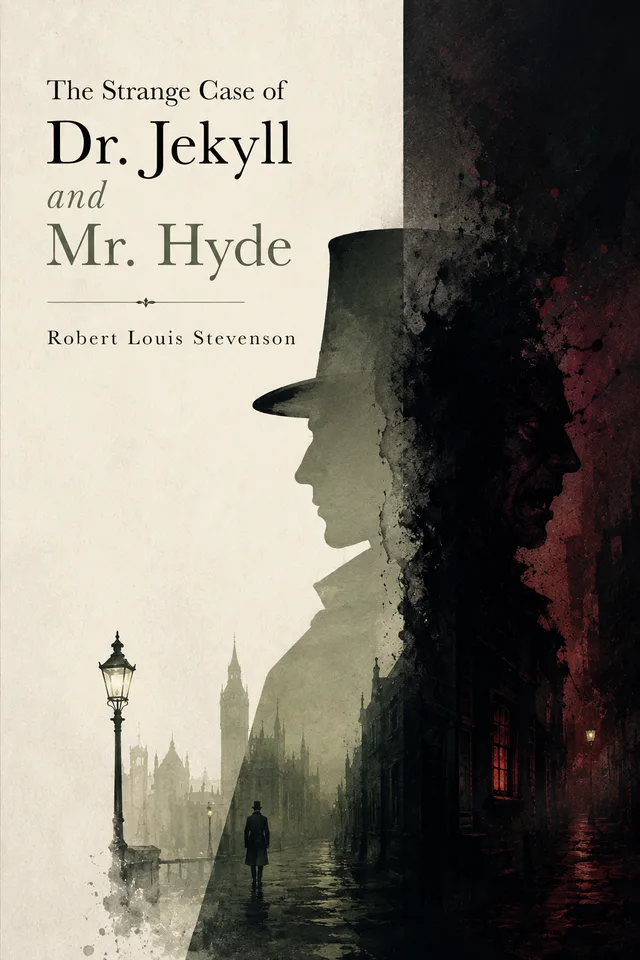
The Strange Case of Dr. Jekyll and Mr. Hyde
Edizione BooksWhale in inglese di Robert Louis Stevenson
A compact Gothic tale of divided identity, repression, experiment, and moral horror.
- Anteprima
- Estratto dal testo preparato
- Formati
- Lettore online, EPUB, PDF
- Accesso
- Claim Libreria
Introduzione al libro
The Strange Case of Dr. Jekyll and Mr. Hyde
The Strange Case of Dr. Jekyll and Mr. Hyde turns a mystery of London doors and documents into a terrifying study of split selfhood. Stevenson’s tale asks what happens when respectable identity tries to separate itself from desire and violence.
Edizione BooksWhale
Come è stata preparata
Questa edizione si basa su un testo di pubblico dominio ed è stata preparata da BooksWhale per la lettura digitale.
Base di pubblico dominio
Perché può essere condivisa
Robert Louis Stevenson died in 1894, and The Strange Case of Dr. Jekyll and Mr. Hyde was first published in 1886. These dates support the public-domain basis for this English original edition.
Leggi anteprima
Estratto dal testo preparato
Anteprima selezionata dal testo preparato per la lettura.
Capitolo in anteprimaFull textLeggi anteprima
The Strange Case of Dr. Jekyll and Mr. Hyde
Robert Louis Stevenson
TO KATHARINE DE MATTOS.
It’s ill to loose the bands that God decreed to bind; Still will we be the children of the heather and the wind. Far away from home, O it’s still for you and me That the broom is blowing bonnie in the north countrie.
Capitolo in anteprimaStory of the DoorAnteprima
Mr. Utterson the lawyer was a man of a rugged countenance, that was never lighted by a smile; cold, scanty and embarrassed in discourse; backward in sentiment; lean, long, dusty, dreary, and yet somehow lovable. At friendly meetings, and when the wine was to his taste, something eminently human beaconed from his eye; something indeed which never found its way into his talk, but which spoke not only in these silent symbols of the after-dinner face, but more often and loudly in the acts of his life. He was austere with himself; drank gin when he was alone, to mortify a taste for vintages; and though he enjoyed the theatre, had not crossed the doors of one for twenty years. But he had an approved tolerance for others; sometimes wondering, almost with envy, at the high pressure of spirits involved in their misdeeds; and in any extremity inclined to help rather than to reprove. “I incline to Cain’s heresy,” he used to say quaintly: “I let my brother go to the devil in his own way.” In this character, it was frequently his fortune to be the last reputable acquaintance and the last good influence in the lives of down-going men. And to such as these, so long as they came about his chambers, he never marked a shade of change in his demeanour.
No doubt the feat was easy to Mr. Utterson; for he was undemonstrative at the best, and even his friendship seemed to be founded in a similar catholicity of good-nature. It is the mark of a modest man to accept his friendly circle ready-made from the hands of opportunity; and that was the lawyer’s way. His friends were those of his own blood or those whom he had known the longest; his affections, like ivy, were the growth of time, they implied no aptness in the object. Hence, no doubt, the bond that united him to Mr. Richard Enfield, his distant kinsman, the well-known man about town. It was a nut to crack for many, what these two could see in each other, or what subject they could find in common. It was reported by those who encountered them in their Sunday walks, that they said nothing, looked singularly dull, and would hail with obvious relief the appearance of a friend. For all that, the two men put the greatest store by these excursions, counted them the chief jewel of each week, and not only set aside occasions of pleasure, but even resisted the calls of business, that they might enjoy them uninterrupted.
It chanced on one of these rambles that their way led them down a by-street in a busy quarter of London. The street was small and what is called quiet, but it drove a thriving trade on the week-days. The inhabitants were all doing well, it seemed, and all emulously hoping to do better still, and laying out the surplus of their gains in coquetry; so that the shop fronts stood along that thoroughfare with an air of invitation, like rows of smiling saleswomen. Even on Sunday, when it veiled its more florid charms and lay comparatively empty of passage, the street shone out in contrast to its dingy neighbourhood, like a fire in a forest; and with its freshly painted shutters, well-polished brasses, and general cleanliness and gaiety of note, instantly caught and pleased the eye of the passenger.
Two doors from one corner, on the left hand going east, the line was broken by the entry of a court; and just at that point, a certain sinister block of building thrust forward its gable on the street. It was two stories high; showed no window, nothing but a door on the lower story and a blind forehead of discoloured wall on the upper; and bore in every feature, the marks of prolonged and sordid negligence. The door, which was equipped with neither bell nor knocker, was blistered and distained. Tramps slouched into the recess and struck matches on the panels; children kept shop upon the steps; the schoolboy had tried his knife on the mouldings; and for close on a generation, no one had appeared to drive away these random visitors or to repair their ravages.
Capitolo in anteprimaSearch for Mr. HydeAnteprima
That evening Mr. Utterson came home to his bachelor house in sombre spirits and sat down to dinner without relish. It was his custom of a Sunday, when this meal was over, to sit close by the fire, a volume of some dry divinity on his reading-desk, until the clock of the neighbouring church rang out the hour of twelve, when he would go soberly and gratefully to bed. On this night, however, as soon as the cloth was taken away, he took up a candle and went into his business-room. There he opened his safe, took from the most private part of it a document endorsed on the envelope as Dr. Jekyll’s Will, and sat down with a clouded brow to study its contents. The will was holograph, for Mr. Utterson, though he took charge of it now that it was made, had refused to lend the least assistance in the making of it; it provided not only that, in case of the decease of Henry Jekyll, M.D., D.C.L., L.L.D., F.R.S., etc., all his possessions were to pass into the hands of his “friend and benefactor Edward Hyde,” but that in case of Dr. Jekyll’s “disappearance or unexplained absence for any period exceeding three calendar months,” the said Edward Hyde should step into the said Henry Jekyll’s shoes without further delay and free from any burthen or obligation, beyond the payment of a few small sums to the members of the doctor’s household. This document had long been the lawyer’s eyesore. It offended him both as a lawyer and as a lover of the sane and customary sides of life, to whom the fanciful was the immodest. And hitherto it was his ignorance of Mr. Hyde that had swelled his indignation; now, by a sudden turn, it was his knowledge. It was already bad enough when the name was but a name of which he could learn no more. It was worse when it began to be clothed upon with detestable attributes; and out of the shifting, insubstantial mists that had so long baffled his eye, there leaped up the sudden, definite presentment of a fiend.
“I thought it was madness,” he said, as he replaced the obnoxious paper in the safe, “and now I begin to fear it is disgrace.”
With that he blew out his candle, put on a great-coat, and set forth in the direction of Cavendish Square, that citadel of medicine, where his friend, the great Dr. Lanyon, had his house and received his crowding patients. “If any one knows, it will be Lanyon,” he had thought.
The solemn butler knew and welcomed him; he was subjected to no stage of delay, but ushered direct from the door to the dining-room where Dr. Lanyon sat alone over his wine. This was a hearty, healthy, dapper, red-faced gentleman, with a shock of hair prematurely white, and a boisterous and decided manner. At sight of Mr. Utterson, he sprang up from his chair and welcomed him with both hands. The geniality, as was the way of the man, was somewhat theatrical to the eye; but it reposed on genuine feeling. For these two were old friends, old mates both at school and college, both thorough respecters of themselves and of each other, and, what does not always follow, men who thoroughly enjoyed each other’s company.
After a little rambling talk, the lawyer led up to the subject which so disagreeably pre-occupied his mind.
“I suppose, Lanyon,” said he “you and I must be the two oldest friends that Henry Jekyll has?”
“I wish the friends were younger,” chuckled Dr. Lanyon. “But I suppose we are. And what of that? I see little of him now.”
“Indeed?” said Utterson. “I thought you had a bond of common interest.”
“We had,” was the reply. “But it is more than ten years since Henry Jekyll became too fanciful for me. He began to go wrong, wrong in mind; and though of course I continue to take an interest in him for old sake’s sake, as they say, I see and I have seen devilish little of the man. Such unscientific balderdash,” added the doctor, flushing suddenly purple, “would have estranged Damon and Pythias.”
Indice
In questa edizione
- 01Full text
- 02Story of the Door
- 03Search for Mr. Hyde
- 04Dr. Jekyll Was Quite at Ease
- 05The Carew Murder Case
- 06Incident of the Letter
- 07Remarkable Incident of Dr. Lanyon
- 08Incident at the Window
- 09The Last Night
- 10Dr. Lanyon’s Narrative
- 11Henry Jekyll’s Full Statement of the Case
Disponibilità lingue
Altre lingue
Altre edizioni linguistiche non sono ancora pubblicate. Qui appariranno quando disponibili.
Richiedi un'altra lingua