inglese Edizione
Letteratura
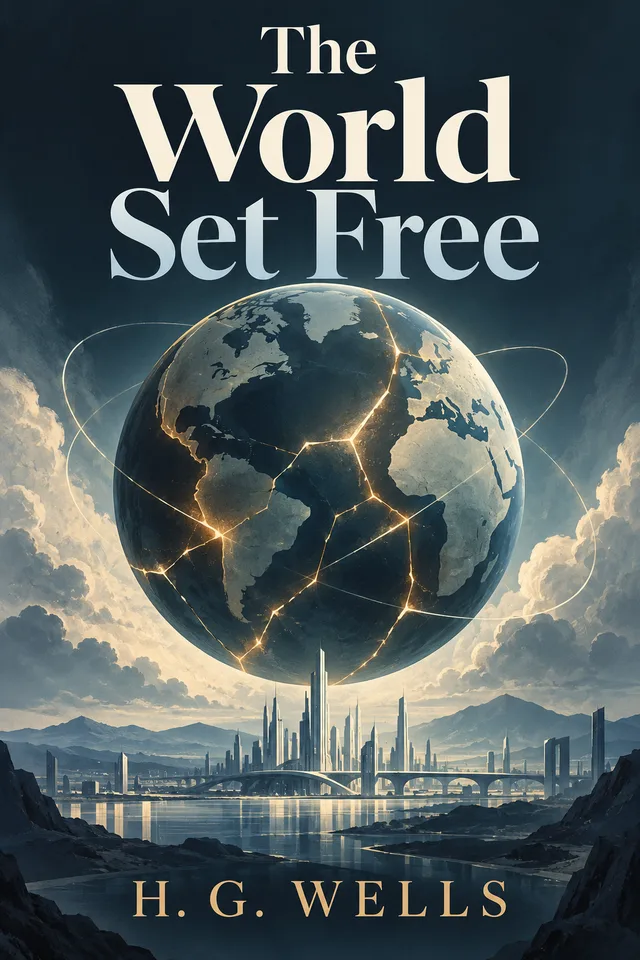
The World Set Free
Edizione BooksWhale in inglese di H. G. Wells
A visionary science-fiction history of atomic energy, world war, and the political reconstruction of civilization.
- Anteprima
- Estratto dal testo preparato
- Formati
- Lettore online, EPUB, PDF
- Accesso
- Claim Libreria
Introduzione al libro
The World Set Free
Wells imagines a chain reaction that changes warfare before societies understand its consequences. Told on a broad historical scale, the novel asks how scientific power might destroy old nations and force humanity toward new forms of international government.
Edizione BooksWhale
Come è stata preparata
Questa edizione si basa su un testo di pubblico dominio ed è stata preparata da BooksWhale per la lettura digitale.
Base di pubblico dominio
Perché può essere condivisa
The author died before 1955 and the work was first published before 1931; the original English text is treated as public-domain source material for this edition.
Leggi anteprima
Estratto dal testo preparato
Anteprima selezionata dal testo preparato per la lettura.
Capitolo in anteprimaFull textLeggi anteprima
The World Set Free
H. G. Wells
We Are All Things That Make And Pass, Striving Upon A Hidden Mission, Out To The Open Sea.
TO Frederick Soddy’s ‘Interpretation Of Radium’ This Story, Which Owes Long Passages To The Eleventh Chapter Of That Book, Acknowledges And Inscribes Itself
Capitolo in anteprimaPREFACEAnteprima
The World Set Free was written in 1913 and published early in 1914, and it is the latest of a series of three fantasias of possibility, stories which all turn on the possible developments in the future of some contemporary force or group of forces. The World Set Free was written under the immediate shadow of the Great War. Every intelligent person in the world felt that disaster was impending and knew no way of averting it, but few of us realised in the earlier half of 1914 how near the crash was to us. The reader will be amused to find that here it is put off until the year 1956. He may naturally want to know the reason for what will seem now a quite extraordinary delay. As a prophet, the author must confess he has always been inclined to be rather a slow prophet. The war aeroplane in the world of reality, for example, beat the forecast in Anticipations by about twenty years or so. I suppose a desire not to shock the sceptical reader’s sense of use and wont and perhaps a less creditable disposition to hedge, have something to do with this dating forward of one’s main events, but in the particular case of The World Set Free there was, I think, another motive in holding the Great War back, and that was to allow the chemist to get well forward with his discovery of the release of atomic energy. 1956—or for that matter 2056—may be none too late for that crowning revolution in human potentialities. And apart from this procrastination of over forty years, the guess at the opening phase of the war was fairly lucky; the forecast of an alliance of the Central Empires, the opening campaign through the Netherlands, and the despatch of the British Expeditionary Force were all justified before the book had been published six months. And the opening section of Chapter the Second remains now, after the reality has happened, a fairly adequate diagnosis of the essentials of the matter. One happy hit (in Chapter the Second, Section 2), on which the writer may congratulate himself, is the forecast that under modern conditions it would be quite impossible for any great general to emerge to supremacy and concentrate the enthusiasm of the armies of either side. There could be no Alexanders or Napoleons. And we soon heard the scientific corps muttering, ‘These old fools,’ exactly as it is here foretold.
These, however, are small details, and the misses in the story far outnumber the hits. It is the main thesis which is still of interest now; the thesis that because of the development of scientific knowledge, separate sovereign states and separate sovereign empires are no longer possible in the world, that to attempt to keep on with the old system is to heap disaster upon disaster for mankind and perhaps to destroy our race altogether. The remaining interest of this book now is the sustained validity of this thesis and the discussion of the possible ending of war on the earth. I have supposed a sort of epidemic of sanity to break out among the rulers of states and the leaders of mankind. I have represented the native common sense of the French mind and of the English mind—for manifestly King Egbert is meant to be ‘God’s Englishman’—leading mankind towards a bold and resolute effort of salvage and reconstruction. Instead of which, as the school book footnotes say, compare to-day’s newspaper. Instead of a frank and honourable gathering of leading men, Englishman meeting German and Frenchman Russian, brothers in their offences and in their disaster, upon the hills of Brissago, beheld in Geneva at the other end of Switzerland a poor little League of (Allied) Nations (excluding the United States, Russia, and most of the ‘subject peoples’ of the world), meeting obscurely amidst a world-wide disregard to make impotent gestures at the leading problems of the debacle. Either the disaster has not been vast enough yet or it has not been swift enough to inflict the necessary moral shock and achieve the necessary moral revulsion. Just as the world of 1913 was used to an increasing prosperity and thought that increase would go on for ever, so now it would seem the world is growing accustomed to a steady glide towards social disintegration, and thinks that that too can go on continually and never come to a final bump. So soon do use and wont establish themselves, and the most flaming and thunderous of lessons pale into disregard.
Capitolo in anteprimaPRELUDE THE SUN SNARERSAnteprima
PRELUDE THE SUN SNARERS
Indice
In questa edizione
- 01Full text
- 02PREFACE
- 03PRELUDE THE SUN SNARERS
- 04Section I
- 05Section 2
- 06Section 3
- 07Section 4
- 08Section 5
- 09Section 6
- 10Section 7
- 11Section 8
- 12CHAPTER THE FIRST THE NEW SOURCE OF ENERGY
- 13CHAPTER THE SECOND THE LAST WAR
- 14It seemed to her beyond the desert of a woman that she should be privileged to participate....
- 15Section 9
- 16Section 10
- 17CHAPTER THE THIRD THE ENDING OF WAR
- 18Section 1
- 19It was worthy of his subtle reputation and it answered passing well.
- 20CHAPTER THE FOURTH THE NEW PHASE
- 21Section 11
- 22CHAPTER THE FIFTH THE LAST DAYS OF MARCUS KARENIN
Disponibilità lingue
Altre lingue
Altre edizioni linguistiche non sono ancora pubblicate. Qui appariranno quando disponibili.
Richiedi un'altra lingua