inglês Edição
Psicologia
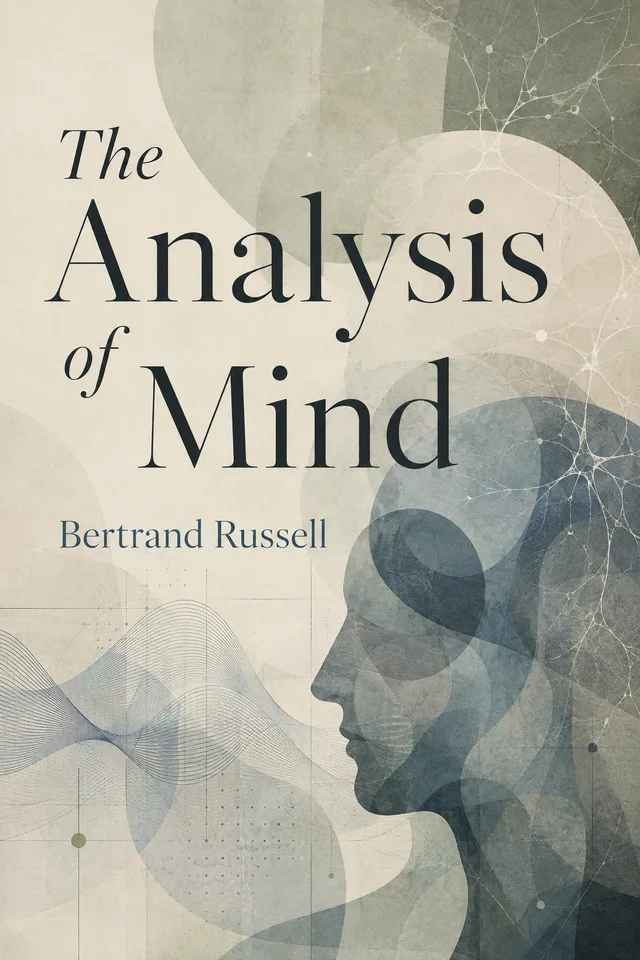
The Analysis of Mind
Edição BooksWhale em inglês por Bertrand Russell
Russell’s influential inquiry into mind, sensation, memory, belief, desire, language, and psychological analysis.
- Prévia
- Amostra do texto preparado
- Formatos
- Leitor online, EPUB, PDF
- Acesso
- Claim da Biblioteca
Introdução do livro
The Analysis of Mind
In The Analysis of Mind, Bertrand Russell brings logic, psychology, and philosophy together to examine sensation, images, memory, belief, desire, words, and consciousness. The book is a major English-language bridge between analytic philosophy and early twentieth-century psychology.
Edição BooksWhale
Como esta edição foi preparada
Esta edição se baseia em um texto em domínio público e foi preparada pela BooksWhale para leitura digital.
Base de domínio público
Por que pode ser compartilhada
This work was first published in 1921. Its publication date supports the public-domain basis for this English edition.
Ler prévia
Amostra do texto preparado
Prévia selecionada do texto preparado.
Capítulo de préviaPart 1Ler prévia
The Analysis of Mind
Bertrand Russell
THE ANALYSIS OF MIND
By Bertrand Russell
MUIRHEAD LIBRARY OF PHILOSOPHY
An admirable statement of the aims of the Library of Philosophy was provided by the first editor, the late Professor J. H. Muirhead, in his Philosophy under the date 1890. This was slightly modified in subsequent volumes to take the form of the following statement:
"The Muirhead Library of Philosophy was designed as a contribution to the History of Modern Philosophy under the heads: first of Different Schools of Thought--Sensationalist, Realist, Idealist, Intuitivist; secondly of different Subjects--Psychology, Ethics, Aesthetics, Political Philosophy, Theology. While much had been done in England in tracing the course of evolution in nature, history, economics, morals and religion, little had been done in tracing the development of thought on these subjects. Yet 'the evolution of opinion is part of the whole evolution'.
"By the co-operation of different writers in carrying out this plan it was hoped that a thoroughness and completeness of treatment, otherwise unattainable, might be secured. It was believed also that from writers mainly British and American fuller consideration of English Philosophy than it had hitherto received might be looked for. In the earlier series of books containing, among others, Bosanquet's "History of Aesthetic," Pfleiderer's "Rational Theology since Kant," Albee's "History of English Utilitarianism," Bonar's "Philosophy and Political Economy," Brett's "History of Psychology," Ritchie's "Natural Rights," these objects were to a large extent effected.
"In the meantime original work of a high order was being produced both in England and America by such writers as Bradley, Stout, Bertrand Russell, Baldwin, Urban, Montague, and others, and a new interest in foreign works, German, French and Italian, which had either become classical or were attracting public attention, had developed. The scope of the Library thus became extended into something more international, and it is entering on the fifth decade of its existence in the hope that it may contribute to that mutual understanding between countries which is so pressing a need of the present time."
The need which Professor Muirhead stressed is no less pressing to-day, and few will deny that philosophy has much to do with enabling us to meet it, although no one, least of all Muirhead himself, would regard that as the sole, or even the main, object of philosophy. As Professor Muirhead continues to lend the distinction of his name to the Library of Philosophy it seemed not inappropriate to allow him to recall us to these aims in his own words. The emphasis on the history of thought also seemed to me very timely; and the number of important works promised for the Library in the very near future augur well for the continued fulfilment, in this and other ways, of the expectations of the original editor.
H. D. Lewis
PREFACE
This book has grown out of an attempt to harmonize two different tendencies, one in psychology, the other in physics, with both of which I find myself in sympathy, although at first sight they might seem inconsistent. On the one hand, many psychologists, especially those of the behaviourist school, tend to adopt what is essentially a materialistic position, as a matter of method if not of metaphysics. They make psychology increasingly dependent on physiology and external observation, and tend to think of matter as something much more solid and indubitable than mind. Meanwhile the physicists, especially Einstein and other exponents of the theory of relativity, have been making "matter" less and less material. Their world consists of "events," from which "matter" is derived by a logical construction. Whoever reads, for example, Professor Eddington's "Space, Time and Gravitation" (Cambridge University Press, 1920), will see that an old-fashioned materialism can receive no support from modern physics. I think that what has permanent value in the outlook of the behaviourists is the feeling that physics is the most fundamental science at present in existence. But this position cannot be called materialistic, if, as seems to be the case, physics does not assume the existence of matter.
Capítulo de préviaPart 2Prévia
The view expressed by Brentano has been held very generally, and developed by many writers. Among these we may take as an example his Austrian successor Meinong.* According to him there are three elements involved in the thought of an object. These three he calls the act, the content and the object. The act is the same in any two cases of the same kind of consciousness; for instance, if I think of Smith or think of Brown, the act of thinking, in itself, is exactly similar on both occasions. But the content of my thought, the particular event that is happening in my mind, is different when I think of Smith and when I think of Brown. The content, Meinong argues, must not be confounded with the object, since the content must exist in my mind at the moment when I have the thought, whereas the object need not do so. The object may be something past or future; it may be physical, not mental; it may be something abstract, like equality for example; it may be something imaginary, like a golden mountain; or it may even be something self-contradictory, like a round square. But in all these cases, so he contends, the content exists when the thought exists, and is what distinguishes it, as an occurrence, from other thoughts.
* See, e.g. his article: "Ueber Gegenstande hoherer Ordnung und deren Verhaltniss zur inneren Wahrnehmung," "Zeitschrift fur Psychologie and Physiologie der Sinnesorgane," vol. xxi, pp. 182-272 (1899), especially pp. 185-8.
To make this theory concrete, let us suppose that you are thinking of St. Paul's. Then, according to Meinong, we have to distinguish three elements which are necessarily combined in constituting the one thought. First, there is the act of thinking, which would be just the same whatever you were thinking about. Then there is what makes the character of the thought as contrasted with other thoughts; this is the content. And finally there is St. Paul's, which is the object of your thought. There must be a difference between the content of a thought and what it is about, since the thought is here and now, whereas what it is about may not be; hence it is clear that the thought is not identical with St. Paul's. This seems to show that we must distinguish between content and object. But if Meinong is right, there can be no thought without an object: the connection of the two is essential. The object might exist without the thought, but not the thought without the object: the three elements of act, content and object are all required to constitute the one single occurrence called "thinking of St. Paul's."
The above analysis of a thought, though I believe it to be mistaken, is very useful as affording a schema in terms of which other theories can be stated. In the remainder of the present lecture I shall state in outline the view which I advocate, and show how various other views out of which mine has grown result from modifications of the threefold analysis into act, content and object.
The first criticism I have to make is that the ACT seems unnecessary and fictitious. The occurrence of the content of a thought constitutes the occurrence of the thought. Empirically, I cannot discover anything corresponding to the supposed act; and theoretically I cannot see that it is indispensable. We say: "_I_ think so-and-so," and this word "I" suggests that thinking is the act of a person. Meinong's "act" is the ghost of the subject, or what once was the full-blooded soul. It is supposed that thoughts cannot just come and go, but need a person to think them. Now, of course it is true that thoughts can be collected into bundles, so that one bundle is my thoughts, another is your thoughts, and a third is the thoughts of Mr. Jones. But I think the person is not an ingredient in the single thought: he is rather constituted by relations of the thoughts to each other and to the body. This is a large question, which need not, in its entirety, concern us at present. All that I am concerned with for the moment is that the grammatical forms "I think," "you think," and "Mr. Jones thinks," are misleading if regarded as indicating an analysis of a single thought. It would be better to say "it thinks in me," like "it rains here"; or better still, "there is a thought in me." This is simply on the ground that what Meinong calls the act in thinking is not empirically discoverable, or logically deducible from what we can observe.
Capítulo de préviaPart 3Prévia
There is a psychological school called "Behaviourists," of whom the protagonist is Professor John B. Watson,* formerly of the Johns Hopkins University. To them also, on the whole, belongs Professor John Dewey, who, with James and Dr. Schiller, was one of the three founders of pragmatism. The view of the "behaviourists" is that nothing can be known except by external observation. They deny altogether that there is a separate source of knowledge called "introspection," by which we can know things about ourselves which we could never observe in others. They do not by any means deny that all sorts of things MAY go on in our minds: they only say that such things, if they occur, are not susceptible of scientific observation, and do not therefore concern psychology as a science. Psychology as a science, they say, is only concerned with BEHAVIOUR, i.e. with what we DO; this alone, they contend, can be accurately observed. Whether we think meanwhile, they tell us, cannot be known; in their observation of the behaviour of human beings, they have not so far found any evidence of thought. True, we talk a great deal, and imagine that in so doing we are showing that we can think; but behaviourists say that the talk they have to listen to can be explained without supposing that people think. Where you might expect a chapter on "thought processes" you come instead upon a chapter on "The Language Habit." It is humiliating to find how terribly adequate this hypothesis turns out to be.
* See especially his "Behavior: an Introduction to Comparative Psychology," New York, 1914.
Behaviourism has not, however, sprung from observing the folly of men. It is the wisdom of animals that has suggested the view. It has always been a common topic of popular discussion whether animals "think." On this topic people are prepared to take sides without having the vaguest idea what they mean by "thinking." Those who desired to investigate such questions were led to observe the behaviour of animals, in the hope that their behaviour would throw some light on their mental faculties. At first sight, it might seem that this is so. People say that a dog "knows" its name because it comes when it is called, and that it "remembers" its master, because it looks sad in his absence, but wags its tail and barks when he returns. That the dog behaves in this way is matter of observation, but that it "knows" or "remembers" anything is an inference, and in fact a very doubtful one. The more such inferences are examined, the more precarious they are seen to be. Hence the study of animal behaviour has been gradually led to abandon all attempt at mental interpretation. And it can hardly be doubted that, in many cases of complicated behaviour very well adapted to its ends, there can be no prevision of those ends. The first time a bird builds a nest, we can hardly suppose it knows that there will be eggs to be laid in it, or that it will sit on the eggs, or that they will hatch into young birds. It does what it does at each stage because instinct gives it an impulse to do just that, not because it foresees and desires the result of its actions.*
* An interesting discussion of the question whether instinctive actions, when first performed, involve any prevision, however vague, will be found in Lloyd Morgan's "Instinct and Experience" (Methuen, 1912), chap. ii.
Careful observers of animals, being anxious to avoid precarious inferences, have gradually discovered more and more how to give an account of the actions of animals without assuming what we call "consciousness." It has seemed to the behaviourists that similar methods can be applied to human behaviour, without assuming anything not open to external observation. Let us give a crude illustration, too crude for the authors in question, but capable of affording a rough insight into their meaning. Suppose two children in a school, both of whom are asked "What is six times nine?" One says fifty-four, the other says fifty-six. The one, we say, "knows" what six times nine is, the other does not. But all that we can observe is a certain language-habit. The one child has acquired the habit of saying "six times nine is fifty-four"; the other has not. There is no more need of "thought" in this than there is when a horse turns into his accustomed stable; there are merely more numerous and complicated habits. There is obviously an observable fact called "knowing" such-and-such a thing; examinations are experiments for discovering such facts. But all that is observed or discovered is a certain set of habits in the use of words. The thoughts (if any) in the mind of the examinee are of no interest to the examiner; nor has the examiner any reason to suppose even the most successful examinee capable of even the smallest amount of thought.
Sumário
Nesta edição
- 01Part 1
- 02Part 2
- 03Part 3
- 04Part 4
- 05Part 5
- 06Part 6
- 07Part 7
- 08Part 8
- 09Part 9
- 10Part 10
- 11Part 11
- 12Part 12
- 13Part 13
- 14Part 14
- 15Part 15
- 16Part 16
- 17Part 17
- 18Part 18
- 19Part 19
- 20Part 20
- 21Part 21
- 22Part 22
- 23Part 23
- 24Part 24
- 25Part 25
- 26Part 26
- 27Part 27
- 28Part 28
- 29Part 29
Disponibilidade de idiomas
Outros idiomas
Outras edições de idioma ainda não foram publicadas. Elas aparecerão aqui quando disponíveis.
Solicitar outro idioma