inglês Edição
Educação
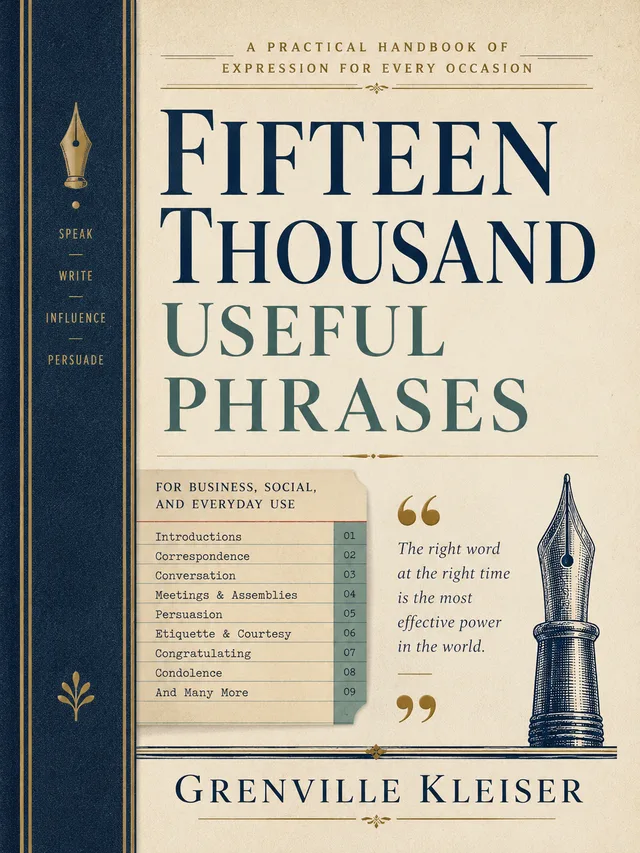
Fifteen Thousand Useful Phrases
Edição BooksWhale em inglês por Grenville Kleiser
A practical language reference for expression, vocabulary, style, public speaking, and fluent written English.
- Prévia
- Aprox. 3%
- Formatos
- Leitor online, EPUB, PDF
- Acesso
- Claim da Biblioteca
Introdução do livro
Fifteen Thousand Useful Phrases
Fifteen Thousand Useful Phrases is a practical collection of expressions designed to improve vocabulary, style, speaking, and writing. It belongs to a tradition of self-education and rhetoric manuals aimed at readers who want more precise and varied language. This BooksWhale edition presents the English original text for online reading, EPUB, and PDF.
Edição BooksWhale
Como esta edição foi preparada
Esta edição se baseia em um texto em domínio público e foi preparada pela BooksWhale para leitura digital.
Base de domínio público
Por que pode ser compartilhada
Grenville Kleiser died in 1953, and Fifteen Thousand Useful Phrases was published in the early twentieth century. The selected public-domain source text should be confirmed before final publication.
Ler prévia
Amostra do texto preparado
Aprox. 3%
Prévia selecionada do texto preparado.
Capítulo de prévia
Full text
Fifteen Thousand Useful Phrases
Grenville Kleiser
Capítulo de prévia
INTRODUCTION
The most powerful and the most perfect expression of thought and feeling
through the medium of oral language must be traced to the mastery of
words. Nothing is better suited to lead speakers and readers of English
into an easy control of this language than the command of the phrase that
perfectly expresses the thought. Every speaker's aim is to be heard and understood. A clear, crisp articulation holds an audience as by the spell of some irresistible power. The choice word, the correct phrase, are
instruments that may reach the heart, and awake the soul if they fall upon
the ear in melodious cadence; but if the utterance be harsh and discordant
they fail to interest, fall upon deaf ears, and are as barren as seed sown
on fallow ground. In language, nothing conduces so emphatically to the
harmony of sounds as perfect phrasing--that is, the emphasizing of the
relation of clause to clause, and of sentence to sentence by the
systematic grouping of words. The phrase consists usually of a few words which denote a single idea that forms a separate part of a sentence. In
this respect it differs from the clause, which is a short sentence that
forms a distinct part of a composition, paragraph, or discourse. Correct
phrasing is regulated by rests, such rests as do not break the continuity
of a thought or the progress of the sense.
GRENVILLE KLEISER, who has devoted years of his diligent life to imparting
the art of correct expression in speech and writing, has provided many
aids for those who would know not merely what to say, but how to say it. He has taught also what the great HOLMES taught, that language is a temple
in which the human soul is enshrined, and that it grows out of life--out
of its joys and its sorrows, its burdens and its necessities. To him, as
well as to the writer, the deep strong voice of man and the low sweet
voice of woman are never heard at finer advantage than in the earnest but
mellow tones of familiar speech. In the present volume Mr. Kleiser
furnishes an additional and an exceptional aid for those who would have a
mint of phrases at their command from which to draw when in need of the
golden mean for expressing thought. Few indeed are the books fitted to-day
for the purpose of imparting this knowledge, yet two centuries ago
phrase-books were esteemed as supplements to the dictionaries, and have
not by any manner of means lost their value. The guide to familiar
quotations, the index to similes, the grammars, the readers, the
machine-made letter-writer of mechanically perfect letters of
congratulation or condolence--none are sententious enough to supply the
need. By the compilation of this praxis, Mr. Kleiser has not only supplied
it, but has furnished a means for the increase of one's vocabulary by
practical methods. There are thousands of persons who may profit by the
systematic study of such a book as this if they will familiarize
themselves with the author's purpose by a careful reading of the
preliminary pages of his book. To speak in public pleasingly and readily
and to read well are accomplishments acquired only after many days, weeks
even, of practise.
Foreigners sometimes reproach us for the asperity and discordance of our
speech, and in general, this reproach is just, for there are many persons
who do scanty justice to the vowel-elements of our language. Although these elements constitute its music they are continually mistreated. We flirt with and pirouette around them constantly. If it were not so, English would be found full of beauty and harmony of sound. Familiar with the maxim, "Take care of the vowels and the consonants will take care of
themselves,"--a maxim that when put into practise has frequently led to
the breaking-down of vowel values--the writer feels that the common custom
of allowing "the consonants to take care of themselves" is pernicious. It
leads to suppression or to imperfect utterance, and thus produces
indistinct articulation.
The English language is so complex in character that it can scarcely be
learned by rule, and can best be mastered by the study of such idioms and
phrases as are provided in this book; but just as care must be taken to
place every accent or stress on the proper syllable in the pronouncing of
every word it contains, so must the stress or emphasis be placed on the
proper word in every sentence spoken. To read or speak pleasingly one
should resort to constant practise by doing so aloud in private, or
preferably, in the presence of such persons as know good reading when they
hear it and are masters of the melody of sounds. It was Dean Swift's
belief that the common fluency of speech in many men and most women was
due to scarcity of matter and scarcity of words. He claimed that a master
of language possessed a mind full of ideas, and that before speaking, such
a mind paused to select the choice word--the phrase best suited to the
occasion. "Common speakers," he said, "have only one set of ideas, and one set of words to clothe them in," and these are always ready on the lips. Because he holds the Dean's view sound to-day, the writer will venture to
warn the readers of this book against a habit that, growing far too common
among us, should be checked, and this is the iteration and reiteration in
conversation of "the battered, stale, and trite" phrases, the like of
which were credited by the worthy Dean to the women of his time.
Human thought elaborates itself with the progress of intelligence. Speech
is the harvest of thought, and the relation which exists between words and
the mouths that speak them must be carefully observed. Just as nothing is
more beautiful than a word fitly spoken, so nothing is rarer than the use
of a word in its exact meaning. There is a tendency to overwork both words and phrases that is not restricted to any particular class. The learned
sin in this respect even as do the ignorant, and the practise spreads
until it becomes an epidemic. The epidemic word with us yesterday was
unquestionably "conscription"; several months ago it was "preparedness."
Before then "efficiency" was heard on every side and succeeded in
superseding "vocational teaching," only to be displaced in turn by "life
extension" activities. "Safety-first" had a long run which was brought
almost to abrupt end by "strict accountability," but these are mere
reflections of our cosmopolitan life and activities. There are others that stand out as indicators of brain-weariness. These are most frequently met in the work of our novelists.
English authors and journalists are abusing and overworking the word intrigue to-day. Sir Arthur Quillercouch on page 81 of his book "On the Art of Writing" uses it: "We are intrigued by the process of manufacture instead of being wearied by a description of the ready-made article." Mrs. Sidgwick in "Salt and Savour," page 232, wrote: "But what intrigued her was Little Mamma's remark at breakfast," From the Parliamentary news, one learns that "Mr. Harcourt intrigued the House of Commons by his sustained silence for two years" and that "London is interested in, and not a little intrigued, by the statement." This use of intrigue in the sense of "perplex, puzzle, trick, or deceive" dates from 1600. Then it fell into a
state of somnolence, and after an existence of innocuous desuetude lasting
till 1794 it was revived, only to hibernate again until 1894. It owes its new lease of life to a writer on The Westminster Gazette, a London journal
famous for its competitions in aid of the restoring of the dead meanings
of words.
One is almost exasperated by the repeated use and abuse of the word
"intimate" in a recently published work of fiction, by an author who
aspires to the first rank in his profession. He writes of "the intimate
dimness of the room;" "a fierce intimate whispering;" "a look that was
intimate;" "the noise of the city was intimate," etc. Who has not heard, "The idea!" "What's the idea?" "Is that the idea?" "Yes, that's the idea," with increased inflection at each repetition. And who is without a friend who at some time or another has not sprung "meticulous" upon him? Another example is afforded by the endemic use of "of sorts" which struck London while the writer was in that city a few years ago. Whence it came no one knew, but it was heard on every side. "She was a woman of sorts;" "he is a Tory of sorts;" "he had a religion of sorts;" "he was a critic of sorts." While it originally meant "of different or various kinds," as hats of
sorts; offices of sorts; cheeses of sorts, etc., it is now used
disparagingly, and implies something of a kind that is not satisfactory,
or of a character that is rather poor. This, as Shakespeare might have said, is "Sodden business! There's a stewed phrase indeed!" [Footnote: Troilus and Cressida, act iii, sc. 1.]
The abuse of phrases and the misuse of words rife among us can be checked by diligent exercises in good English, such as this book provides. These
exercises, in conjunction with others to be found in different volumes by
the same author, will serve to correct careless diction and slovenly
speech, and lead to the art of speaking and writing correctly; for, after
all, accuracy in the use of words is more a matter of habit than of
theory, and once it is acquired it becomes just as easy to speak or to
write good English as bad English. It was Chesterfield's resolution not to speak a word in conversation which was not the fittest he could recall. All persons should avoid using words whose meanings they do not know, and with the correct application of which they are unfamiliar. The best spoken and the best written English is that which conforms to the language as
used by men and women of culture--a high standard, it is true, but one not
so high that it is unattainable by any earnest student of the English tongue.
Capítulo de prévia
FRANK H. VIZETELLY.
FRANK H. VIZETELLY.
Capítulo de prévia
HOW TO USE THIS BOOK
The study of words, phrases, and literary expressions is a highly interesting pursuit. There is a reciprocal influence between thought and language. What we think molds the words we use, and the words we use react upon our thoughts. Hence a study of words is a study of ideas, and a stimulant to deep and original thinking.
We should not, however, study "sparkling words and sonorous phrases" with the object of introducing them consciously into our speech. To do so would inevitably lead to stiltedness and superficiality. Words and phrases
should be studied as symbols of ideas, and as we become thoroughly
familiar with them they will play an unconscious but effective part in our
daily expression.
We acquire our vocabulary largely from our reading and our personal associates. The words we use are an unmistakable indication of our thought habits, tastes, ideals, and interests in life. In like manner, the
habitual language of a people is a barometer of their intellectual, civil,
moral, and spiritual ideals. A great and noble people express themselves in great and noble words.
Ruskin earnestly counsels us to form the habit of looking intensely at words. We should scrutinize them closely and endeavor to grasp their innermost meaning. There is an indefinable satisfaction in knowing how to choose and use words with accuracy and precision. As Fox once said, "I am never at a loss for a word, but Pitt always has the word."
All the great writers and orators have been diligent students of words. Demosthenes and Cicero were indefatigable in their study of language. Shakespeare, "infinite in faculty," took infinite pains to embody his thought in words of crystal clearness. Coleridge once said of him that
one might as well try to dislodge a brick from a building with one's
forefinger as to omit a single word from one of his finest passages.
Milton, master of majestic prose, under whose touch words became as living things; Flaubert, who believed there was one and one only best word with which to express a given thought; De Quincey, who exercised a weird-like power over words; Ruskin, whose rhythmic prose enchanted the ear; Keats, who brooded over phrases like a lover; Newman, of pure and melodious style; Stevenson, forever in quest of the scrupulously precise word; Tennyson, graceful and exquisite as the limpid stream; Emerson, of trenchant and epigrammatic style; Webster, whose virile words sometimes weighed a pound; and Lincoln, of simple, Saxon speech,--all these illustrious men were assiduous in their study of words.
Many persons of good education unconsciously circumscribe themselves within a small vocabulary. They have a knowledge of hundreds of desirable words which they do not put into practical use in their speech or writing. Many, too, are conscious of a poverty of language, which engenders in them a sense of timidity and self-depreciation. The method used for building a large vocabulary has usually been confined to the study of single words. This has produced good results, but it is believed that eminently better
results can be obtained from a careful study of words and expressions, as
furnished in this book, where words can be examined in their context.
It is intended and suggested that this study should be pursued in connection with, and as a supplement to, a good standard dictionary. Fifteen minutes a day devoted to this subject, in the manner outlined,
will do more to improve and enlarge the vocabulary than an hour spent in
desultory reading.
There is no better way in which to develop the mental qualities of
clearness, accuracy, and precision, and to improve and enlarge the
intellectual powers generally, than by regular and painstaking study of
judiciously selected phrases and literary expressions.
Capítulo de prévia
PLAN OF STUDY
First examine the book in a general way to grasp its character, scope, and purpose. Carefully note the following plan of classification of the
various kinds of phrases, and choose for initial study a section which you
think will be of the most immediate value to you.
Sumário
Nesta edição
- 01Full text
- 02INTRODUCTION
- 03FRANK H. VIZETELLY.
- 04HOW TO USE THIS BOOK
- 05PLAN OF STUDY
- 06I. USEFUL PHRASES
- 07II. SIGNIFICANT PHRASES
- 08III. FELICITOUS PHRASES
- 09IV. IMPRESSIVE PHRASES
- 10V. PREPOSITIONAL PHRASES
- 11VI. BUSINESS PHRASES
- 12VII. LITERARY EXPRESSIONS
- 13VIII. STRIKING SIMILES
- 14IX. CONVERSATIONAL PHRASES
- 15X. PUBLIC SPEAKING PHRASES
- 16XI. MISCELLANEOUS PHRASES
- 17GRENVILLE KLEISER.
- 18SECTION I
- 19USEFUL PHRASES
- 20A
- 21B
- 22C
- 23D
- 24E
- 25F
- 26G
- 27H
- 28I
- 29J
- 30K
- 31L
- 32M
- 33N
- 34O
- 35P
- 36Q
- 37R
- 38S
- 39T
- 40U
- 41V
- 42W
- 43Y
- 44Z
- 45SECTION II
- 46SIGNIFICANT PHRASES
- 47A
- 48B
- 49C
- 50D
- 51E
- 52F
- 53G
- 54H
- 55I
- 56J
- 57K
- 58L
- 59M
- 60N
- 61O
- 62P
- 63Q
- 64R
- 65S
- 66T
- 67U
- 68V
- 69W
- 70Y
- 71Z
- 72SECTION III
- 73FELICITOUS PHRASES
- 74A
- 75B
- 76C
- 77D
- 78E
- 79F
- 80G
- 81H
- 82I
- 83J
- 84K
- 85L
- 86M
- 87N
- 88O
- 89P
- 90Q
- 91R
- 92S
- 93T
- 94U
- 95V
- 96W
- 97SECTION IV
- 98IMPRESSIVE PHRASES
- 99A
- 100B
- 101C
- 102D
- 103E
- 104F
- 105G
- 106H
- 107I
- 108J
- 109K
- 110L
- 111M
- 112N
- 113O
- 114P
- 115Q
- 116R
- 117S
- 118T
- 119U
- 120V
- 121W
- 122SECTION V
- 123PREPOSITIONAL PHRASES
- 124A
- 125B
- 126C
- 127D
- 128E
- 129F
- 130G
- 131H
- 132I
- 133J
- 134K
- 135L
- 136M
- 137N
- 138O
- 139P
- 140Q
- 141R
- 142S
- 143T
- 144U
- 145V
- 146W
- 147Z
- 148A
- 149B
- 150C
- 151D
- 152E
- 153F
- 154G
- 155H
- 156I
- 157L
- 158M
- 159N
- 160O
- 161R
- 162S
- 163T
- 164U
- 165V
- 166W
- 167A
- 168B
- 169C
- 170D
- 171E
- 172F
- 173G
- 174H
- 175I
- 176K
- 177L
- 178M
- 179N
- 180O
- 181P
- 182Q
- 183R
- 184S
- 185T
- 186U
- 187V
- 188W
- 189A
- 190B
- 191C
- 192D
- 193E
- 194F
- 195G
- 196H
- 197I
- 198K
- 199L
- 200M
- 201Q
- 202R
- 203S
- 204T
- 205U
- 206V
- 207W
- 208A
- 209B
- 210C
- 211D
- 212E
- 213F
- 214G
- 215H
- 216I
- 217L
- 218O
- 219R
- 220S
- 221T
- 222U
- 223V
- 224W
- 225Y
- 226A
- 227B
- 228C
- 229D
- 230E
- 231F
- 232G
- 233I
- 234K
- 235L
- 236M
- 237O
- 238P
- 239Q
- 240R
- 241S
- 242T
- 243U
- 244V
- 245W
- 246SECTION VI
- 247BUSINESS PHRASES
- 248A
- 249B
- 250C
- 251D
- 252E
- 253F
- 254H
- 255I
- 256J
- 257K
- 258L
- 259M
- 260O
- 261P
- 262R
- 263S
- 264T
- 265U
- 266W
- 267Y
- 268SECTION VII
- 269LITERARY EXPRESSIONS
- 270A
- 271B
- 272C
- 273D
- 274E
- 275F
- 276G
- 277H
- 278I
- 279J
- 280K
- 281L
- 282M
- 283N
- 284O
- 285P
- 286Q
- 287R
- 288S
- 289T
- 290U
- 291V
- 292W
- 293Y
- 294SECTION VIII
- 295STRIKING SIMILES
- 296A
- 297B
- 298C
- 299D
- 300E
- 301F
- 302G
- 303H
- 304I
- 305J
- 306K
- 307L
- 308M
- 309N
- 310O
- 311P
- 312Q
- 313R
- 314S
- 315T
- 316U
- 317V
- 318W
- 319Y
- 320SECTION IX
- 321CONVERSATIONAL PHRASES
- 322A
- 323B
- 324C
- 325D
- 326E
- 327F
- 328G
- 329H
- 330I
- 331J
- 332L
- 333M
- 334N
- 335O
- 336P
- 337Q
- 338R
- 339S
- 340T
- 341U
- 342V
- 343W
- 344Y
- 345SECTION X
- 346PUBLIC SPEAKING PHRASES
- 347A
- 348B
- 349C
- 350D
- 351E
- 352F
- 353G
- 354H
- 355I
- 356J
- 357L
- 358M
- 359N
- 360O
- 361P
- 362R
- 363S
- 364T
- 365U
- 366V
- 367W
- 368Y
- 369SECTION XI
- 370MISCELLANEOUS PHRASES
- 371A
- 372B
- 373C
- 374D
- 375E
- 376F
- 377G
- 378H
- 379I
- 380J
- 381K
- 382L
- 383M
- 384N
- 385O
- 386P
- 387Q
- 388R
- 389S
- 390T
- 391U
- 392V
- 393W
- 394Y
- 395Z
Disponibilidade de idiomas
Outros idiomas
Outras edições de idioma ainda não foram publicadas. Elas aparecerão aqui quando disponíveis.
Solicitar outro idioma