inglês Edição
Literatura
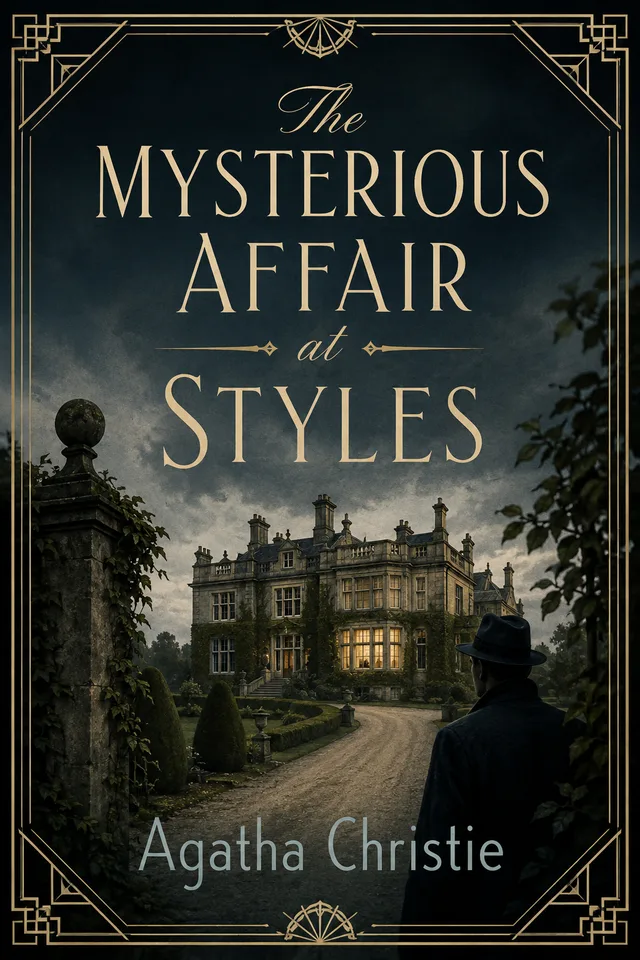
The Mysterious Affair at Styles
Edição BooksWhale em inglês por Agatha Christie
Agatha Christie’s first Poirot mystery, built around poison, inheritance, suspicion, and elegant deduction.
- Prévia
- Amostra do texto preparado
- Formatos
- Leitor online, EPUB, PDF
- Acesso
- Claim da Biblioteca
Introdução do livro
The Mysterious Affair at Styles
The Mysterious Affair at Styles introduces Hercule Poirot in a tightly plotted country-house murder mystery. Christie’s English debut combines wartime atmosphere, family tension, poison, clues, and detective reasoning that helped define modern crime fiction.
Edição BooksWhale
Como esta edição foi preparada
Esta edição se baseia em um texto em domínio público e foi preparada pela BooksWhale para leitura digital.
Base de domínio público
Por que pode ser compartilhada
Agatha Christie died in 1976, and The Mysterious Affair at Styles was first published in 1920. Its publication date supports the public-domain basis for this English edition where applicable.
Ler prévia
Amostra do texto preparado
Prévia selecionada do texto preparado.
Capítulo de préviaFull textLer prévia
The Mysterious Affair at Styles
Agatha Christie
Capítulo de préviaCHAPTER I. I GO TO STYLESPrévia
The intense interest aroused in the public by what was known at the time as "The Styles Case" has now somewhat subsided. Nevertheless, in view of the world-wide notoriety which attended it, I have been asked, both by my friend Poirot and the family themselves, to write an account of the whole story. This, we trust, will effectually silence the sensational rumours which still persist.
I will therefore briefly set down the circumstances which led to my being connected with the affair.
I had been invalided home from the Front; and, after spending some months in a rather depressing Convalescent Home, was given a month's sick leave. Having no near relations or friends, I was trying to make up my mind what to do, when I ran across John Cavendish. I had seen very little of him for some years. Indeed, I had never known him particularly well. He was a good fifteen years my senior, for one thing, though he hardly looked his forty-five years. As a boy, though, I had often stayed at Styles, his mother's place in Essex.
We had a good yarn about old times, and it ended in his inviting me down to Styles to spend my leave there.
"The mater will be delighted to see you again - after all those years," he added.
"Your mother keeps well?" I asked.
"Oh, yes. I suppose you know that she has married again?"
I am afraid I showed my surprise rather plainly. Mrs. Cavendish, who had married John's father when he was a widower with two sons, had been a handsome woman of middle-age as I remembered her. She certainly could not be a day less than seventy now. I recalled her as an energetic, autocratic personality, somewhat inclined to charitable and social notoriety, with a fondness for opening bazaars and playing the Lady Bountiful. She was a most generous woman, and possessed a considerable fortune of her own.
Their country-place, Styles Court, had been purchased by Mr. Cavendish early in their married life. He had been completely under his wife's ascendancy, so much so that, on dying, he left the place to her for her lifetime, as well as the larger part of his income; an arrangement that was distinctly unfair to his two sons. Their step-mother, however, had always been most generous to them; indeed, they were so young at the time of their father's remarriage that they always thought of her as their own mother.
Lawrence, the younger, had been a delicate youth. He had qualified as a doctor but early relinquished the profession of medicine, and lived at home while pursuing literary ambitions; though his verses never had any marked success.
John practised for some time as a barrister, but had finally settled down to the more congenial life of a country squire. He had married two years ago, and had taken his wife to live at Styles, though I entertained a shrewd suspicion that he would have preferred his mother to increase his allowance, which would have enabled him to have a home of his own. Mrs. Cavendish, however, was a lady who liked to make her own plans, and expected other people to fall in with them, and in this case she certainly had the whip hand, namely: the purse strings.
John noticed my surprise at the news of his mother's remarriage and smiled rather ruefully.
"Rotten little bounder too!" he said savagely. "I can tell you, Hastings, it's making life jolly difficult for us. As for Evie - you remember Evie?"
"No."
"Oh, I suppose she was after your time. She's the mater's factotum, companion, Jack of all trades! A great sport - old Evie! Not precisely young and beautiful, but as game as they make them."
"You were going to say - - ?"
"Oh, this fellow! He turned up from nowhere, on the pretext of being a second cousin or something of Evie's, though she didn't seem particularly keen to acknowledge the relationship. The fellow is an absolute outsider, anyone can see that. He's got a great black beard, and wears patent leather boots in all weathers! But the mater cottoned to him at once, took him on as secretary - you know how she's always running a hundred societies?"
Capítulo de préviaCHAPTER II. THE 16TH AND 17TH OF JULYPrévia
I had arrived at Styles on the 5th of July. I come now to the events of the 16th and 17th of that month. For the convenience of the reader I will recapitulate the incidents of those days in as exact a manner as possible. They were elicited subsequently at the trial by a process of long and tedious cross-examinations.
I received a letter from Evelyn Howard a couple of days after her departure, telling me she was working as a nurse at the big hospital in Middlingham, a manufacturing town some fifteen miles away, and begging me to let her know if Mrs. Inglethorp should show any wish to be reconciled.
The only fly in the ointment of my peaceful days was Mrs. Cavendish's extraordinary, and, for my part, unaccountable preference for the society of Dr. Bauerstein. What she saw in the man I cannot imagine, but she was always asking him up to the house, and often went off for long expeditions with him. I must confess that I was quite unable to see his attraction.
The 16th of July fell on a Monday. It was a day of turmoil. The famous bazaar had taken place on Saturday, and an entertainment, in connection with the same charity, at which Mrs. Inglethorp was to recite a War poem, was to be held that night. We were all busy during the morning arranging and decorating the Hall in the village where it was to take place. We had a late luncheon and spent the afternoon resting in the garden. I noticed that John's manner was somewhat unusual. He seemed very excited and restless.
After tea, Mrs. Inglethorp went to lie down to rest before her efforts in the evening and I challenged Mary Cavendish to a single at tennis.
About a quarter to seven, Mrs. Inglethorp called us that we should be late as supper was early that night. We had rather a scramble to get ready in time; and before the meal was over the motor was waiting at the door.
The entertainment was a great success, Mrs. Inglethorp's recitation receiving tremendous applause. There were also some tableaux in which Cynthia took part. She did not return with us, having been asked to a supper party, and to remain the night with some friends who had been acting with her in the tableaux.
The following morning, Mrs. Inglethorp stayed in bed to breakfast, as she was rather overtired; but she appeared in her briskest mood about 12.30, and swept Lawrence and myself off to a luncheon party.
"Such a charming invitation from Mrs. Rolleston. Lady Tadminster's sister, you know. The Rollestons came over with the Conqueror - one of our oldest families."
Mary had excused herself on the plea of an engagement with Dr. Bauerstein.
We had a pleasant luncheon, and as we drove away Lawrence suggested that we should return by Tadminster, which was barely a mile out of our way, and pay a visit to Cynthia in her dispensary. Mrs. Inglethorp replied that this was an excellent idea, but as she had several letters to write she would drop us there, and we could come back with Cynthia in the pony-trap.
We were detained under suspicion by the hospital porter, until Cynthia appeared to vouch for us, looking very cool and sweet in her long white overall. She took us up to her sanctum, and introduced us to her fellow dispenser, a rather awe-inspiring individual, whom Cynthia cheerily addressed as "Nibs."
"What a lot of bottles!" I exclaimed, as my eye travelled round the small room. "Do you really know what's in them all?"
"Say something original," groaned Cynthia. "Every single person who comes up here says that. We are really thinking of bestowing a prize on the first individual who does _not_ say: 'What a lot of bottles!' And I know the next thing you're going to say is: 'How many people have you poisoned?'"
Sumário
Nesta edição
- 01Full text
- 02CHAPTER I. I GO TO STYLES
- 03CHAPTER II. THE 16TH AND 17TH OF JULY
- 04CHAPTER III. THE NIGHT OF THE TRAGEDY
- 05CHAPTER IV. POIROT INVESTIGATES
- 06CHAPTER V. "IT ISN'T STRYCHNINE, IS IT?"
- 07CHAPTER VI. THE INQUEST
- 08CHAPTER VII. POIROT PAYS HIS DEBTS
- 09CHAPTER VIII. FRESH SUSPICIONS
- 10CHAPTER IX. DR. BAUERSTEIN
- 11CHAPTER X. THE ARREST
- 12CHAPTER XI. THE CASE FOR THE PROSECUTION
- 13CHAPTER XII. THE LAST LINK
- 14CHAPTER XIII. POIROT EXPLAINS
Disponibilidade de idiomas
Outros idiomas
Outras edições de idioma ainda não foram publicadas. Elas aparecerão aqui quando disponíveis.
Solicitar outro idioma