inglês Edição
História
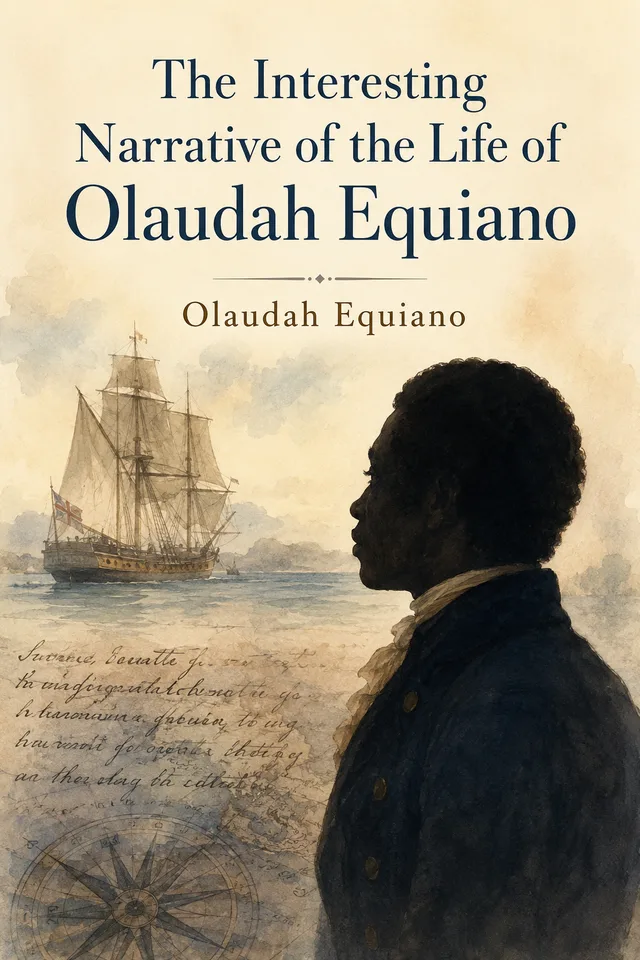
The Interesting Narrative of the Life of Olaudah Equiano
Edição BooksWhale em inglês por Olaudah Equiano
A public-domain classic of enslavement, freedom, travel, and abolitionist witness, presented in a clean BooksWhale reading edition.
- Prévia
- Amostra do texto preparado
- Formatos
- Leitor online, EPUB, PDF
- Acesso
- Claim da Biblioteca
Introdução do livro
The Interesting Narrative of the Life of Olaudah Equiano
The Interesting Narrative of the Life of Olaudah Equiano by Olaudah Equiano is a public-domain classic of enslavement, freedom, travel, and abolitionist witness. This edition presents the text in a clean reading format for sustained reading and catalog discovery.
Edição BooksWhale
Como esta edição foi preparada
Esta edição se baseia em um texto em domínio público e foi preparada pela BooksWhale para leitura digital.
Base de domínio público
Por que pode ser compartilhada
Olaudah Equiano died in 1797, and The Interesting Narrative of the Life of Olaudah Equiano was first published around 1789. These dates support the public-domain basis for the source text used in this edition.
Ler prévia
Amostra do texto preparado
Prévia selecionada do texto preparado.
Capítulo de préviaPart 1Ler prévia
The Interesting Narrative of the Life of Olaudah Equiano
Olaudah Equiano
To the Lords Spiritual and Temporal, and the Commons of the Parliament of Great Britain.
My Lords and Gentlemen ,
Permit me, with the greatest deference and respect, to lay at your feet the following genuine Narrative; the chief design of which is to excite in your august assemblies a sense of compassion for the miseries which the Slave-Trade has entailed on my unfortunate countrymen. By the horrors of that trade was I first torn away from all the tender connexions that were naturally dear to my heart; but these, through the mysterious ways of Providence, I ought to regard as infinitely more than compensated by the introduction I have thence obtained to the knowledge of the Christian religion, and of a nation which, by its liberal sentiments, its humanity, the glorious freedom of its government, and its proficiency in arts and sciences, has exalted the dignity of human nature.
I am sensible I ought to entreat your pardon for addressing to you a work so wholly devoid of literary merit; but, as the production of an unlettered African, who is actuated by the hope of becoming an instrument towards the relief of his suffering countrymen, I trust that such a man , pleading in such a cause , will be acquitted of boldness and presumption.
May the God of heaven inspire your hearts with peculiar benevolence on that important day when the question of Abolition is to be discussed, when thousands, in consequence of your Determination, are to look for Happiness or Misery!
I am, My Lords and Gentlemen, Your most obedient, And devoted humble servant, Olaudah Equiano, or Gustavus Vassa.
Union-Street, Mary-le-bone, March 24, 1789.
CONTENTS Page
CHAP. I.
The author's account of his country, their manners and customs, &c. 49
CHAP. II.
The author's birth and parentage—His being kidnapped with his sister—Horrors of a slave ship 65
CHAP. III.
The author is carried to Virginia—Arrives in England—His wonder at a fall of snow 80
CHAP. IV.
A particular account of the celebrated engagement between Admiral Boscawen and Monsieur Le Clue 94
CHAP. V.
Various interesting instances of oppression, cruelty, and extortion 112
CHAP. VI.
Favourable change in the author's situation—He commences merchant with threepence 129
VOLUME II
CHAP. VII.
The author's disgust at the West Indies—Forms schemes to obtain his freedom 147
CHAP. VIII.
Three remarkable dreams—The author is shipwrecked on the Bahama-bank 160
CHAP. IX
The author arrives at Martinico—Meets with new difficulties, and sails for England 173
CHAP. X.
Some account of the manner of the author's conversion to the faith of Jesus Christ 189
CHAP. XI.
Picking up eleven miserable men at sea in returning to England 207
CHAP. XII.
Different transactions of the author's life—Petition to the Queen—Conclusion 227
CHAPTER I.
The author's account of his country, and their manners and customs—Administration of justice—Embrenche—Marriage ceremony, and public entertainments—Mode of living—Dress—Manufactures Buildings—Commerce—Agriculture—War and religion—Superstition of the natives—Funeral ceremonies of the priests or magicians—Curious mode of discovering poison—Some hints concerning the origin of the author's countrymen, with the opinions of different writers on that subject.
I believe it is difficult for those who publish their own memoirs to escape the imputation of vanity; nor is this the only disadvantage under which they labour: it is also their misfortune, that what is uncommon is rarely, if ever, believed, and what is obvious we are apt to turn from with disgust, and to charge the writer with impertinence. People generally think those memoirs only worthy to be read or remembered which abound in great or striking events, those, in short, which in a high degree excite either admiration or pity: all others they consign to contempt and oblivion. It is therefore, I confess, not a little hazardous in a private and obscure individual, and a stranger too, thus to solicit the indulgent attention of the public; especially when I own I offer here the history of neither a saint, a hero, nor a tyrant. I believe there are few events in my life, which have not happened to many: it is true the incidents of it are numerous; and, did I consider myself an European, I might say my sufferings were great: but when I compare my lot with that of most of my countrymen, I regard myself as a particular favourite of Heaven , and acknowledge the mercies of Providence in every occurrence of my life. If then the following narrative does not appear sufficiently interesting to engage general attention, let my motive be some excuse for its publication. I am not so foolishly vain as to expect from it either immortality or literary reputation. If it affords any satisfaction to my numerous friends, at whose request it has been written, or in the smallest degree promotes the interests of humanity, the ends for which it was undertaken will be fully attained, and every wish of my heart gratified. Let it therefore be remembered, that, in wishing to avoid censure, I do not aspire to praise.
Capítulo de préviaPart 2Prévia
Our land is uncommonly rich and fruitful, and produces all kinds of vegetables in great abundance. We have plenty of Indian corn, and vast quantities of cotton and tobacco. Our pine apples grow without culture; they are about the size of the largest sugar-loaf, and finely flavoured. We have also spices of different kinds, particularly pepper; and a variety of delicious fruits which I have never seen in Europe; together with gums of various kinds, and honey in abundance. All our industry is exerted to improve those blessings of nature. Agriculture is our chief employment; and every one, even the children and women, are engaged in it. Thus we are all habituated to labour from our earliest years. Every one contributes something to the common stock; and as we are unacquainted with idleness, we have no beggars. The benefits of such a mode of living are obvious. The West India planters prefer the slaves of Benin or Eboe to those of any other part of Guinea, for their hardiness, intelligence, integrity, and zeal. Those benefits are felt by us in the general healthiness of the people, and in their vigour and activity; I might have added too in their comeliness. Deformity is indeed unknown amongst us, I mean that of shape. Numbers of the natives of Eboe now in London might be brought in support of this assertion: for, in regard to complexion, ideas of beauty are wholly relative. I remember while in Africa to have seen three negro children, who were tawny, and another quite white, who were universally regarded by myself, and the natives in general, as far as related to their complexions, as deformed. Our women too were in my eyes at least uncommonly graceful, alert, and modest to a degree of bashfulness; nor do I remember to have ever heard of an instance of incontinence amongst them before marriage. They are also remarkably cheerful. Indeed cheerfulness and affability are two of the leading characteristics of our nation.
Our tillage is exercised in a large plain or common, some hours walk from our dwellings, and all the neighbours resort thither in a body. They use no beasts of husbandry; and their only instruments are hoes, axes, shovels, and beaks, or pointed iron to dig with. Sometimes we are visited by locusts, which come in large clouds, so as to darken the air, and destroy our harvest. This however happens rarely, but when it does, a famine is produced by it. I remember an instance or two wherein this happened. This common is often the theatre of war; and therefore when our people go out to till their land, they not only go in a body, but generally take their arms with them for fear of a surprise; and when they apprehend an invasion they guard the avenues to their dwellings, by driving sticks into the ground, which are so sharp at one end as to pierce the foot, and are generally dipt in poison. From what I can recollect of these battles, they appear to have been irruptions of one little state or district on the other, to obtain prisoners or booty. Perhaps they were incited to this by those traders who brought the European goods I mentioned amongst us. Such a mode of obtaining slaves in Africa is common; and I believe more are procured this way, and by kidnapping, than any other [E] . When a trader wants slaves, he applies to a chief for them, and tempts him with his wares. It is not extraordinary, if on this occasion he yields to the temptation with as little firmness, and accepts the price of his fellow creatures liberty with as little reluctance as the enlightened merchant. Accordingly he falls on his neighbours, and a desperate battle ensues. If he prevails and takes prisoners, he gratifies his avarice by selling them; but, if his party be vanquished, and he falls into the hands of the enemy, he is put to death: for, as he has been known to foment their quarrels, it is thought dangerous to let him survive, and no ransom can save him, though all other prisoners may be redeemed. We have fire-arms, bows and arrows, broad two-edged swords and javelins: we have shields also which cover a man from head to foot. All are taught the use of these weapons; even our women are warriors, and march boldly out to fight along with the men. Our whole district is a kind of militia: on a certain signal given, such as the firing of a gun at night, they all rise in arms and rush upon their enemy. It is perhaps something remarkable, that when our people march to the field a red flag or banner is borne before them. I was once a witness to a battle in our common. We had been all at work in it one day as usual, when our people were suddenly attacked. I climbed a tree at some distance, from which I beheld the fight. There were many women as well as men on both sides; among others my mother was there, and armed with a broad sword. After fighting for a considerable time with great fury, and after many had been killed our people obtained the victory, and took their enemy's Chief prisoner. He was carried off in great triumph, and, though he offered a large ransom for his life, he was put to death. A virgin of note among our enemies had been slain in the battle, and her arm was exposed in our market-place, where our trophies were always exhibited. The spoils were divided according to the merit of the warriors. Those prisoners which were not sold or redeemed we kept as slaves: but how different was their condition from that of the slaves in the West Indies! With us they do no more work than other members of the community, even their masters; their food, clothing and lodging were nearly the same as theirs, (except that they were not permitted to eat with those who were free-born); and there was scarce any other difference between them, than a superior degree of importance which the head of a family possesses in our state, and that authority which, as such, he exercises over every part of his household. Some of these slaves have even slaves under them as their own property, and for their own use.
Capítulo de préviaPart 3Prévia
These instances, and a great many more which might be adduced, while they shew how the complexions of the same persons vary in different climates, it is hoped may tend also to remove the prejudice that some conceive against the natives of Africa on account of their colour. Surely the minds of the Spaniards did not change with their complexions! Are there not causes enough to which the apparent inferiority of an African may be ascribed, without limiting the goodness of God, and supposing he forbore to stamp understanding on certainly his own image, because "carved in ebony." Might it not naturally be ascribed to their situation? When they come among Europeans, they are ignorant of their language, religion, manners, and customs. Are any pains taken to teach them these? Are they treated as men? Does not slavery itself depress the mind, and extinguish all its fire and every noble sentiment? But, above all, what advantages do not a refined people possess over those who are rude and uncultivated. Let the polished and haughty European recollect that his ancestors were once, like the Africans, uncivilized, and even barbarous. Did Nature make them inferior to their sons? and should they too have been made slaves? Every rational mind answers, No. Let such reflections as these melt the pride of their superiority into sympathy for the wants and miseries of their sable brethren, and compel them to acknowledge, that understanding is not confined to feature or colour. If, when they look round the world, they feel exultation, let it be tempered with benevolence to others, and gratitude to God, "who hath made of one blood all nations of men for to dwell on all the face of the earth [K] ; and whose wisdom is not our wisdom, neither are our ways his ways."
CHAP. II.
The author's birth and parentage—His being kidnapped with his sister—Their separation—Surprise at meeting again—Are finally separated—Account of the different places and incidents the author met with till his arrival on the coast—The effect the sight of a slave ship had on him—He sails for the West Indies—Horrors of a slave ship—Arrives at Barbadoes, where the cargo is sold and dispersed.
I hope the reader will not think I have trespassed on his patience in introducing myself to him with some account of the manners and customs of my country. They had been implanted in me with great care, and made an impression on my mind, which time could not erase, and which all the adversity and variety of fortune I have since experienced served only to rivet and record; for, whether the love of one's country be real or imaginary, or a lesson of reason, or an instinct of nature, I still look back with pleasure on the first scenes of my life, though that pleasure has been for the most part mingled with sorrow.
I have already acquainted the reader with the time and place of my birth. My father, besides many slaves, had a numerous family, of which seven lived to grow up, including myself and a sister, who was the only daughter. As I was the youngest of the sons, I became, of course, the greatest favourite with my mother, and was always with her; and she used to take particular pains to form my mind. I was trained up from my earliest years in the art of war; my daily exercise was shooting and throwing javelins; and my mother adorned me with emblems, after the manner of our greatest warriors. In this way I grew up till I was turned the age of eleven, when an end was put to my happiness in the following manner:—Generally when the grown people in the neighbourhood were gone far in the fields to labour, the children assembled together in some of the neighbours' premises to play; and commonly some of us used to get up a tree to look out for any assailant, or kidnapper, that might come upon us; for they sometimes took those opportunities of our parents' absence to attack and carry off as many as they could seize. One day, as I was watching at the top of a tree in our yard, I saw one of those people come into the yard of our next neighbour but one, to kidnap, there being many stout young people in it. Immediately on this I gave the alarm of the rogue, and he was surrounded by the stoutest of them, who entangled him with cords, so that he could not escape till some of the grown people came and secured him. But alas! ere long it was my fate to be thus attacked, and to be carried off, when none of the grown people were nigh. One day, when all our people were gone out to their works as usual, and only I and my dear sister were left to mind the house, two men and a woman got over our walls, and in a moment seized us both, and, without giving us time to cry out, or make resistance, they stopped our mouths, and ran off with us into the nearest wood. Here they tied our hands, and continued to carry us as far as they could, till night came on, when we reached a small house, where the robbers halted for refreshment, and spent the night. We were then unbound, but were unable to take any food; and, being quite overpowered by fatigue and grief, our only relief was some sleep, which allayed our misfortune for a short time. The next morning we left the house, and continued travelling all the day. For a long time we had kept the woods, but at last we came into a road which I believed I knew. I had now some hopes of being delivered; for we had advanced but a little way before I discovered some people at a distance, on which I began to cry out for their assistance: but my cries had no other effect than to make them tie me faster and stop my mouth, and then they put me into a large sack. They also stopped my sister's mouth, and tied her hands; and in this manner we proceeded till we were out of the sight of these people. When we went to rest the following night they offered us some victuals; but we refused it; and the only comfort we had was in being in one another's arms all that night, and bathing each other with our tears. But alas! we were soon deprived of even the small comfort of weeping together. The next day proved a day of greater sorrow than I had yet experienced; for my sister and I were then separated, while we lay clasped in each other's arms. It was in vain that we besought them not to part us; she was torn from me, and immediately carried away, while I was left in a state of distraction not to be described. I cried and grieved continually; and for several days I did not eat any thing but what they forced into my mouth. At length, after many days travelling, during which I had often changed masters, I got into the hands of a chieftain, in a very pleasant country. This man had two wives and some children, and they all used me extremely well, and did all they could to comfort me; particularly the first wife, who was something like my mother. Although I was a great many days journey from my father's house, yet these people spoke exactly the same language with us. This first master of mine, as I may call him, was a smith, and my principal employment was working his bellows, which were the same kind as I had seen in my vicinity. They were in some respects not unlike the stoves here in gentlemen's kitchens; and were covered over with leather; and in the middle of that leather a stick was fixed, and a person stood up, and worked it, in the same manner as is done to pump water out of a cask with a hand pump. I believe it was gold he worked, for it was of a lovely bright yellow colour, and was worn by the women on their wrists and ancles. I was there I suppose about a month, and they at last used to trust me some little distance from the house. This liberty I used in embracing every opportunity to inquire the way to my own home: and I also sometimes, for the same purpose, went with the maidens, in the cool of the evenings, to bring pitchers of water from the springs for the use of the house. I had also remarked where the sun rose in the morning, and set in the evening, as I had travelled along; and I had observed that my father's house was towards the rising of the sun. I therefore determined to seize the first opportunity of making my escape, and to shape my course for that quarter; for I was quite oppressed and weighed down by grief after my mother and friends; and my love of liberty, ever great, was strengthened by the mortifying circumstance of not daring to eat with the free-born children, although I was mostly their companion. While I was projecting my escape, one day an unlucky event happened, which quite disconcerted my plan, and put an end to my hopes. I used to be sometimes employed in assisting an elderly woman slave to cook and take care of the poultry; and one morning, while I was feeding some chickens, I happened to toss a small pebble at one of them, which hit it on the middle and directly killed it. The old slave, having soon after missed the chicken, inquired after it; and on my relating the accident (for I told her the truth, because my mother would never suffer me to tell a lie) she flew into a violent passion, threatened that I should suffer for it; and, my master being out, she immediately went and told her mistress what I had done. This alarmed me very much, and I expected an instant flogging, which to me was uncommonly dreadful; for I had seldom been beaten at home. I therefore resolved to fly; and accordingly I ran into a thicket that was hard by, and hid myself in the bushes. Soon afterwards my mistress and the slave returned, and, not seeing me, they searched all the house, but not finding me, and I not making answer when they called to me, they thought I had run away, and the whole neighbourhood was raised in the pursuit of me. In that part of the country (as in ours) the houses and villages were skirted with woods, or shrubberies, and the bushes were so thick that a man could readily conceal himself in them, so as to elude the strictest search. The neighbours continued the whole day looking for me, and several times many of them came within a few yards of the place where I lay hid. I then gave myself up for lost entirely, and expected every moment, when I heard a rustling among the trees, to be found out, and punished by my master: but they never discovered me, though they were often so near that I even heard their conjectures as they were looking about for me; and I now learned from them, that any attempt to return home would be hopeless. Most of them supposed I had fled towards home; but the distance was so great, and the way so intricate, that they thought I could never reach it, and that I should be lost in the woods. When I heard this I was seized with a violent panic, and abandoned myself to despair. Night too began to approach, and aggravated all my fears. I had before entertained hopes of getting home, and I had determined when it should be dark to make the attempt; but I was now convinced it was fruitless, and I began to consider that, if possibly I could escape all other animals, I could not those of the human kind; and that, not knowing the way, I must perish in the woods. Thus was I like the hunted deer:
Sumário
Nesta edição
- 01Part 1
- 02Part 2
- 03Part 3
- 04Part 4
- 05Part 5
- 06Part 6
- 07Part 7
- 08Part 8
- 09Part 9
- 10Part 10
- 11Part 11
- 12Part 12
- 13Part 13
- 14Part 14
- 15Part 15
- 16Part 16
- 17Part 17
- 18Part 18
- 19Part 19
- 20Part 20
- 21Part 21
- 22Part 22
Disponibilidade de idiomas
Outros idiomas
Outras edições de idioma ainda não foram publicadas. Elas aparecerão aqui quando disponíveis.
Solicitar outro idioma