inglês Edição
Política
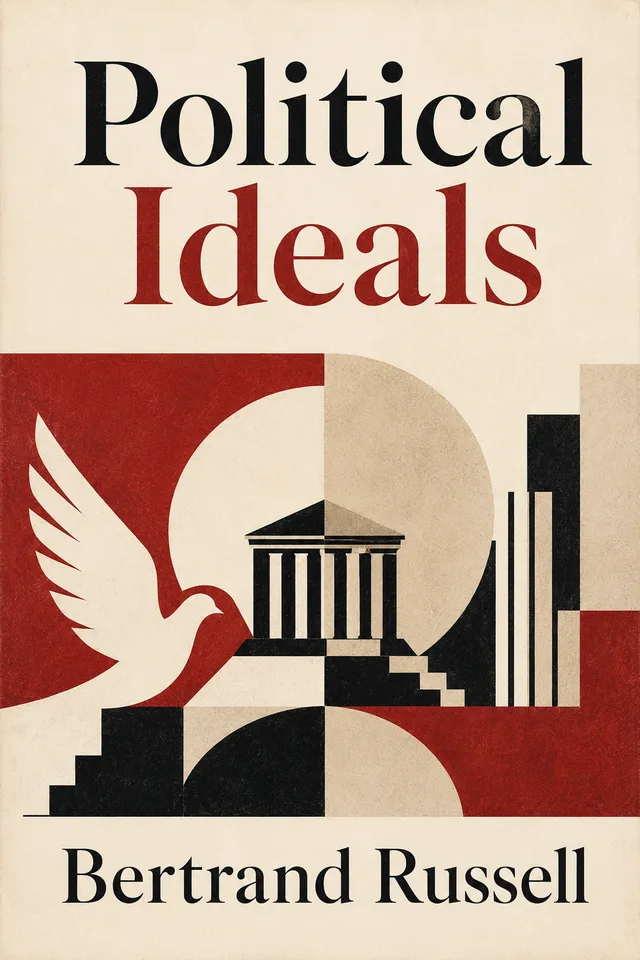
Political Ideals
Edição BooksWhale em inglês por Bertrand Russell
A concise statement of Russell’s political ethics, liberty, justice, social power, and democratic reform.
- Prévia
- Amostra do texto preparado
- Formatos
- Leitor online, EPUB, PDF
- Acesso
- Claim da Biblioteca
Introdução do livro
Political Ideals
Political Ideals presents Bertrand Russell’s reflections on liberty, justice, creative individuality, economic power, war, and social institutions. Written during the First World War, it remains a forceful English classic of modern political thought.
Edição BooksWhale
Como esta edição foi preparada
Esta edição se baseia em um texto em domínio público e foi preparada pela BooksWhale para leitura digital.
Base de domínio público
Por que pode ser compartilhada
This work was first published in 1917. Its publication date supports the public-domain basis for this English edition.
Ler prévia
Amostra do texto preparado
Prévia selecionada do texto preparado.
Capítulo de préviaPart 1Ler prévia
Political Ideals
Bertrand Russell
POLITICAL IDEALS
by
Bertrand Russell
I: Political Ideals II: Capitalism and the Wage System III: Pitfalls in Socialism IV: Individual Liberty and Public Control V: National Independence and Internationalism
Chapter I: Political Ideals
In dark days, men need a clear faith and a well-grounded hope; and as the outcome of these, the calm courage which takes no account of hardships by the way. The times through which we are passing have afforded to many of us a confirmation of our faith. We see that the things we had thought evil are really evil, and we know more definitely than we ever did before the directions in which men must move if a better world is to arise on the ruins of the one which is now hurling itself into destruction. We see that men's political dealings with one another are based on wholly wrong ideals, and can only be saved by quite different ideals from continuing to be a source of suffering, devastation, and sin.
Political ideals must be based upon ideals for the individual life. The aim of politics should be to make the lives of individuals as good as possible. There is nothing for the politician to consider outside or above the various men, women, and children who compose the world. The problem of politics is to adjust the relations of human beings in such a way that each severally may have as much of good in his existence as possible. And this problem requires that we should first consider what it is that we think good in the individual life.
To begin with, we do not want all men to be alike. We do not want to lay down a pattern or type to which men of all sorts are to be made by some means or another to approximate. This is the ideal of the impatient administrator. A bad teacher will aim at imposing his opinion, and turning out a set of pupils all of whom will give the same definite answer on a doubtful point. Mr. Bernard Shaw is said to hold that _Troilus and Cressida_ is the best of Shakespeare's plays. Although I disagree with this opinion, I should welcome it in a pupil as a sign of individuality; but most teachers would not tolerate such a heterodox view. Not only teachers, but all commonplace persons in authority, desire in their subordinates that kind of uniformity which makes their actions easily predictable and never inconvenient. The result is that they crush initiative and individuality when they can, and when they cannot, they quarrel with it.
It is not one ideal for all men, but a separate ideal for each separate man, that has to be realized if possible. Every man has it in his being to develop into something good or bad: there is a best possible for him, and a worst possible. His circumstances will determine whether his capacities for good are developed or crushed, and whether his bad impulses are strengthened or gradually diverted into better channels.
But although we cannot set up in any detail an ideal of character which is to be universally applicable--although we cannot say, for instance, that all men ought to be industrious, or self-sacrificing, or fond of music--there are some broad principles which can be used to guide our estimates as to what is possible or desirable.
We may distinguish two sorts of goods, and two corresponding sorts of impulses. There are goods in regard to which individual possession is possible, and there are goods in which all can share alike. The food and clothing of one man is not the food and clothing of another; if the supply is insufficient, what one man has is obtained at the expense of some other man. This applies to material goods generally, and therefore to the greater part of the present economic life of the world. On the other hand, mental and spiritual goods do not belong to one man to the exclusion of another. If one man knows a science, that does not prevent others from knowing it; on the contrary, it helps them to acquire the knowledge. If one man is a great artist or poet, that does not prevent others from painting pictures or writing poems, but helps to create the atmosphere in which such things are possible. If one man is full of good-will toward others, that does not mean that there is less good-will to be shared among the rest; the more good-will one man has, the more he is likely to create among others. In such matters there is no _possession_, because there is not a definite amount to be shared; any increase anywhere tends to produce an increase everywhere.
Capítulo de préviaPart 2Prévia
[1] In England this is called "a sense of humor."
Vast organizations are an inevitable element in modern life, and it is useless to aim at their abolition, as has been done by some reformers, for instance, William Morris. It is true that they make the preservation of individuality more difficult, but what is needed is a way of combining them with the greatest possible scope for individual initiative.
One very important step toward this end would be to render democratic the government of every organization. At present, our legislative institutions are more or less democratic, except for the important fact that women are excluded. But our administration is still purely bureaucratic, and our economic organizations are monarchical or oligarchic. Every limited liability company is run by a small number of self-appointed or coöpted directors. There can be no real freedom or democracy until the men who do the work in a business also control its management.
Another measure which would do much to increase liberty would be an increase of self-government for subordinate groups, whether geographical or economic or defined by some common belief, like religious sects. A modern state is so vast and its machinery is so little understood that even when a man has a vote he does not feel himself any effective part of the force which determines its policy. Except in matters where he can act in conjunction with an exceptionally powerful group, he feels himself almost impotent, and the government remains a remote impersonal circumstance, which must be simply endured, like the weather. By a share in the control of smaller bodies, a man might regain some of that sense of personal opportunity and responsibility which belonged to the citizen of a city-state in ancient Greece or medieval Italy.
When any group of men has a strong corporate consciousness--such as belongs, for example, to a nation or a trade or a religious body--liberty demands that it should be free to decide for itself all matters which are of great importance to the outside world. This is the basis of the universal claim for national independence. But nations are by no means the only groups which ought to have self-government for their internal concerns. And nations, like other groups, ought not to have complete liberty of action in matters which are of equal concern to foreign nations. Liberty demands self-government, but not the right to interfere with others. The greatest degree of liberty is not secured by anarchy. The reconciliation of liberty with government is a difficult problem, but it is one which any political theory must face.
The essence of government is the use of force in accordance with law to secure certain ends which the holders of power consider desirable. The coercion of an individual or a group by force is always in itself more or less harmful. But if there were no government, the result would not be an absence of force in men's relations to each other; it would merely be the exercise of force by those who had strong predatory instincts, necessitating either slavery or a perpetual readiness to repel force with force on the part of those whose instincts were less violent. This is the state of affairs at present in international relations, owing to the fact that no international government exists. The results of anarchy between states should suffice to persuade us that anarchism has no solution to offer for the evils of the world.
There is probably one purpose, and only one, for which the use of force by a government is beneficent, and that is to diminish the total amount of force used m the world. It is clear, for example, that the legal prohibition of murder diminishes the total amount of violence in the world. And no one would maintain that parents should have unlimited freedom to ill-treat their children. So long as some men wish to do violence to others, there cannot be complete liberty, for either the wish to do violence must be restrained, or the victims must be left to suffer. For this reason, although individuals and societies should have the utmost freedom as regards their own affairs, they ought not to have complete freedom as regards their dealings with others. To give freedom to the strong to oppress the weak is not the way to secure the greatest possible amount of freedom in the world. This is the basis of the socialist revolt against the kind of freedom which used to be advocated by _laissez-faire_ economists.
Capítulo de préviaPart 3Prévia
Such a system as that suggested by the French syndicalists, in which each trade would be self-governing and completely independent, without the control of any central authority, would not secure economic justice. Some trades are in a much stronger bargaining position than others. Coal and transport, for example, could paralyze the national life, and could levy blackmail by threatening to do so. On the other hand, such people as school teachers, for example, could rouse very little terror by the threat of a strike and would be in a very weak bargaining position. Justice can never be secured by any system of unrestrained force exercised by interested parties in their own interests. For this reason the abolition of the state, which the syndicalists seem to desire, would be a measure not compatible with economic justice.
The tyranny of the employer, which at present robs the greater part of most men's lives of all liberty and all initiative, is unavoidable so long as the employer retains the right of dismissal with consequent loss of pay. This right is supposed to be essential in order that men may have an incentive to work thoroughly. But as men grow more civilized, incentives based on hope become increasingly preferable to those that are based on fear. It would be far better that men should be rewarded for working well than that they should be punished for working badly. This system is already in operation in the civil service, where a man is only dismissed for some exceptional degree of vice or virtue, such as murder or illegal abstention from it. Sufficient pay to ensure a livelihood ought to be given to every person who is willing to work, independently of the question whether the particular work at which he is skilled is wanted at the moment or not. If it is not wanted, some new trade which is wanted ought to be taught at the public expense. Why, for example, should a hansom-cab driver be allowed to suffer on account of the introduction of taxies? He has not committed any crime, and the fact that his work is no longer wanted is due to causes entirely outside his control. Instead of being allowed to starve, he ought to be given instruction in motor driving or in whatever other trade may seem most suitable. At present, owing to the fact that all industrial changes tend to cause hardships to some section of wage-earners, there is a tendency to technical conservatism on the part of labor, a dislike of innovations, new processes, and new methods. But such changes, if they are in the permanent interest of the community, ought to be carried out without allowing them to bring unmerited loss to those sections of the community whose labor is no longer wanted in the old form. The instinctive conservatism of mankind is sure to make all processes of production change more slowly than they should. It is a pity to add to this by the avoidable conservatism which is forced upon organized labor at present through the unjust workings of a change.
It will be said that men will not work well if the fear of dismissal does not spur them on. I think it is only a small percentage of whom this would be true at present. And those of whom it would be true might easily become industrious if they were given more congenial work or a wiser training. The residue who cannot be coaxed into industry by any such methods are probably to be regarded as pathological cases, requiring medical rather than penal treatment. And against this residue must be set the very much larger number who are now ruined in health or in morale by the terrible uncertainty of their livelihood and the great irregularity of their employment. To very many, security would bring a quite new possibility of physical and moral health.
Sumário
Nesta edição
- 01Part 1
- 02Part 2
- 03Part 3
- 04Part 4
- 05Part 5
- 06Part 6
- 07Part 7
- 08Part 8
Disponibilidade de idiomas
Outros idiomas
Outras edições de idioma ainda não foram publicadas. Elas aparecerão aqui quando disponíveis.
Solicitar outro idioma