inglês Edição
Filosofia
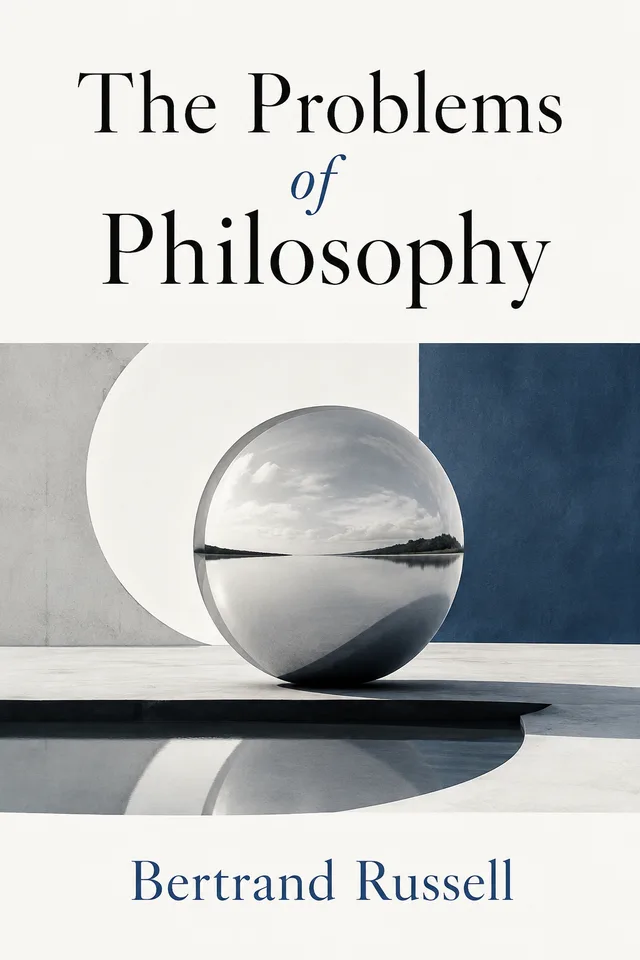
The Problems of Philosophy
Edição BooksWhale em inglês por Bertrand Russell
Russell’s clear introduction to knowledge, reality, appearance, idealism, induction, and philosophical inquiry.
- Prévia
- Amostra do texto preparado
- Formatos
- Leitor online, EPUB, PDF
- Acesso
- Claim da Biblioteca
Introdução do livro
The Problems of Philosophy
The Problems of Philosophy is Bertrand Russell’s elegant introduction to central questions of modern philosophy. It explains appearance and reality, matter, induction, universals, truth, and the value of philosophical doubt in unusually direct English prose.
Edição BooksWhale
Como esta edição foi preparada
Esta edição se baseia em um texto em domínio público e foi preparada pela BooksWhale para leitura digital.
Base de domínio público
Por que pode ser compartilhada
This work was first published in 1912. Its publication date supports the public-domain basis for this English edition.
Ler prévia
Amostra do texto preparado
Prévia selecionada do texto preparado.
Capítulo de préviaPart 1Ler prévia
The Problems of Philosophy
Bertrand Russell
THE PROBLEMS OF PHILOSOPHY
By Bertrand Russell
PREFACE
In the following pages I have confined myself in the main to those problems of philosophy in regard to which I thought it possible to say something positive and constructive, since merely negative criticism seemed out of place. For this reason, theory of knowledge occupies a larger space than metaphysics in the present volume, and some topics much discussed by philosophers are treated very briefly, if at all.
I have derived valuable assistance from unpublished writings of G. E. Moore and J. M. Keynes: from the former, as regards the relations of sense-data to physical objects, and from the latter as regards probability and induction. I have also profited greatly by the criticisms and suggestions of Professor Gilbert Murray.
CHAPTER I. APPEARANCE AND REALITY
Is there any knowledge in the world which is so certain that no reasonable man could doubt it? This question, which at first sight might not seem difficult, is really one of the most difficult that can be asked. When we have realized the obstacles in the way of a straightforward and confident answer, we shall be well launched on the study of philosophy--for philosophy is merely the attempt to answer such ultimate questions, not carelessly and dogmatically, as we do in ordinary life and even in the sciences, but critically, after exploring all that makes such questions puzzling, and after realizing all the vagueness and confusion that underlie our ordinary ideas.
In daily life, we assume as certain many things which, on a closer scrutiny, are found to be so full of apparent contradictions that only a great amount of thought enables us to know what it is that we really may believe. In the search for certainty, it is natural to begin with our present experiences, and in some sense, no doubt, knowledge is to be derived from them. But any statement as to what it is that our immediate experiences make us know is very likely to be wrong. It seems to me that I am now sitting in a chair, at a table of a certain shape, on which I see sheets of paper with writing or print. By turning my head I see out of the window buildings and clouds and the sun. I believe that the sun is about ninety-three million miles from the earth; that it is a hot globe many times bigger than the earth; that, owing to the earth's rotation, it rises every morning, and will continue to do so for an indefinite time in the future. I believe that, if any other normal person comes into my room, he will see the same chairs and tables and books and papers as I see, and that the table which I see is the same as the table which I feel pressing against my arm. All this seems to be so evident as to be hardly worth stating, except in answer to a man who doubts whether I know anything. Yet all this may be reasonably doubted, and all of it requires much careful discussion before we can be sure that we have stated it in a form that is wholly true.
To make our difficulties plain, let us concentrate attention on the table. To the eye it is oblong, brown and shiny, to the touch it is smooth and cool and hard; when I tap it, it gives out a wooden sound. Any one else who sees and feels and hears the table will agree with this description, so that it might seem as if no difficulty would arise; but as soon as we try to be more precise our troubles begin. Although I believe that the table is 'really' of the same colour all over, the parts that reflect the light look much brighter than the other parts, and some parts look white because of reflected light. I know that, if I move, the parts that reflect the light will be different, so that the apparent distribution of colours on the table will change. It follows that if several people are looking at the table at the same moment, no two of them will see exactly the same distribution of colours, because no two can see it from exactly the same point of view, and any change in the point of view makes some change in the way the light is reflected.
Capítulo de préviaPart 2Prévia
Among these surprising possibilities, doubt suggests that perhaps there is no table at all. Philosophy, if it cannot _answer_ so many questions as we could wish, has at least the power of _asking_ questions which increase the interest of the world, and show the strangeness and wonder lying just below the surface even in the commonest things of daily life.
CHAPTER II. THE EXISTENCE OF MATTER
In this chapter we have to ask ourselves whether, in any sense at all, there is such a thing as matter. Is there a table which has a certain intrinsic nature, and continues to exist when I am not looking, or is the table merely a product of my imagination, a dream-table in a very prolonged dream? This question is of the greatest importance. For if we cannot be sure of the independent existence of objects, we cannot be sure of the independent existence of other people's bodies, and therefore still less of other people's minds, since we have no grounds for believing in their minds except such as are derived from observing their bodies. Thus if we cannot be sure of the independent existence of objects, we shall be left alone in a desert--it may be that the whole outer world is nothing but a dream, and that we alone exist. This is an uncomfortable possibility; but although it cannot be strictly proved to be false, there is not the slightest reason to suppose that it is true. In this chapter we have to see why this is the case.
Before we embark upon doubtful matters, let us try to find some more or less fixed point from which to start. Although we are doubting the physical existence of the table, we are not doubting the existence of the sense-data which made us think there was a table; we are not doubting that, while we look, a certain colour and shape appear to us, and while we press, a certain sensation of hardness is experienced by us. All this, which is psychological, we are not calling in question. In fact, whatever else may be doubtful, some at least of our immediate experiences seem absolutely certain.
Descartes (1596-1650), the founder of modern philosophy, invented a method which may still be used with profit--the method of systematic doubt. He determined that he would believe nothing which he did not see quite clearly and distinctly to be true. Whatever he could bring himself to doubt, he would doubt, until he saw reason for not doubting it. By applying this method he gradually became convinced that the only existence of which he could be _quite_ certain was his own. He imagined a deceitful demon, who presented unreal things to his senses in a perpetual phantasmagoria; it might be very improbable that such a demon existed, but still it was possible, and therefore doubt concerning things perceived by the senses was possible.
But doubt concerning his own existence was not possible, for if he did not exist, no demon could deceive him. If he doubted, he must exist; if he had any experiences whatever, he must exist. Thus his own existence was an absolute certainty to him. 'I think, therefore I am,' he said (_Cogito, ergo sum_); and on the basis of this certainty he set to work to build up again the world of knowledge which his doubt had laid in ruins. By inventing the method of doubt, and by showing that subjective things are the most certain, Descartes performed a great service to philosophy, and one which makes him still useful to all students of the subject.
But some care is needed in using Descartes' argument. 'I think, therefore I am' says rather more than is strictly certain. It might seem as though we were quite sure of being the same person to-day as we were yesterday, and this is no doubt true in some sense. But the real Self is as hard to arrive at as the real table, and does not seem to have that absolute, convincing certainty that belongs to particular experiences. When I look at my table and see a certain brown colour, what is quite certain at once is not '_I_ am seeing a brown colour', but rather, 'a brown colour is being seen'. This of course involves something (or somebody) which (or who) sees the brown colour; but it does not of itself involve that more or less permanent person whom we call 'I'. So far as immediate certainty goes, it might be that the something which sees the brown colour is quite momentary, and not the same as the something which has some different experience the next moment.
Capítulo de préviaPart 3Prévia
To this question physical science gives an answer, somewhat incomplete it is true, and in part still very hypothetical, but yet deserving of respect so far as it goes. Physical science, more or less unconsciously, has drifted into the view that all natural phenomena ought to be reduced to motions. Light and heat and sound are all due to wave-motions, which travel from the body emitting them to the person who sees light or feels heat or hears sound. That which has the wave-motion is either aether or 'gross matter', but in either case is what the philosopher would call matter. The only properties which science assigns to it are position in space, and the power of motion according to the laws of motion. Science does not deny that it _may_ have other properties; but if so, such other properties are not useful to the man of science, and in no way assist him in explaining the phenomena.
It is sometimes said that 'light _is_ a form of wave-motion', but this is misleading, for the light which we immediately see, which we know directly by means of our senses, is _not_ a form of wave-motion, but something quite different--something which we all know if we are not blind, though we cannot describe it so as to convey our knowledge to a man who is blind. A wave-motion, on the contrary, could quite well be described to a blind man, since he can acquire a knowledge of space by the sense of touch; and he can experience a wave-motion by a sea voyage almost as well as we can. But this, which a blind man can understand, is not what we mean by _light_: we mean by _light_ just that which a blind man can never understand, and which we can never describe to him.
Now this something, which all of us who are not blind know, is not, according to science, really to be found in the outer world: it is something caused by the action of certain waves upon the eyes and nerves and brain of the person who sees the light. When it is said that light _is_ waves, what is really meant is that waves are the physical cause of our sensations of light. But light itself, the thing which seeing people experience and blind people do not, is not supposed by science to form any part of the world that is independent of us and our senses. And very similar remarks would apply to other kinds of sensations.
It is not only colours and sounds and so on that are absent from the scientific world of matter, but also _space_ as we get it through sight or touch. It is essential to science that its matter should be in _a_ space, but the space in which it is cannot be exactly the space we see or feel. To begin with, space as we see it is not the same as space as we get it by the sense of touch; it is only by experience in infancy that we learn how to touch things we see, or how to get a sight of things which we feel touching us. But the space of science is neutral as between touch and sight; thus it cannot be either the space of touch or the space of sight.
Again, different people see the same object as of different shapes, according to their point of view. A circular coin, for example, though we should always _judge_ it to be circular, will _look_ oval unless we are straight in front of it. When we judge that it _is_ circular, we are judging that it has a real shape which is not its apparent shape, but belongs to it intrinsically apart from its appearance. But this real shape, which is what concerns science, must be in a real space, not the same as anybody's _apparent_ space. The real space is public, the apparent space is private to the percipient. In different people's _private_ spaces the same object seems to have different shapes; thus the real space, in which it has its real shape, must be different from the private spaces. The space of science, therefore, though _connected_ with the spaces we see and feel, is not identical with them, and the manner of its connexion requires investigation.
Sumário
Nesta edição
- 01Part 1
- 02Part 2
- 03Part 3
- 04Part 4
- 05Part 5
- 06Part 6
- 07Part 7
- 08Part 8
- 09Part 9
- 10Part 10
- 11Part 11
- 12Part 12
- 13Part 13
- 14Part 14
Disponibilidade de idiomas
Outros idiomas
Outras edições de idioma ainda não foram publicadas. Elas aparecerão aqui quando disponíveis.
Solicitar outro idioma