inglês Edição
Literatura
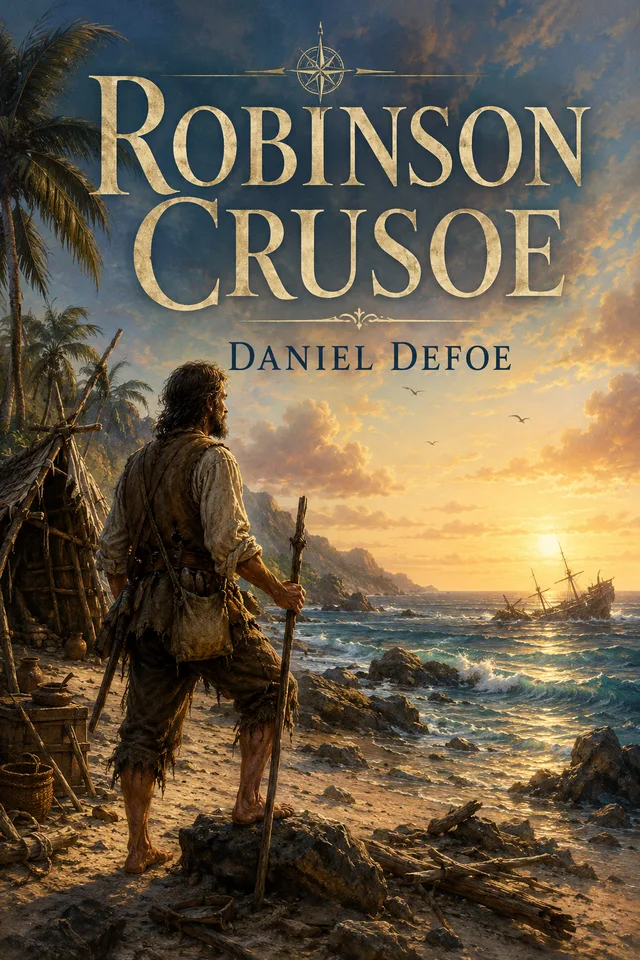
Robinson Crusoe
Edição BooksWhale em inglês por Daniel Defoe
A public-domain classic of shipwreck, survival, empire, labor, and solitude, presented in a clean BooksWhale reading edition.
- Prévia
- Amostra do texto preparado
- Formatos
- Leitor online, EPUB, PDF
- Acesso
- Claim da Biblioteca
Introdução do livro
Robinson Crusoe
Robinson Crusoe by Daniel Defoe is a public-domain classic of shipwreck, survival, empire, labor, and solitude. This edition presents the text in a clean reading format for sustained reading and catalog discovery.
Edição BooksWhale
Como esta edição foi preparada
Esta edição se baseia em um texto em domínio público e foi preparada pela BooksWhale para leitura digital.
Base de domínio público
Por que pode ser compartilhada
Daniel Defoe died in 1731, and Robinson Crusoe was first published around 1719. These dates support the public-domain basis for the source text used in this edition.
Ler prévia
Amostra do texto preparado
Prévia selecionada do texto preparado.
Capítulo de préviaFull textLer prévia
Robinson Crusoe
Daniel Defoe
Capítulo de préviaPart 1Prévia
I was born in the year 1632, in the city of York, of a good family, though not of that country, my father being a foreigner of Bremen, who settled first at Hull. He got a good estate by merchandise, and leaving off his trade, lived afterwards at York, from whence he had married my mother, whose relations were named Robinson, a very good family in that country, and from whom I was called Robinson Kreutznaer; but, by the usual corruption of words in England, we are now called - nay we call ourselves and write our name - Crusoe; and so my companions always called me.
I had two elder brothers, one of whom was lieutenant-colonel to an English regiment of foot in Flanders, formerly commanded by the famous Colonel Lockhart, and was killed at the battle near Dunkirk against the Spaniards. What became of my second brother I never knew, any more than my father or mother knew what became of me.
Being the third son of the family and not bred to any trade, my head began to be filled very early with rambling thoughts. My father, who was very ancient, had given me a competent share of learning, as far as house-education and a country free school generally go, and designed me for the law; but I would be satisfied with nothing but going to sea; and my inclination to this led me so strongly against the will, nay, the commands of my father, and against all the entreaties and persuasions of my mother and other friends, that there seemed to be something fatal in that propensity of nature, tending directly to the life of misery which was to befall me.
My father, a wise and grave man, gave me serious and excellent counsel against what he foresaw was my design. He called me one morning into his chamber, where he was confined by the gout, and expostulated very warmly with me upon this subject. He asked me what reasons, more than a mere wandering inclination, I had for leaving father's house and my native country, where I might be well introduced, and had a prospect of raising my fortune by application and industry, with a life of ease and pleasure. He told me it was men of desperate fortunes on one hand, or of aspiring, superior fortunes on the other, who went abroad upon adventures, to rise by enterprise, and make themselves famous in undertakings of a nature out of the common road; that these things were all either too far above me or too far below me; that mine was the middle state, or what might be called the upper station of low life, which he had found, by long experience, was the best state in the world, the most suited to human happiness, not exposed to the miseries and hardships, the labour and sufferings of the mechanic part of mankind, and not embarrassed with the pride, luxury, ambition, and envy of the upper part of mankind. He told me I might judge of the happiness of this state by this one thing - viz. that this was the state of life which all other people envied; that kings have frequently lamented the miserable consequence of being born to great things, and wished they had been placed in the middle of the two extremes, between the mean and the great; that the wise man gave his testimony to this, as the standard of felicity, when he prayed to have neither poverty nor riches.
He bade me observe it, and I should always find that the calamities of life were shared among the upper and lower part of mankind, but that the middle station had the fewest disasters, and was not exposed to so many vicissitudes as the higher or lower part of mankind; nay, they were not subjected to so many distempers and uneasinesses, either of body or mind, as those were who, by vicious living, luxury, and extravagances on the one hand, or by hard labour, want of necessaries, and mean or insufficient diet on the other hand, bring distemper upon themselves by the natural consequences of their way of living; that the middle station of life was calculated for all kind of virtue and all kind of enjoyments; that peace and plenty were the handmaids of a middle fortune; that temperance, moderation, quietness, health, society, all agreeable diversions, and all desirable pleasures, were the blessings attending the middle station of life; that this way men went silently and smoothly through the world, and comfortably out of it, not embarrassed with the labours of the hands or of the head, not sold to a life of slavery for daily bread, nor harassed with perplexed circumstances, which rob the soul of peace and the body of rest, nor enraged with the passion of envy, or the secret burning lust of ambition for great things; but, in easy circumstances, sliding gently through the world, and sensibly tasting the sweets of living, without the bitter; feeling that they are happy, and learning by every day's experience to know it more sensibly.
Capítulo de préviaPart 2Prévia
While I was in view of the Moor that was swimming, I stood out directly to sea with the boat, rather stretching to windward, that they might think me gone towards the Straits' mouth (as indeed any one that had been in their wits must have been supposed to do): for who would have supposed we were sailed on to the southward, to the truly Barbarian coast, where whole nations of negroes were sure to surround us with their canoes and destroy us; where we could not go on shore but we should be devoured by savage beasts, or more merciless savages of human kind.
But as soon as it grew dusk in the evening, I changed my course, and steered directly south and by east, bending my course a little towards the east, that I might keep in with the shore; and having a fair, fresh gale of wind, and a smooth, quiet sea, I made such sail that I believe by the next day, at three o'clock in the afternoon, when I first made the land, I could not be less than one hundred and fifty miles south of Sallee; quite beyond the Emperor of Morocco's dominions, or indeed of any other king thereabouts, for we saw no people.
Yet such was the fright I had taken of the Moors, and the dreadful apprehensions I had of falling into their hands, that I would not stop, or go on shore, or come to an anchor; the wind continuing fair till I had sailed in that manner five days; and then the wind shifting to the southward, I concluded also that if any of our vessels were in chase of me, they also would now give over; so I ventured to make to the coast, and came to an anchor in the mouth of a little river, I knew not what, nor where, neither what latitude, what country, what nation, or what river. I neither saw, nor desired to see any people; the principal thing I wanted was fresh water. We came into this creek in the evening, resolving to swim on shore as soon as it was dark, and discover the country; but as soon as it was quite dark, we heard such dreadful noises of the barking, roaring, and howling of wild creatures, of we knew not what kinds, that the poor boy was ready to die with fear, and begged of me not to go on shore till day. “Well, Xury,” said I, “then I won't; but it may be that we may see men by day, who will be as bad to us as those lions.” “Then we give them the shoot gun,” says Xury, laughing, “make them run wey.” Such English Xury spoke by conversing among us slaves. However, I was glad to see the boy so cheerful, and I gave him a dram (out of our patron's case of bottles) to cheer him up. After all, Xury's advice was good, and I took it; we dropped our little anchor, and lay still all night; I say still, for we slept none; for in two or three hours we saw vast great creatures (we knew not what to call them) of many sorts, come down to the sea-shore and run into the water, wallowing and washing themselves for the pleasure of cooling themselves; and they made such hideous howlings and yellings, that I never indeed heard the like.
Xury was dreadfully frighted, and indeed so was I too; but we were both more frighted when we heard one of these mighty creatures come swimming towards our boat; we could not see him, but we might hear him by his blowing to be a monstrous huge and furious beast. Xury said it was a lion, and it might be so for aught I know; but poor Xury cried to me to weigh the anchor and row away; “No,” says I, “Xury; we can slip our cable, with the buoy to it, and go off to sea; they cannot follow us far.” I had no sooner said so, but I perceived the creature (whatever it was) within two oars' length, which something surprised me; however, I immediately stepped to the cabin door, and taking up my gun, fired at him; upon which he immediately turned about and swam towards the shore again.
Sumário
Nesta edição
- 01Full text
- 02Part 1
- 03Part 2
- 04Part 3
- 05Part 4
- 06Part 5
- 07Part 6
- 08Part 7
- 09Part 8
- 10Part 9
- 11Part 10
- 12Part 11
- 13Part 12
- 14Part 13
- 15Part 14
- 16Part 15
Disponibilidade de idiomas
Outros idiomas
Outras edições de idioma ainda não foram publicadas. Elas aparecerão aqui quando disponíveis.
Solicitar outro idioma