inglês Edição
História
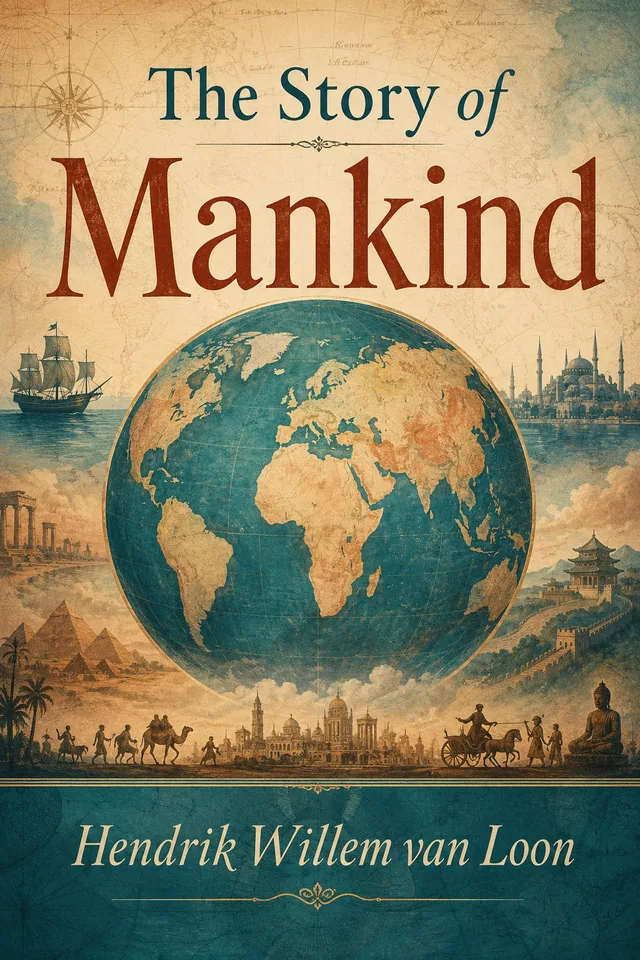
The Story of Mankind
Edição BooksWhale em inglês por Hendrik Willem van Loon
A popular world-history classic that turns civilizations, discoveries, wars, and ideas into a broad human story.
- Prévia
- Amostra do texto preparado
- Formatos
- Leitor online, EPUB, PDF
- Acesso
- Claim da Biblioteca
Introdução do livro
The Story of Mankind
Hendrik Willem van Loon’s The Story of Mankind won early fame for making world history readable to a broad audience. Its narrative moves from ancient peoples to modern revolutions, linking rulers, inventions, wars, and culture in an accessible historical panorama.
Edição BooksWhale
Como esta edição foi preparada
Esta edição se baseia em um texto em domínio público e foi preparada pela BooksWhale para leitura digital.
Base de domínio público
Por que pode ser compartilhada
Hendrik Willem van Loon died in 1944, and the work was first published in 1921. These dates support the public-domain basis for this English edition.
Ler prévia
Amostra do texto preparado
Prévia selecionada do texto preparado.
Capítulo de préviaPart 1Ler prévia
The Story of Mankind
Hendrik Willem van Loon
THE STORY OF MANKIND
By Hendrik Van Loon, Ph.D.
Professor of the Social Sciences in Antioch College. Author of The Fall of the Dutch Republic, The Rise of the Dutch Kingdom, The Golden Book of the Dutch Navigators, A Short Story of Discovery, Ancient Man.
Frontispiece caption= THE SCENE OF OUR HISTORY IS LAID UPON A LITTLE
PLANET, LOST IN THE VASTNESS OF THE UNIVERSE.
To JIMMIE "What is the use of a book without pictures?" said Alice.
FOREWORD
For Hansje and Willem:
WHEN I was twelve or thirteen years old, an uncle of mine who gave me my love for books and pictures promised to take me upon a memorable expedition. I was to go with him to the top of the tower of Old Saint Lawrence in Rotterdam.
And so, one fine day, a sexton with a key as large as that of Saint Peter opened a mysterious door. "Ring the bell," he said, "when you come back and want to get out," and with a great grinding of rusty old hinges he separated us from the noise of the busy street and locked us into a world of new and strange experiences.
For the first time in my life I was confronted by the phenomenon of audible silence. When we had climbed the first flight of stairs, I added another discovery to my limited knowledge of natural phenomena--that of tangible darkness. A match showed us where the upward road continued. We went to the next floor and then to the next and the next until I had lost count and then there came still another floor, and suddenly we had plenty of light. This floor was on an even height with the roof of the church, and it was used as a storeroom. Covered with many inches of dust, there lay the abandoned symbols of a venerable faith which had been discarded by the good people of the city many years ago. That which had meant life and death to our ancestors was here reduced to junk and rubbish. The industrious rat had built his nest among the carved images and the ever watchful spider had opened up shop between the outspread arms of a kindly saint.
The next floor showed us from where we had derived our light. Enormous open windows with heavy iron bars made the high and barren room the roosting place of hundreds of pigeons. The wind blew through the iron bars and the air was filled with a weird and pleasing music. It was the noise of the town below us, but a noise which had been purified and cleansed by the distance. The rumbling of heavy carts and the clinking of horses' hoofs, the winding of cranes and pulleys, the hissing sound of the patient steam which had been set to do the work of man in a thousand different ways--they had all been blended into a softly rustling whisper which provided a beautiful background for the trembling cooing of the pigeons.
Here the stairs came to an end and the ladders began. And after the first ladder (a slippery old thing which made one feel his way with a cautious foot) there was a new and even greater wonder, the town-clock. I saw the heart of time. I could hear the heavy pulsebeats of the rapid seconds--one--two--three--up to sixty. Then a sudden quivering noise when all the wheels seemed to stop and another minute had been chopped off eternity. Without pause it began again--one--two--three--until at last after a warning rumble and the scraping of many wheels a thunderous voice, high above us, told the world that it was the hour of noon.
On the next floor were the bells. The nice little bells and their terrible sisters. In the centre the big bell, which made me turn stiff with fright when I heard it in the middle of the night telling a story of fire or flood. In solitary grandeur it seemed to reflect upon those six hundred years during which it had shared the joys and the sorrows of the good people of Rotterdam. Around it, neatly arranged like the blue jars in an old-fashioned apothecary shop, hung the little fellows, who twice each week played a merry tune for the benefit of the country-folk who had come to market to buy and sell and hear what the big world had been doing. But in a corner--all alone and shunned by the others--a big black bell, silent and stern, the bell of death.
Capítulo de préviaPart 2Prévia
Man was the last to come but the first to use his brain for the purpose of conquering the forces of nature. That is the reason why we are going to study him, rather than cats or dogs or horses or any of the other animals, who, all in their own way, have a very interesting historical development behind them.
In the beginning, the planet upon which we live was (as far as we now know) a large ball of flaming matter, a tiny cloud of smoke in the endless ocean of space. Gradually, in the course of millions of years, the surface burned itself out, and was covered with a thin layer of rocks. Upon these lifeless rocks the rain descended in endless torrents, wearing out the hard granite and carrying the dust to the valleys that lay hidden between the high cliffs of the steaming earth.
Finally the hour came when the sun broke through the clouds and saw how this little planet was covered with a few small puddles which were to develop into the mighty oceans of the eastern and western hemispheres.
Then one day the great wonder happened. What had been dead, gave birth to life.
The first living cell floated upon the waters of the sea.
For millions of years it drifted aimlessly with the currents. But during all that time it was developing certain habits that it might survive more easily upon the inhospitable earth. Some of these cells were happiest in the dark depths of the lakes and the pools. They took root in the slimy sediments which had been carried down from the tops of the hills and they became plants. Others preferred to move about and they grew strange jointed legs, like scorpions and began to crawl along the bottom of the sea amidst the plants and the pale green things that looked like jelly-fishes. Still others (covered with scales) depended upon a swimming motion to go from place to place in their search for food, and gradually they populated the ocean with myriads of fishes.
Meanwhile the plants had increased in number and they had to search for new dwelling places. There was no more room for them at the bottom of the sea. Reluctantly they left the water and made a new home in the marshes and on the mud-banks that lay at the foot of the mountains. Twice a day the tides of the ocean covered them with their brine. For the rest of the time, the plants made the best of their uncomfortable situation and tried to survive in the thin air which surrounded the surface of the planet. After centuries of training, they learned how to live as comfortably in the air as they had done in the water. They increased in size and became shrubs and trees and at last they learned how to grow lovely flowers which attracted the attention of the busy big bumble-bees and the birds who carried the seeds far and wide until the whole earth had become covered with green pastures, or lay dark under the shadow of the big trees. But some of the fishes too had begun to leave the sea, and they had learned how to breathe with lungs as well as with gills. We call such creatures amphibious, which means that they are able to live with equal ease on the land and in the water. The first frog who crosses your path can tell you all about the pleasures of the double existence of the amphibian.
Once outside of the water, these animals gradually adapted themselves more and more to life on land. Some became reptiles (creatures who crawl like lizards) and they shared the silence of the forests with the insects. That they might move faster through the soft soil, they improved upon their legs and their size increased until the world was populated with gigantic forms (which the hand-books of biology list under the names of Ichthyosaurus and Megalosaurus and Brontosaurus) who grew to be thirty to forty feet long and who could have played with elephants as a full grown cat plays with her kittens.
Capítulo de préviaPart 3Prévia
The Egyptians have taught us many things. They were excellent farmers. They knew all about irrigation. They built temples which were afterwards copied by the Greeks and which served as the earliest models for the churches in which we worship nowadays. They had invented a calendar which proved such a useful instrument for the purpose of measuring time that it has survived with a few changes until today. But most important of all, the Egyptians had learned how to preserve speech for the benefit of future generations. They had invented the art of writing.
We are so accustomed to newspapers and books and magazines that we take it for granted that the world has always been able to read and write. As a matter of fact, writing, the most important of all inventions, is quite new. Without written documents we would be like cats and dogs, who can only teach their kittens and their puppies a few simple things and who, because they cannot write, possess no way in which they can make use of the experience of those generations of cats and dogs that have gone before.
In the first century before our era, when the Romans came to Egypt, they found the valley full of strange little pictures which seemed to have something to do with the history of the country. But the Romans were not interested in "anything foreign" and did not inquire into the origin of these queer figures which covered the walls of the temples and the walls of the palaces and endless reams of flat sheets made out of the papyrus reed. The last of the Egyptian priests who had understood the holy art of making such pictures had died several years before. Egypt deprived of its independence had become a store-house filled with important historical documents which no one could decipher and which were of no earthly use to either man or beast.
Seventeen centuries went by and Egypt remained a land of mystery. But in the year 1798 a French general by the name of Bonaparte happened to visit eastern Africa to prepare for an attack upon the British Indian Colonies. He did not get beyond the Nile, and his campaign was a failure. But, quite accidentally, the famous French expedition solved the problem of the ancient Egyptian picture-language.
One day a young French officer, much bored by the dreary life of his little fortress on the Rosetta river (a mouth of the Nile) decided to spend a few idle hours rummaging among the ruins of the Nile Delta. And behold! he found a stone which greatly puzzled him. Like everything else in Egypt it was covered with little figures. But this particular slab of black basalt was different from anything that had ever been discovered. It carried three inscriptions. One of these was in Greek. The Greek language was known. "All that is necessary," so he reasoned, "is to compare the Greek text with the Egyptian figures, and they will at once tell their secrets."
The plan sounded simple enough but it took more than twenty years to solve the riddle. In the year 1802 a French professor by the name of Champollion began to compare the Greek and the Egyptian texts of the famous Rosetta stone. In the year 1823 he announced that he had discovered the meaning of fourteen little figures. A short time later he died from overwork, but the main principles of Egyptian writing had become known. Today the story of the valley of the Nile is better known to us than the story of the Mississippi River. We possess a written record which covers four thousand years of chronicled history.
As the ancient Egyptian hieroglyphics (the word means "sacred writing") have played such a very great role in history, (a few of them in modified form have even found their way into our own alphabet,) you ought to know something about the ingenious system which was used fifty centuries ago to preserve the spoken word for the benefit of the coming generations.
Sumário
Nesta edição
- 01Part 1
- 02Part 2
- 03Part 3
- 04Part 4
- 05Part 5
- 06Part 6
- 07Part 7
- 08Part 8
- 09Part 9
- 10Part 10
- 11Part 11
- 12Part 12
- 13Part 13
- 14Part 14
- 15Part 15
- 16Part 16
- 17Part 17
- 18Part 18
- 19Part 19
- 20Part 20
- 21Part 21
- 22Part 22
- 23Part 23
- 24Part 24
- 25Part 25
- 26Part 26
- 27Part 27
- 28Part 28
- 29Part 29
- 30Part 30
- 31Part 31
- 32Part 32
- 33Part 33
- 34Part 34
- 35Part 35
- 36Part 36
- 37Part 37
- 38Part 38
- 39Part 39
- 40Part 40
- 41Part 41
- 42Part 42
Disponibilidade de idiomas
Outros idiomas
Outras edições de idioma ainda não foram publicadas. Elas aparecerão aqui quando disponíveis.
Solicitar outro idioma