inglês Edição
História
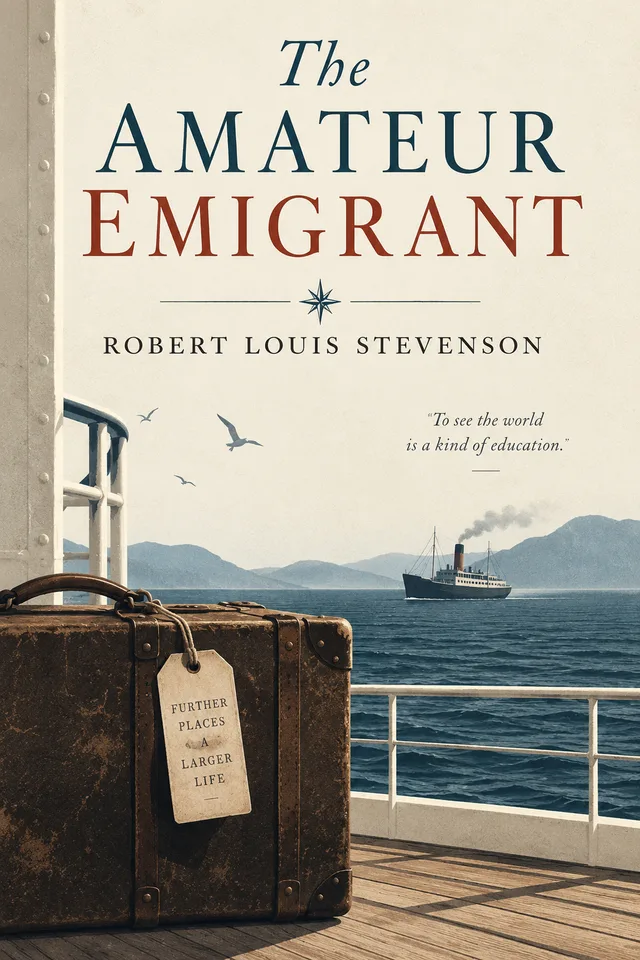
The Amateur Emigrant
Edição BooksWhale em inglês por Robert Louis Stevenson
The Amateur Emigrant presents a focused classic of literature and cultural history.
- Prévia
- Amostra do texto preparado
- Formatos
- Leitor online, EPUB, PDF
- Acesso
- Claim da Biblioteca
Introdução do livro
The Amateur Emigrant
The Amateur Emigrant by Robert Louis Stevenson brings its central world, characters and themes into view, offering a distinctive entry to the period and tradition that shaped it.
Edição BooksWhale
Como esta edição foi preparada
Esta edição se baseia em um texto em domínio público e foi preparada pela BooksWhale para leitura digital.
Base de domínio público
Por que pode ser compartilhada
Public-domain original text; historical author or anonymous source.
Ler prévia
Amostra do texto preparado
Prévia selecionada do texto preparado.
Capítulo de préviaTHE SECOND CABINLer prévia
I first encountered my fellow-passengers on the Broomielaw in Glasgow.
Thence we descended the Clyde in no familiar spirit, but looking askance
on each other as on possible enemies. A few Scandinavians, who had
already grown acquainted on the North Sea, were friendly and voluble
over their long pipes; but among English speakers distance and suspicion
reigned supreme. The sun was soon overclouded, the wind freshened and
grew sharp as we continued to descend the widening estuary; and with the
falling temperature the gloom among the passengers increased. Two of the
women wept. Any one who had come aboard might have supposed we were all
absconding from the law. There was scarce a word interchanged, and no
common sentiment but that of cold united us, until at length, having
touched at Greenock, a pointing arm and rush to the starboard bow
announced that our ocean steamer was in sight. There she lay in
mid-river, at the tail of the Bank, her sea-signal flying: a wall of
bulwark, a street of white deck-houses, an aspiring forest of spars,
larger than a church, and soon to be as populous as many an incorporated
town in the land to which she was to bear us.
I was not, in truth, a steerage passenger. Although anxious to see the
worst of emigrant life, I had some work to finish on the voyage, and was
advised to go by the second cabin, where at least I should have a table
at command. The advice was excellent; but to understand the choice, and
what I gained, some outline of the internal disposition of the ship will
first be necessary. In her very nose is Steerage No. 1, down two pair of
stairs. A little abaft, another companion, labelled Steerage No. 2 and
3, gives admission to three galleries, two running forward towards
steerage No. 1, and the third aft towards the engines. The starboard
forward gallery is the second cabin. Away abaft the engines and below
the officers' cabins, to complete our survey of the vessel, there is yet
a third nest of steerages, labelled 4 and 5. The second cabin, to
return, is thus a modified oasis in the very heart of the steerages.
Through the thin partition you can hear the steerage passengers being
sick, the rattle of tin dishes as they sit at meals, the varied accents
in which they converse, the crying of their children terrified by this
new experience, or the clean flat smack of the parental hand in
chastisement.
There are, however, many advantages for the inhabitant of this strip. He
does not require to bring his own bedding or dishes, but finds berths
and a table completely if somewhat roughly furnished. He enjoys a
distinct superiority in diet; but this, strange to say, differs not only
on different ships, but on the same ship according as her head is to the
east or west. In my own experience, the principal difference between our
table and that of the true steerage passenger was the table itself, and
the crockery plates from which we ate. But lest I should show myself
ungrateful, let me recapitulate every advantage. At breakfast we had a
choice between tea and coffee for beverage; a choice not easy to make,
the two were so surprisingly alike. I found that I could sleep after the
coffee and lay awake after the tea; which is proof conclusive of some
chemical disparity; and even by the palate I could distinguish a smack
of snuff in the former from a flavour of boiling and dish-cloths in the
second. As a matter of fact, I have seen passengers, after many sips,
still doubting which had been supplied them. In the way of eatables at
the same meal we were gloriously favoured; for in addition to porridge,
which was common to all, we had Irish stew, sometimes a bit of fish, and
Capítulo de préviaEARLY IMPRESSIONSPrévia
We steamed out of the Clyde on Thursday night, and early on the Friday
forenoon we took in our last batch of emigrants at Lough Foyle, in
Ireland, and said farewell to Europe. The company was now complete, and
began to draw together, by inscrutable magnetisms, upon the deck. There
were Scots and Irish in plenty, a few English, a few Americans, a good
handful of Scandinavians, a German or two, and one Russian; all now
belonging for ten days to one small iron country on the deep.
As I walked the deck and looked round upon my fellow-passengers, thus
curiously assorted from all northern Europe, I began for the first time
to understand the nature of emigration. Day by day throughout the
passage, and thenceforward across all the States, and on to the shores
of the Pacific, this knowledge grew more clear and melancholy.
Emigration, from a word of the most cheerful import, came to sound most
dismally in my ear. There is nothing more agreeable to picture and
nothing more pathetic to behold. The abstract idea, as conceived at
home, is hopeful and adventurous. A young man, you fancy, scorning
restraints and helpers, issues forth into life, that great battle, to
fight for his own hand. The most pleasant stories of ambition, of
difficulties overcome, and of ultimate success, are but as episodes to
this great epic of self-help. The epic is composed of individual
heroisms; it stands to them as the victorious war which subdued an
empire stands to the personal act of bravery which spiked a single
cannon and was adequately rewarded with a medal. For in emigration the
young men enter direct and by the ship-load on their heritage of work;
empty continents swarm, as at the bo's'un's whistle, with industrious
hands, and whole new empires are domesticated to the service of man.
This is the closet picture, and is found, on trial, to consist mostly of
embellishments. The more I saw of my fellow passengers, the less I was
tempted to the lyric note. Comparatively few of the men were below
thirty; many were married, and encumbered with families; not a few were
already up in years; and this itself was out of tune with my
imaginations, for the ideal emigrant should certainly be young. Again, I
thought he should offer to the eye some bold type of humanity, with
bluff or hawk-like features, and the stamp of an eager and pushing
disposition. Now those around me were for the most part quiet, orderly,
obedient citizens, family men broken by adversity, elderly youths who
had failed to place themselves in life, and people who had seen better
days. Mildness was the prevailing character; mild mirth and mild
endurance. In a word, I was not taking part in an impetuous and
conquering sally, such as swept over Mexico or Siberia, but found
myself, like Marmion, "in the lost battle, borne down by the flying."
Labouring mankind had in the last years, and throughout Great Britain,
sustained a prolonged and crushing series of defeats. I had heard
vaguely of these reverses; of whole streets of houses standing deserted
by the Tyne, the cellar-doors broken and removed for firewood; of
homeless men loitering at the street-corners of Glasgow with their
chests beside them; of closed factories, useless strikes, and starving
girls. But I had never taken them home to me or represented these
distresses livingly to my imagination. A turn of the market may be a
calamity as disastrous as the French retreat from Moscow; but it hardly
lends itself to lively treatment, and makes a trifling figure in the
morning papers. We may struggle as we please, we are not born
economists. The individual is more affecting than the mass. It is by
the scenic accidents, and the appeal to the carnal eye, that for the
most part we grasp the significance of tragedies. Thus it was only now,
Capítulo de préviaSTEERAGE SCENESPrévia
Our companion (Steerage No. 2 and 3) was a favourite resort. Down one
flight of stairs there was a comparatively large open space, the centre
occupied by a hatchway, which made a convenient seat for about twenty
persons, while barrels, coils of rope, and the carpenter's bench
afforded perches for perhaps as many more. The canteen, or steerage bar,
was on one side of the stair; on the other a no less attractive spot,
the cabin of the indefatigable interpreter. I have seen people packed
into this space like herrings in a barrel, and many merry evenings
prolonged there until five bells, when the lights were ruthlessly
extinguished and all must go to roost.
It had been rumoured since Friday that there was a fiddler aboard, who
lay sick and unmelodious in Steerage No. 1; and on the Monday forenoon,
as I came down the companion, I was saluted by something in Strathspey
time. A white-faced Orpheus was cheerily playing to an audience of
white-faced women. It was as much as he could do to play, and some of
his hearers were scarce able to sit; yet they had crawled from their
bunks at the first experimental flourish, and found better than medicine
in the music. Some of the heaviest heads began to nod in time, and a
degree of animation looked from some of the palest eyes. Humanly
speaking, it is a more important matter to play the fiddle, even badly,
than to write huge works upon recondite subjects. What could Mr. Darwin
have done for these sick women? But this fellow scraped away; and the
world was positively a better place for all who heard him. We have yet
to understand the economical value of these mere accomplishments. I
told the fiddler he was a happy man, carrying happiness about with him
in his fiddle-case, and he seemed alive to the fact.
"It is a privilege," I said. He thought a while upon the word, turning
it over in his Scots head, and then answered with conviction, "Yes, a
privilege."
That night I was summoned by "Merrily danced the Quaker's Wife" into the
companion of Steerage No. 4 and 5. This was, properly speaking, but a
strip across a deck-house, lit by a sickly lantern which swung to and
fro with the motion of the ship. Through the open slide-door we had a
glimpse of the grey night sea, with patches of phosphorescent foam
flying, swift as birds, into the wake, and the horizon rising and
falling as the vessel rolled to the wind. In the centre the companion
ladder plunged down sheerly like an open pit. Below, on the first
landing, and lighted by another lamp, lads and lasses danced, not more
than three at a time for lack of space, in jigs and reels, and
hornpipes. Above, on either side, there was a recess railed with iron,
perhaps two feet wide and four long, which stood for orchestra and seats
of honour. In the one balcony, five slatternly Irish lasses sat woven in
a comely group. In the other was posted Orpheus, his body, which was
convulsively in motion, forming an odd contrast to his somnolent,
imperturbable Scots face. His brother, a dark man with a vehement,
interested countenance, who made a god of the fiddler, sat by with open
mouth, drinking in the general admiration and throwing out remarks to
kindle it.
"That's a bonny hornpipe now," he would say; "it's a great favourite
with performers; they dance the sand dance to it." And he expounded the
sand dance. Then suddenly, it would be a long "Hush!" with uplifted
finger and glowing, supplicating eyes; "he's going to play 'Auld Robin
Gray' on one string!" And throughout this excruciating movement,--"On
one string, that's on one string!" he kept crying. I would have given
something myself that it had been on none; but the hearers were much
Sumário
Nesta edição
- 01THE SECOND CABIN
- 02EARLY IMPRESSIONS
- 03STEERAGE SCENES
- 04STEERAGE TYPES
- 05THE SICK MAN
- 06THE STOWAWAYS
- 07PERSONAL EXPERIENCE AND REVIEW
- 08NEW YORK
Disponibilidade de idiomas
Outros idiomas
Outras edições de idioma ainda não foram publicadas. Elas aparecerão aqui quando disponíveis.
Solicitar outro idioma