inglês Edição
Literatura
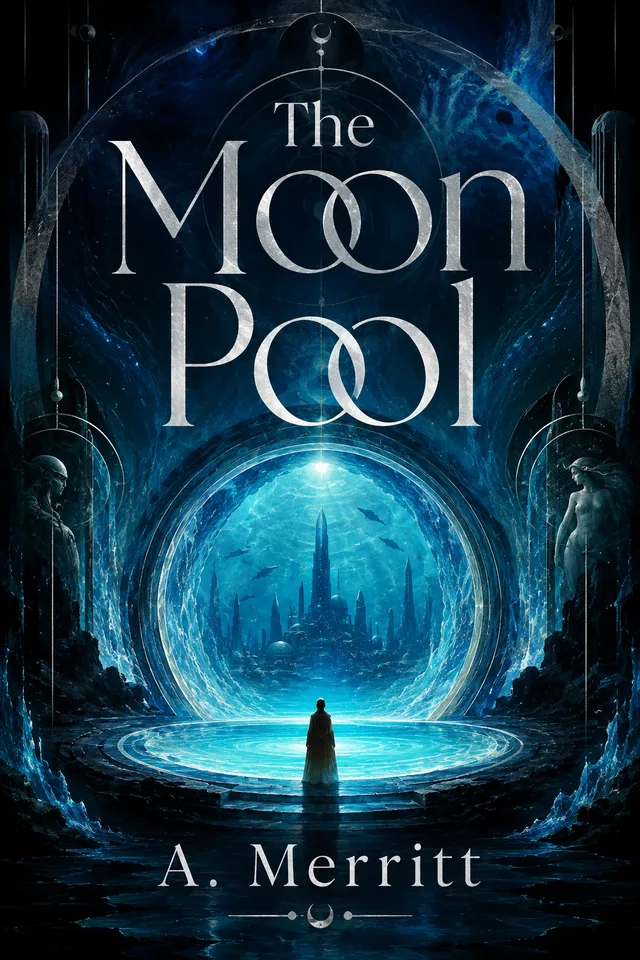
The Moon Pool
Edição BooksWhale em inglês por A. Merritt
An early fantasy-adventure classic of hidden worlds, strange science, and luminous supernatural mystery.
- Prévia
- Amostra do texto preparado
- Formatos
- Leitor online, EPUB, PDF
- Acesso
- Claim da Biblioteca
Introdução do livro
The Moon Pool
The Moon Pool sends explorers into a lost realm of ancient powers, uncanny beings, and forbidden knowledge. Merritt’s lush style and hybrid of science fiction, fantasy, and adventure made the novel a pulp-era landmark.
Edição BooksWhale
Como esta edição foi preparada
Esta edição se baseia em um texto em domínio público e foi preparada pela BooksWhale para leitura digital.
Base de domínio público
Por que pode ser compartilhada
A. Merritt died in 1943, and The Moon Pool was first published in book form in 1919. These dates support the public-domain basis for this English edition.
Ler prévia
Amostra do texto preparado
Prévia selecionada do texto preparado.
Capítulo de préviaFull textLer prévia
The Moon Pool
A. Merritt
Capítulo de préviaCHAPTER IPrévia
The Thing on the Moon Path
For two months I had been on the d'Entrecasteaux Islands gathering data for the concluding chapters of my book upon the flora of the volcanic islands of the South Pacific. The day before I had reached
Port Moresby and had seen my specimens safely stored on board the
Southern Queen. As I sat on the upper deck I thought, with homesick mind, of the long leagues between me and Melbourne, and the longer ones between Melbourne and New York.
It was one of Papua's yellow mornings when she shows herself in her
sombrest, most baleful mood. The sky was smouldering ochre. Over the island brooded a spirit sullen, alien, implacable, filled with the threat of latent, malefic forces waiting to be unleashed. It seemed an emanation out of the untamed, sinister heart of Papua herself--sinister even when she smiles. And now and then, on the wind, came a breath from virgin jungles, laden with unfamiliar odours, mysterious and menacing.
It is on such mornings that Papua whispers to you of her immemorial
ancientness and of her power. And, as every white man must, I fought against her spell. While I struggled I saw a tall figure striding down the pier; a Kapa-Kapa boy followed swinging a new valise. There was something familiar about the tall man. As he reached the gangplank he looked up straight into my eyes, stared for a moment, then waved his hand.
And now I knew him. It was Dr. David Throckmartin--"Throck" he was to me always, one of my oldest friends and, as well, a mind of the first water whose power and achievements were for me a constant inspiration as they were, I know, for scores other.
Coincidentally with my recognition came a shock of surprise, definitely--unpleasant. It was Throckmartin--but about him was something disturbingly unlike the man I had known long so well and to whom and to whose little party I had bidden farewell less than a month before I myself had sailed for these seas. He had married only a few weeks before, Edith, the daughter of Professor William Frazier, younger by at least a decade than he but at one with him in his ideals and as much in love, if it were possible, as Throckmartin. By virtue of her father's training a wonderful assistant, by virtue of her own sweet, sound heart a--I use the word in its olden sense--lover. With his equally youthful associate Dr. Charles Stanton and a Swedish woman, Thora Halversen, who had been Edith Throckmartin's nurse from babyhood, they had set forth for the Nan-Matal, that extraordinary group of island ruins clustered along the eastern shore of Ponape in the Carolines.
I knew that he had planned to spend at least a year among these ruins,
not only of Ponape but of Lele--twin centres of a colossal riddle of humanity, a weird flower of civilization that blossomed ages before the seeds of Egypt were sown; of whose arts we know little enough and of whose science nothing. He had carried with him unusually complete equipment for the work he had expected to do and which, he hoped, would be his monument.
What then had brought Throckmartin to Port Moresby, and what was that change I had sensed in him?
Hurrying down to the lower deck I found him with the purser. As I spoke he turned, thrust out to me an eager hand--and then I saw what was that difference that had so moved me. He knew, of course by my silence and involuntary shrinking the shock my closer look had given me. His eyes filled; he turned brusquely from the purser, hesitated--then hurried off to his stateroom.
"'E looks rather queer--eh?" said the purser. "Know 'im well, sir?
Seems to 'ave given you quite a start."
I made some reply and went slowly up to my chair. There I sat,
Capítulo de préviaCHAPTER IIPrévia
"Dead! All Dead!"
He was sitting, face in hands, on the side of his berth as I entered.
He had taken off his coat.
"Throck," I cried. "What was it? What are you flying from, man?
Where is your wife--and Stanton?"
"Dead!" he replied monotonously. "Dead! All dead!" Then as I recoiled from him--"All dead. Edith, Stanton, Thora--dead--or worse.
And Edith in the Moon Pool--with them--drawn by what you saw on the moon path--that has put its brand upon me--and follows me!"
He ripped open his shirt.
"Look at this," he said. Around his chest, above his heart, the skin was white as pearl. This whiteness was sharply defined against the healthy tint of the body. It circled him with an even cincture about two inches wide.
"Burn it!" he said, and offered me his cigarette. I drew back. He gestured--peremptorily. I pressed the glowing end of the cigarette into the ribbon of white flesh. He did not flinch nor was there odour of burning nor, as I drew the little cylinder away, any mark upon the whiteness.
"Feel it!" he commanded again. I placed my fingers upon the band. It was cold--like frozen marble.
He drew his shirt around him.
"Two things you have seen," he said. "_It_--and its mark. Seeing, you must believe my story. Goodwin, I tell you again that my wife is dead--or worse--I do not know; the prey of--what you saw; so, too, is
Stanton; so Thora. How--"
Tears rolled down the seared face.
"Why did God let it conquer us? Why did He let it take my Edith?" he cried in utter bitterness. "Are there things stronger than God, do you think, Walter?"
I hesitated.
"Are there? Are there?" His wild eyes searched me.
"I do not know just how you define God," I managed at last through my astonishment to make answer. "If you mean the will to know, working through science--"
He waved me aside impatiently.
"Science," he said. "What is our science against--that? Or against the science of whatever devils that made it--or made the way for it to enter this world of ours?"
With an effort he regained control.
"Goodwin," he said, "do you know at all of the ruins on the Carolines;
the cyclopean, megalithic cities and harbours of Ponape and Lele, of
Kusaie, of Ruk and Hogolu, and a score of other islets there?
Particularly, do you know of the Nan-Matal and the Metalanim?"
"Of the Metalanim I have heard and seen photographs," I said. "They call it, don't they, the Lost Venice of the Pacific?"
"Look at this map," said Throckmartin. "That," he went on, "is
Christian's chart of Metalanim harbour and the Nan-Matal. Do you see the rectangles marked Nan-Tauach?"
"Yes," I said.
"There," he said, "under those walls is the Moon Pool and the seven gleaming lights that raise the Dweller in the Pool, and the altar and shrine of the Dweller. And there in the Moon Pool with it lie Edith and Stanton and Thora."
"The Dweller in the Moon Pool?" I repeated half-incredulously.
"The Thing you saw," said Throckmartin solemnly.
A solid sheet of rain swept the ports, and the Southern Queen began to roll on the rising swells. Throckmartin drew another deep breath of relief, and drawing aside a curtain peered out into the night. Its blackness seemed to reassure him. At any rate, when he sat again he was entirely calm.
"There are no more wonderful ruins in the world," he began almost casually. "They take in some fifty islets and cover with their intersecting canals and lagoons about twelve square miles. Who built them? None knows. When were they built? Ages before the memory of present man, that is sure. Ten thousand, twenty thousand, a hundred thousand years ago--the last more likely.
"All these islets, Walter, are squared, and their shores are frowning seawalls of gigantic basalt blocks hewn and put in place by the hands of ancient man. Each inner water-front is faced with a terrace of those basalt blocks which stand out six feet above the shallow canals that meander between them. On the islets behind these walls are time-shattered fortresses, palaces, terraces, pyramids; immense courtyards strewn with ruins--and all so old that they seem to wither the eyes of those who look on them.
Sumário
Nesta edição
- 01Full text
- 02CHAPTER I
- 03CHAPTER II
- 04CHAPTER III
- 05CHAPTER IV
- 06CHAPTER V
- 07CHAPTER VI
- 08CHAPTER VII
- 09CHAPTER VIII
- 10CHAPTER IX
- 11CHAPTER X
- 12CHAPTER XI
- 13CHAPTER XII
- 14CHAPTER XIII
- 15CHAPTER XIV
- 16CHAPTER XV
- 17CHAPTER XVI
- 18CHAPTER XVII
- 19CHAPTER XVIII
- 20CHAPTER XIX
- 21CHAPTER XX
- 22CHAPTER XXI
- 23CHAPTER XXII
- 24CHAPTER XXIII
- 25CHAPTER XXIV
- 26CHAPTER XXV
- 27CHAPTER XXVI
- 28CHAPTER XXVII
- 29CHAPTER XXVIII
- 30CHAPTER XXIX
- 31CHAPTER XXX
- 32CHAPTER XXXI
- 33CHAPTER XXXII
- 34CHAPTER XXXIII
- 35CHAPTER XXXIV
- 36CHAPTER XXXV
Disponibilidade de idiomas
Outros idiomas
Outras edições de idioma ainda não foram publicadas. Elas aparecerão aqui quando disponíveis.
Solicitar outro idioma