inglês Edição
Política
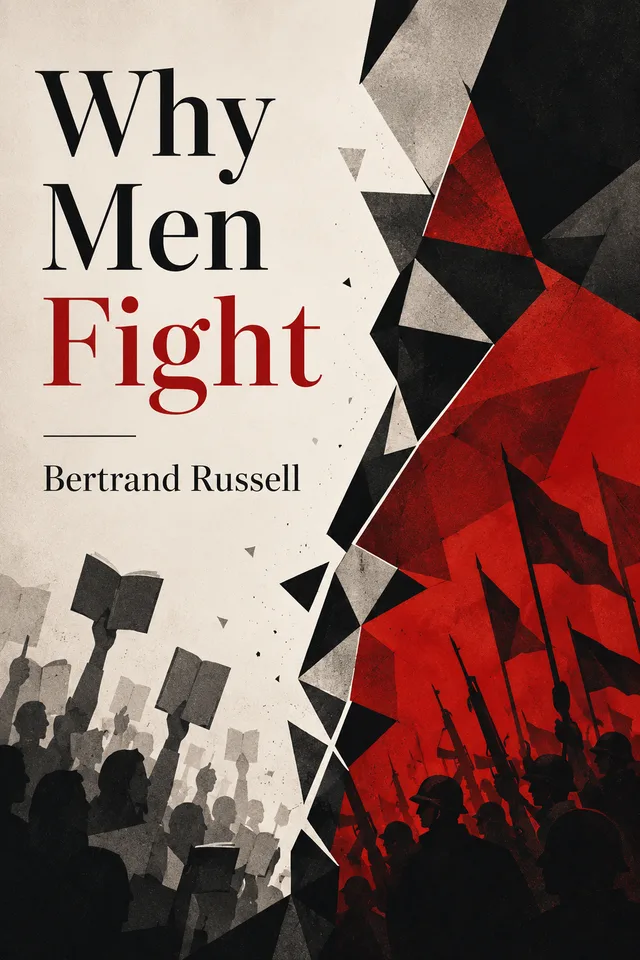
Why Men Fight
Edição BooksWhale em inglês por Bertrand Russell
A wartime political and moral inquiry into conflict, education, nationalism, and social institutions.
- Prévia
- Amostra do texto preparado
- Formatos
- Leitor online, EPUB, PDF
- Acesso
- Claim da Biblioteca
Introdução do livro
Why Men Fight
Why Men Fight examines the impulses and institutions that drive war, competition, obedience, and collective violence. Russell connects politics, education, property, liberty, and international order in a searching public-domain work of social criticism.
Edição BooksWhale
Como esta edição foi preparada
Esta edição se baseia em um texto em domínio público e foi preparada pela BooksWhale para leitura digital.
Base de domínio público
Por que pode ser compartilhada
Why Men Fight was first published in 1916. Its pre-1931 publication date supports the public-domain basis for this original English text in the United States.
Ler prévia
Amostra do texto preparado
Prévia selecionada do texto preparado.
Capítulo de préviaFull textLer prévia
Why Men Fight
Bertrand Russell
Capítulo de préviaIPrévia
I
Capítulo de préviaTHE PRINCIPLE OF GROWTHPrévia
To all who are capable of new impressions and fresh thought, some modification of former beliefs and hopes has been brought by the war. What the modification has been has depended, in each case, upon character and circumstance; but in one form or another it has been almost universal. To me, the chief thing to be learnt through the war has been a certain view of the springs of human action, what they are, and what we may legitimately hope that they will become. This view, if it is true, seems to afford a basis for political philosophy more capable of standing erect in a time of crisis than the philosophy of traditional Liberalism has shown itself to be. The following lectures, though only one of them will deal with war, all are inspired by a view of the springs of action which has been suggested by the war. And all of them are informed by the hope of seeing such political institutions established in Europe as shall make men averse to war—a hope which I firmly believe to be realizable, though not without a great and fundamental reconstruction of economic and social life.
To one who stands outside the cycle of beliefs and passions which make the war seem necessary, an isolation, an almost unbearable separation from the general activity, becomes unavoidable. At the very moment when the universal disaster raises compassion in the highest degree, compassion itself compels aloofness from the impulse to self-destruction which has swept over Europe. The helpless longing to save men from the ruin towards which they are hastening makes it necessary to oppose the stream, to incur hostility, to be thought unfeeling, to lose for the moment the power of winning belief. It is impossible to prevent others from feeling hostile, but it is possible to avoid any reciprocal hostility on one’s own part, by imaginative understanding and the sympathy which grows out of it. And without understanding and sympathy it is impossible to find a cure for the evil from which the world is suffering.
There are two views of the war neither of which seems to me adequate. The usual view in this country is that it is due to the wickedness of the Germans; the view of most pacifists is that it is due to the diplomatic tangle and to the ambitions of Governments. I think both these views fail to realize the extent to which war grows out of ordinary human nature. Germans, and also the men who compose Governments, are on the whole average human beings, actuated by the same passions that actuate others, not differing much from the rest of the world except in their circumstances. War is accepted by men who are neither Germans nor diplomatists with a readiness, an acquiescence in untrue and inadequate reasons, which would not be possible if any deep repugnance to war were widespread in other nations or classes. The untrue things which men believe, and the true things which they disbelieve, are an index to their impulses—not necessarily to individual impulses in each case (since beliefs are contagious), but to the general impulses of the community. We all believe many things which we have no good ground for believing, because, subconsciously, our nature craves certain kinds of action which these beliefs would render reasonable if they were true. Unfounded beliefs are the homage which impulse pays to reason; and thus it is with the beliefs which, opposite but similar, make men here and in Germany believe it their duty to prosecute the war.
The first thought which naturally occurs to one who accepts this view is that it would be well if men were more under the dominion of reason. War, to those who see that it must necessarily do untold harm to all the combatants, seems a mere madness, a collective insanity in which all that has been known in time of peace is forgotten. If impulses were more controlled, if thought were less dominated by passion, men would guard their minds against the approaches of war fever, and disputes would be adjusted amicably. This is true, but it is not by itself sufficient. It is only those in whom the desire to think truly is itself a passion who will find this desire adequate to control the passions of war. Only passion can control passion, and only a contrary impulse or desire can check impulse. Reason, as it is preached by traditional moralists, is too negative, too little living, to make a good life. It is not by reason alone that wars can be prevented, but by a positive life of impulses and passions antagonistic to those that lead to war. It is the life of impulse that needs to be changed, not only the life of conscious thought.
Sumário
Nesta edição
- 01Full text
- 02I
- 03THE PRINCIPLE OF GROWTH
- 04part played by desire has always been sufficiently recognized. When men
- 05part.
- 06II
- 07THE STATE
- 08part of the weapons which capital employs in its conflict with labor.
- 09III
- 10WAR AS AN INSTITUTION
- 11part, driven to frenzy by his continuing to behave as if they did not
- 12part of the psychology of the war fever.
- 13part of a man’s happiness depends upon activity, and only a very small
- 14IV
- 15PROPERTY
- 16V
- 17EDUCATION
- 18part in bringing to mankind a future less somber than the past, with
- 19VI
- 20MARRIAGE AND THE POPULATION QUESTION
- 21VII
- 22RELIGION AND THE CHURCHES
- 23VIII
- 24WHAT WE CAN DO
- 25THE END
- 26FOOTNOTES
- 27THE TEACHING OF PATRIOTISM. HIS MAJESTY’S APPROVAL.
- 28book containing suggestions to local education authorities and teachers
- 29DIVORCE AND WAR.
- 30E. S. P. HAYNES.
Disponibilidade de idiomas
Outros idiomas
Outras edições de idioma ainda não foram publicadas. Elas aparecerão aqui quando disponíveis.
Solicitar outro idioma