
English Edition
Philosophy
Mozi
English BooksWhale Edition by Mozi
Original title: 墨子
An English edition of the Mohist classic on universal care, merit, frugality, and social order.
- Preview
- A sample from the prepared text
- Formats
- Online reader, EPUB, PDF, Audio
- Access
- Library claim
Book introduction
Mozi
Mozi presents arguments for universal care, opposition to aggression, merit-based governance, frugality, and practical social ethics. This English edition makes a major early Chinese philosophical text accessible to new readers.
BooksWhale edition
How this edition was prepared
This edition is an AI-assisted, human-reviewed translation prepared by BooksWhale. It has been reviewed for readability, formatting, and consistency.
Public domain basis
Why this edition can be shared
Mozi is an ancient Chinese public-domain text. This English edition is prepared as an AI-assisted, human-reviewed translation from the Chinese source text.
Read preview
A sample from the prepared text
Preview selected from the prepared reader text.
Preview chapterFull textRead preview
Mozi
The Mohist Canon
Mo Di
Preview chapterPrefacePreview
Among the many voices of ancient Chinese thought, Mozi occupies a distinctive and powerful place. While Confucianism emphasized ritual, hierarchy, and moral cultivation, and Daoism turned toward natural spontaneity and freedom from artificial constraint, Mohism spoke with a strikingly practical and reforming spirit. It asked a direct question: what kind of teaching can truly benefit the world?
Mozi, the thinker traditionally associated with this school, lived during the turbulent Warring States period, when rival kingdoms struggled for power and ordinary people suffered from war, heavy taxation, social disorder, and political ambition. Against this background, the Mohist tradition developed a philosophy centered on usefulness, social responsibility, and moral equality. Its famous doctrine of “impartial care” challenged the narrow loyalties of clan, rank, and privilege. To love only one’s own family, state, or class, Mozi argued, was not enough; disorder arose when people valued themselves and their own groups while neglecting others. A more peaceful world required concern that extended beyond private attachment.
This does not mean that Mozi is merely a book of abstract moral ideals. On the contrary, much of its force lies in its practical reasoning. The text asks whether customs, policies, music, funerals, warfare, and government institutions truly help the people. If they waste resources, increase suffering, or strengthen rulers at the expense of the common good, they are criticized. In this sense, Mozi may be read as one of the earliest works of social ethics and political pragmatism in world philosophy.
One of the most remarkable aspects of the Mohist tradition is its opposition to aggressive war. In a time when military conquest was often praised as glory, Mozi condemned offensive warfare as a great injustice. If killing one person is a crime, he reasoned, how can killing thousands in the name of conquest be celebrated? This moral clarity gives the book enduring relevance. It speaks not only to ancient kings and ministers, but also to any age troubled by violence justified by power.
At the same time, Mozi is not a simple pacifist text. The Mohists were famous for their expertise in defensive warfare, engineering, and strategy. They opposed aggression, but they were prepared to defend the weak against invasion. This combination of moral conviction and technical skill reveals the practical character of the school: justice must not remain a beautiful word; it must be made effective in the real world.
Preview chapterBefriending the LearnedPreview
To govern a country and yet not care for the worthy men there is to bring that country into peril and ruin. To discover worthy talent and yet not employ it promptly is negligence toward the ruler. Without the worthy and capable, urgent difficulties cannot be rescued; without men of talent, there is no one with whom to plan affairs of state. To neglect worthy men and disregard men of talent, and yet be able to make a state long governed and enduringly secure—such a thing has never existed.
In former times, Duke Wen of Jin went into exile abroad, yet later became leader of the covenants under Heaven; Duke Huan of Qi was forced to leave his native state, yet later became hegemon over the feudal lords; King Goujian of Yue suffered humiliation at the hands of the King of Wu, yet later became a worthy ruler whose power extended over the Central Plains. These three men were able to achieve success and fame, and to become illustrious throughout the world, all under circumstances in which their states had suffered grievance and humiliation. Therefore, the best course is not to suffer defeat; the next best is, after suffering defeat, still to have a way to turn defeat into victory. This is due to being skilled in employing people.
I have heard it said: “It is not that there is no stable dwelling; it is that one must not have a mind of careless ease. It is not that there are not sufficient possessions; it is that one must not have a thought of complacent satisfaction.” Therefore, the enlightened gentleman is strict in demanding things of himself and lenient in treating others, while the mediocre person is lenient with himself and harsh in demanding things of others. When the gentleman is appointed to office, he does not change his aspirations; when he withdraws from office, he can reflect on the facts and the reasons. Even if he is reduced to the status of a commoner, he never blames Heaven or resents others, because he has confidence in himself. Therefore, even when he does something difficult for him, he will surely reach the goal he hopes for. I have never heard of a person who does whatever he pleases and can escape hateful consequences.
Ministers with excessive power endanger the ruler; flattering and obsequious subordinates harm the sovereign. A ruler must have ministers who dare to remonstrate; a sovereign must have subordinates who dare to speak directly. Only through repeated debate among those who hold different opinions, and through frank admonition among those who can warn one another, can the people’s livelihood be nurtured and the state preserved. If subordinates merely care about preserving their titles and do not remonstrate; if the ministers around the ruler remain silent, and ministers far away outside the court keep their mouths shut, then resentment will accumulate in the hearts of the people. When flatterers and sycophants are around the ruler and correct opinions are blocked, the state is in danger. Were not Jie of Xia and Zhou of Shang destroyed because there were no worthy men in all the world around them? Thus they met the disaster of death and lost their lands. Therefore it is said: presenting national treasures is not as good as recommending the worthy and promoting men of talent.
Now suppose there are five awls, and one of them is the sharpest; the sharp one will surely be the first to break. Suppose there are five knives, and one of them has been sharpened; the sharpened one will surely be the first to wear away. Therefore, a clear and sweet well is easily drawn dry; a tall tree is easily cut down; a numinous tortoise shell is easily burned for divination; a marvelous long serpent is easily exposed to the sun. Thus Bi Gan was killed because his conduct was upright and unyielding; Meng Ben was killed because he was too brave; Xi Shi was sunk in the river because she was too beautiful; Wu Qi was torn apart by chariots because he devoted himself to the work of reform. Of these people, not one failed to meet disaster because of his own strength. Therefore it is said: when a thing reaches an extreme condition, it is difficult for it to endure for long.
Table of contents
Inside this edition
- 01Full text
- 02Preface
- 03Befriending the Learned
- 04Self-cultivation
- 05On Dyeing
- 06On the Necessity of Standards
- 07The Seven Causes of Anxiety
- 08Indulgence in Excess
- 09Threefold Argument
- 10Exaltation of the Virtuous
- 11Identification with the Superior
- 12Universal Love
- 13Condemnation of Offensive War
- 14Economy of Expenditures
- 15Simplicity in Funerals
- 16Will of Heaven
- 17On Ghosts
- 18Condemnation of Music
- 19Anti-Fatalism
- 20Anti-Confucianism
- 21Canon and Exposition of Canon
- 22Major Illustrations
- 23Minor Illustrations
- 24Geng Zhu
- 25Esteem for Righteousness
- 26Gong Meng
- 27Lu’s Question
- 28Gong Shu
- 29Fortification of the City Gate
- 30Defense against Attack from an Elevation
- 31Defense against Attack with Ladders
- 32Preparation against Inundation
- 33Preparation against a Sally
- 34Preparation against Tunnelling
- 35Defence against Ant-Rush
- 36The Sacrifice against the Coming of the Enemy
- 37Flags and Pennants
- 38Commands and Orders
- 39Miscellaneous Measures in Defence
Language availability
Other languages
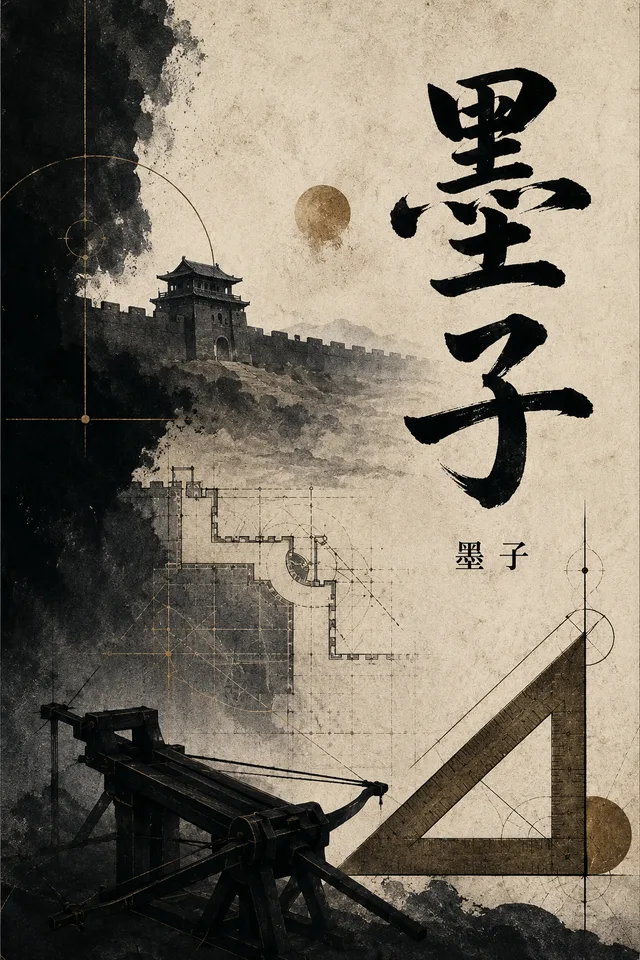
Chinese
Chinese Edition
墨子
Mozi · Philosophy
墨家经典,讨论兼爱、非攻、节用、尚贤和实用理性的政治伦理。
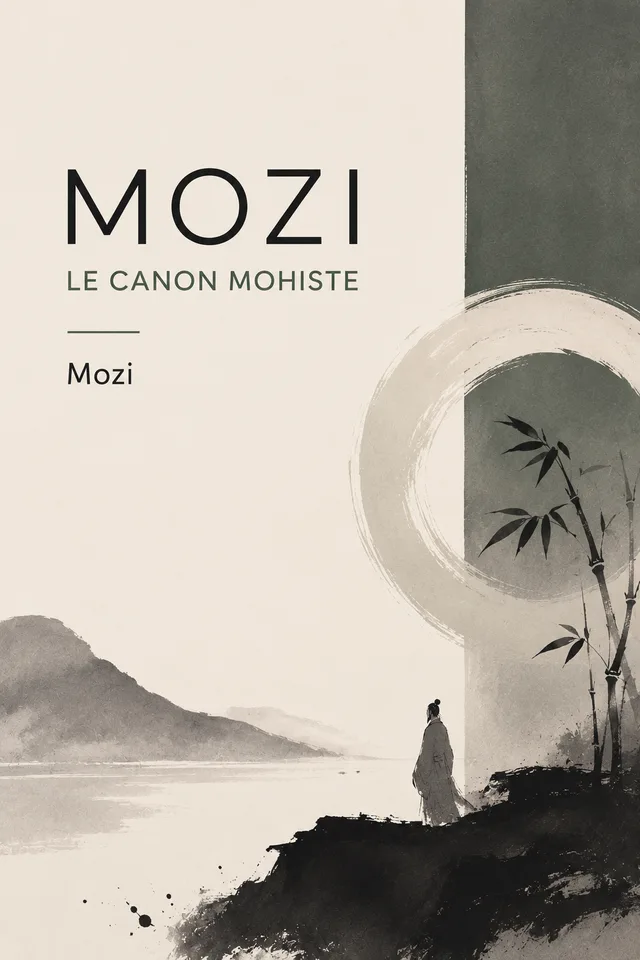
French
French Edition
Mozi
Mozi · Philosophy
Une édition française du classique mohiste sur l’amour universel, le mérite et l’ordre social.

German
German Edition
Mozi
Mozi · Philosophy
Ein Klassiker der chinesischen Philosophie über universelle Liebe, Nutzen, Ordnung und gerechtes Handeln.
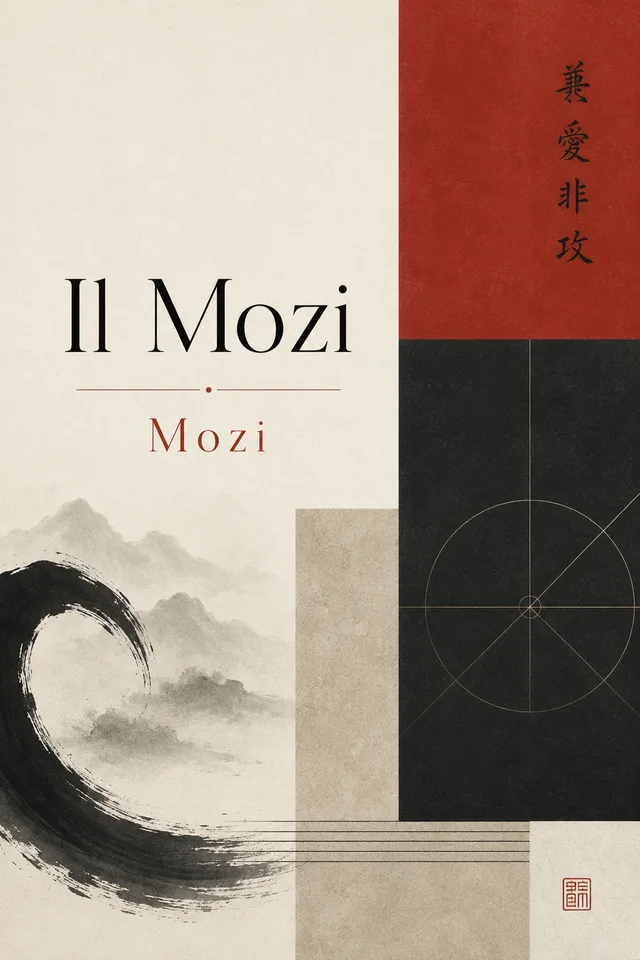
Italian
Italian Edition
Il Mozi
Mozi · Philosophy
Una traduzione italiana del pensiero mohista su amore universale, utilità, guerra difensiva, merito e governo sobrio.
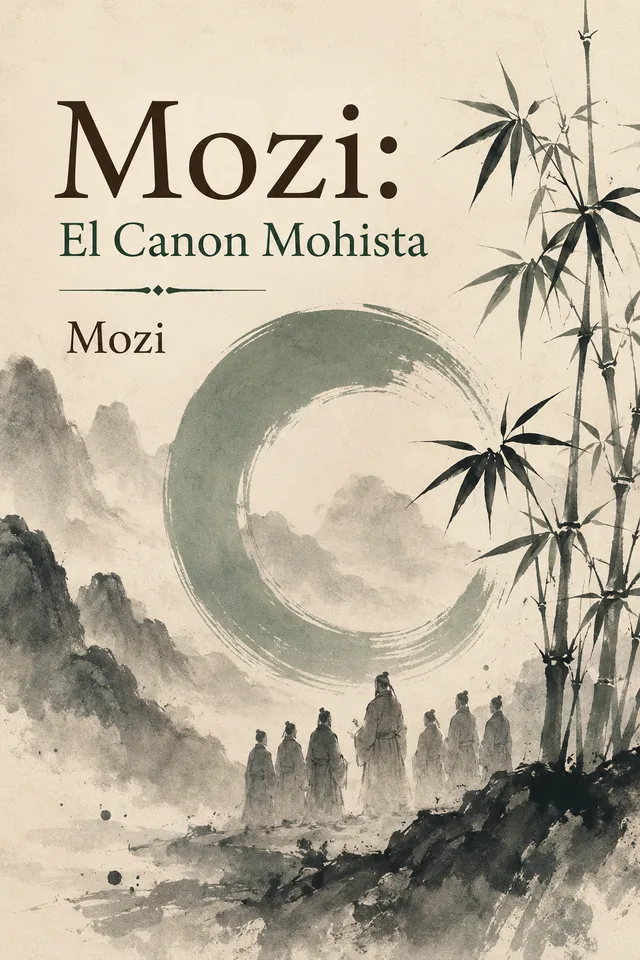
Spanish
Spanish Edition
Mozi
Mozi · Philosophy
Una edición española del clásico mohista sobre amor universal, mérito, frugalidad y orden social.