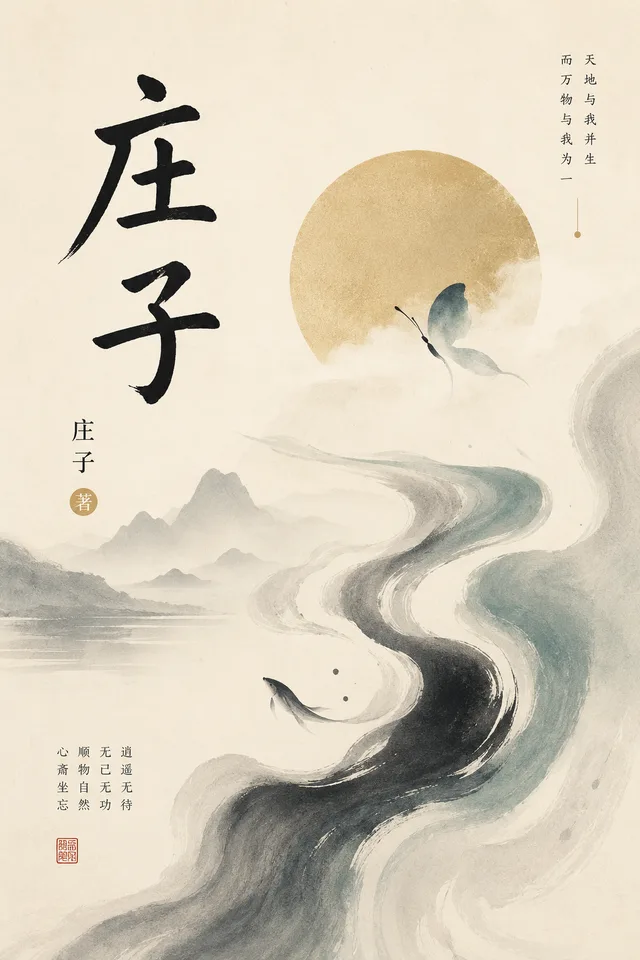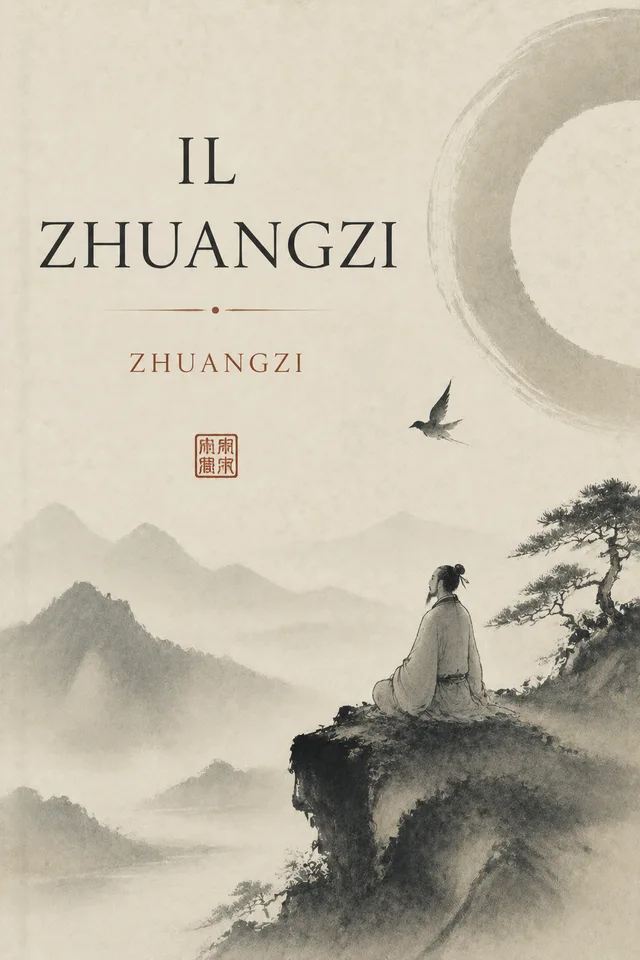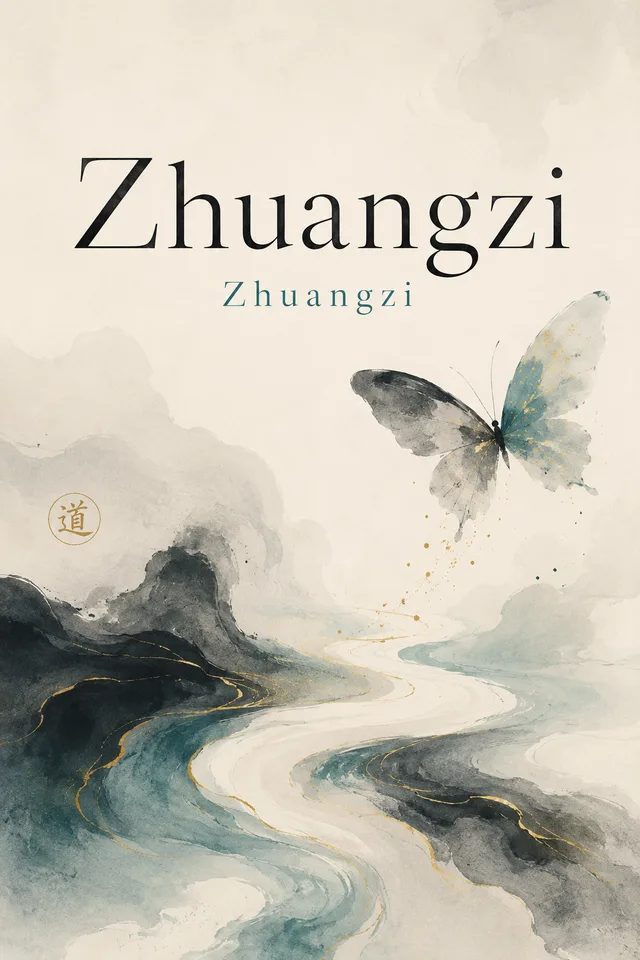
English Edition
Philosophy
Zhuangzi
English BooksWhale Edition by Zhuangzi
Original title: 庄子
An English edition of the Daoist classic on freedom, transformation, language, dreams, usefulness, and wandering beyond fixed distinctions.
- Preview
- A sample from the prepared text
- Formats
- Online reader, EPUB, PDF
- Access
- Library claim
Book introduction
Zhuangzi
Zhuangzi is one of the central works of Daoist philosophy, famous for parables of butterfly dreams, useless trees, skilled artisans, strange transformations, and playful arguments against rigid certainty. This English edition presents its vision of freedom, spontaneity, and perspective in a clean reading format.
BooksWhale edition
How this edition was prepared
This edition is an AI-assisted, human-reviewed translation prepared by BooksWhale. It has been reviewed for readability, formatting, and consistency.
Public domain basis
Why this edition can be shared
Zhuangzi is an ancient Chinese philosophical text traditionally associated with Zhuangzi, who died around 286 BCE. The source text is ancient and public-domain; this English edition is prepared as an AI-assisted, human-reviewed translation from that public-domain Chinese source.
Read preview
A sample from the prepared text
Preview selected from the prepared reader text.
Preview chapterFull textRead preview
Zhuangzi
Zhuangzi
Inner Chapters Free and Easy Wandering
Preview chapterIPreview
In the Northern Sea there is a fish, and its name is Kun. The vastness of Kun—no one knows how many thousand li it measures. It changes and becomes a bird, and its name is Peng. The back of Peng—no one knows how many thousand li it measures; when it rises up and flies, its wings are like clouds on the edge of the sky. This bird, when the sea stirs and the wind rises, migrates to the Southern Sea. That Southern Sea is the natural great lake. The book Qi Xie is a work that records strange and marvelous things. The book Xie says: “When Peng migrates to the Southern Sea, the splashing waves are stirred up for three thousand li, and beating its wings against the whirlwind, it rises straight up ninety thousand li into the high sky. It flies away by riding the great wind of the sixth month.” The wandering vapors like wild horses, the flying dust, and living creatures in motion are all blown and drift along by the wind. The sky is vast and blue—Is that its true color? Is its height and distance without limit? When the great Peng looks down, this is just the kind of scene it sees. If the accumulation of water is not deep and thick, then it has not enough strength to bear a large boat. Pour a cup of water into a hollow before the hall, and a blade of grass placed there may serve as a boat; but place a cup on it, and it will stick fast. This is because the water is shallow while the boat is large. If the strength of the wind is not great, then it has not enough power to bear immense wings. Therefore, when Peng flies ninety thousand li, the thickly accumulated wind lies beneath it; only then does it ride upon the force of the wind, carry the blue sky on its back without obstruction, and then prepare to fly to the Southern Sea. The cicada and the little dove laughed at the great Peng and said, “When I fly with all my strength, I reach an elm or sandalwood tree and stop there. Sometimes, if I cannot fly up, I simply drop to the ground. Why must one fly ninety thousand li to go to the Southern Sea?” One who goes to the outskirts takes three meals’ worth of food and returns the same day, with his belly still full; one who goes a hundred li prepares food for an overnight stay; one who goes a thousand li prepares provisions for three months. What do these two little insects and birds know? Small knowledge cannot be compared with great knowledge; short life cannot be compared with long life. How do we know this is so? The insect born in the morning and dead by evening does not know the span of a month; the cold cicada born in spring and dying in summer, or born in summer and dying in autumn, does not know the span of a year. This is the “small year.” South of Chu there is a spirit tortoise that takes five hundred years as one spring and five hundred years as one autumn; in high antiquity there was a great chun tree that took eight thousand years as one spring and eight thousand years as one autumn. This is the “great year.” Pengzu is still renowned in the world today for his long life, and everyone wishes to compare himself with him. Is this not lamentable? Tang’s question to Ji also contains words like these: Tang asked Ji, “Is there any limit to above and below, to the four directions?” Ji said, “Beyond the limitless, there is again the limitless! North of the barren wastes there is a vast and boundless sea, which is the natural great lake. There is a fish there whose breadth measures several thousand li; no one knows how long it is. Its name is Kun. There is a bird whose name is Peng; Peng’s back is like Mount Tai, and its wings are like clouds on the edge of the sky. Riding the whirlwind, it rises straight up ninety thousand li into the high sky, passes beyond the clouds and vapors, carries the blue sky on its back, and then flies south. The sparrow in the little marsh laughs at it and says, ‘Where is it going? I leap up, and after no more than a few fathoms I come down again; flying about among the weeds and mugwort is the utmost limit of flight. But where in the end is it going?’” This is the distinction between the small and the great. There are some whose talent and intelligence are sufficient to undertake the duties of one office, whose conduct can accord with the inclinations of one village, whose virtue can suit the wishes of one ruler and win the trust of one state. They are self-satisfied, just like the little sparrow. But Song Rongzi could not help laughing at them. Song Rongzi was able to remain unencouraged though the whole world praised him, and untroubled though the whole world condemned him. He could determine the boundary between the inner self and external things, and distinguish the limits of glory and disgrace. That was all! He had no urgent pursuit of worldly reputation. Even so, there was still something he had not yet established. Liezi traveled by riding the wind, light and marvelous, and after fifteen days he returned. As for seeking happiness, he did not appear very eager. Though in this way he could avoid running about, still in the end he had something on which he depended. If one could follow the laws of nature and grasp the changes of the six qi, and thereby wander in the realm of the infinite, what would he have to depend on? Therefore it is said: “The Perfect Man has no self,” “The Spiritual Man has no achievement,” “The Sage has no name.”
Preview chapterIIPreview
Yao yielded the world to Xu You, saying, “The sun and moon have already come forth, and yet the torch fire is not extinguished; to compare its light with the sun and moon—is this not difficult? The timely rain has already fallen, and yet one still carries water to irrigate; for moistening the seedlings, is this not futile? If you, sir, were in office, the world would be settled; yet I still occupy this position. I feel ashamed of myself. Please allow me to yield the world to you.” Xu You said, “You govern the world, and the world is already settled. If I were now to replace you, would I be doing it for fame? Fame is the guest of reality; would I seek the guest? A little bird builds its nest in the deep forest, yet it needs no more than one branch; a mole drinks from the river, yet it needs no more than a bellyful. Please go back! What would I do with the world? Though the cook does not go into the kitchen, the master of ceremonies does not step beyond his place to take over the cooking for him.” Jian Wu asked Lian Shu, saying, “I heard Jie Yu speak. His words were extravagant and without boundary; once he began to discourse, he could not be checked. I was startled by his talk, which was boundless like the Milky Way; it differed too greatly from ordinary principles and did not accord with worldly affairs.” Lian Shu said, “What did he say?” [Jian Wu said:] “He said: ‘On distant Mount Gushe there lives a spiritual man. His skin is as white and pure as ice and snow, and his appearance is as gentle and beautiful as that of a maiden. He does not eat the five grains, but inhales the clear wind and drinks the dew. He rides upon clouds and vapors, drives flying dragons, and wanders beyond the four seas. His spirit is concentrated, so that things suffer no calamity and the grains ripen abundantly.’ I consider this mad talk, and therefore I do not believe it.” Lian Shu said, “Of course! ‘A blind man cannot share in appreciating the beauty of patterns and colors; a deaf man cannot share in enjoying the music of bells and drums. Is it only the body that may be deaf or blind? The mind and intelligence may also be so!’—these words refer precisely to you! As for that spiritual man, his virtue and capacity broadly cover all things and unite them into one body. The human world delights in turmoil; how would he be willing to weary his body and injure his spirit by managing vulgar affairs in the world? Such a person cannot be harmed by external things. If a flood rose to the heavens, it could not drown him; if a great drought melted metal and stone and scorched the earth and mountains, he would not feel hot. From his dust, chaff, and refuse, one could fashion Yao and Shun; how would he be willing to busy himself with vulgar things?” A man of Song went to Yue to sell caps. The people of Yue cut their hair short and tattooed their bodies; they had no use for them. Yao governed the people of the world and settled the affairs within the seas; then he went to distant Mount Gushe, north of the Fen River, to pay respects to four men who had attained the Way, and he could not help becoming dazed and forgetting that he occupied the position of ruler of the world.
Table of contents
Inside this edition
- 01Full text
- 02I
- 03II
- 04III
- 05I
- 06II
- 07III
- 08IV
- 09V
- 10VI
- 11VII
- 12I
- 13II
- 14III
- 15I
- 16II
- 17III
- 18IV
- 19V
- 20VI
- 21VII
- 22I
- 23II
- 24III
- 25IV
- 26V
- 27VI
- 28I
- 29II
- 30III
- 31IV
- 32V
- 33VI
- 34VII
- 35VIII
- 36IX
- 37X
- 38I
- 39II
- 40III
- 41IV
- 42V
- 43VI
- 44I
- 45II
- 46I
- 47II
- 48I
- 49II
- 50I
- 51II
- 52III
- 53IV
- 54V
- 55I
- 56II
- 57III
- 58IV
- 59V
- 60VI
- 61VII
- 62VIII
- 63IX
- 64X
- 65XI
- 66XII
- 67XIII
- 68XIV
- 69XV
- 70I
- 71II
- 72III
- 73IV
- 74V
- 75VI
- 76VII
- 77VIII
- 78I
- 79II
- 80III
- 81IV
- 82V
- 83VI
- 84VII
- 85I
- 86II
- 87III
- 88I
- 89II
- 90III
- 91I
- 92II
- 93III
- 94IV
- 95V
- 96VI
- 97VII
- 98I
- 99II
- 100III
- 101IV
- 102V
- 103VI
- 104VII
- 105I
- 106II
- 107III
- 108IV
- 109V
- 110VI
- 111VII
- 112VIII
- 113IX
- 114X
- 115XI
- 116XII
- 117XIII
- 118I
- 119II
- 120III
- 121IV
- 122V
- 123VI
- 124VII
- 125VIII
- 126IX
- 127I
- 128II
- 129III
- 130IV
- 131V
- 132VI
- 133VII
- 134VIII
- 135IX
- 136X
- 137XI
- 138I
- 139II
- 140III
- 141IV
- 142V
- 143VI
- 144VII
- 145VIII
- 146IX
- 147X
- 148XI
- 149XII
- 150I
- 151II
- 152III
- 153IV
- 154V
- 155VI
- 156VII
- 157VIII
- 158IX
- 159X
- 160XI
- 161XII
- 162I
- 163II
- 164III
- 165IV
- 166V
- 167VI
- 168VII
- 169VIII
- 170IX
- 171X
- 172XI
- 173XII
- 174XIII
- 175XIV
- 176XV
- 177I
- 178II
- 179III
- 180IV
- 181V
- 182VI
- 183VII
- 184VIII
- 185IX
- 186X
- 187XI
- 188I
- 189II
- 190III
- 191IV
- 192V
- 193VI
- 194VII
- 195VIII
- 196IX
- 197X
- 198XI
- 199XII
- 200XIII
- 201I
- 202II
- 203III
- 204IV
- 205V
- 206VI
- 207VII
- 208I
- 209II
- 210III
- 211IV
- 212V
- 213VI
- 214VII
- 215VIII
- 216IX
- 217X
- 218XI
- 219XII
- 220XIII
- 221XIV
- 222XV
- 223I
- 224II
- 225III
- 226I
- 227II
- 228I
- 229II
- 230I
- 231II
- 232III
- 233IV
- 234V
- 235VI
- 236VII
- 237VIII
- 238IX
- 239X
- 240XI
- 241XII
- 242I
- 243II
- 244III
- 245IV
- 246V
- 247VI
- 248VII
- 249VIII