inglés Edición
Política
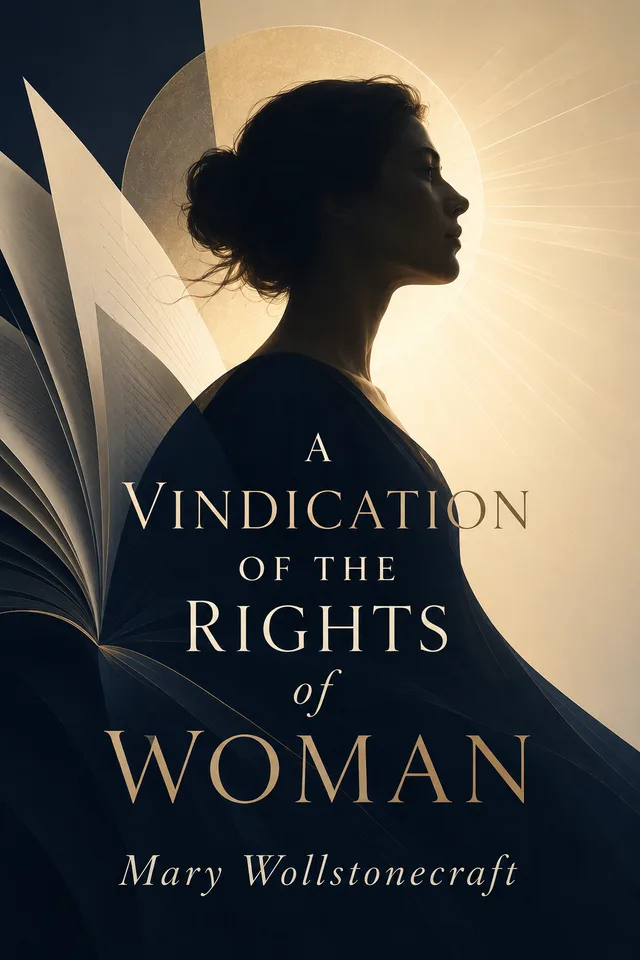
A Vindication of the Rights of Woman
Edición BooksWhale en inglés de Mary Wollstonecraft
A landmark argument for women’s education, reason, equality, and civic dignity.
- Vista previa
- Muestra del texto preparado
- Formatos
- Lector online, EPUB, PDF
- Acceso
- Claim de Biblioteca
Introducción del libro
A Vindication of the Rights of Woman
A Vindication of the Rights of Woman argues for women’s rational education, moral independence, and social equality. Wollstonecraft’s work is a foundational text of feminist political thought.
Edición BooksWhale
Cómo se preparó esta edición
Esta edición se basa en un texto de dominio público y fue preparada por BooksWhale para lectura digital.
Base de dominio público
Por qué puede compartirse
Mary Wollstonecraft died in 1797, and A Vindication of the Rights of Woman was first published in 1792. These dates support the public-domain basis for this English original-language edition.
Leer vista previa
Muestra del texto preparado
Vista previa seleccionada del texto preparado.
Capítulo de vista previaFull textLeer vista previa
A Vindication of the Rights of Woman
WITH STRICTURES ON POLITICAL AND MORAL SUBJECTS, BY MARY WOLLSTONECRAFT.
WITH A BIOGRAPHICAL SKETCH OF THE AUTHOR.
A BRIEF SKETCH OF THE LIFE OF MARY WOLLSTONECRAFT.
M. Wollstonecraft was born in 1759. Her father was so great a wanderer, that the place of her birth is uncertain; she supposed, however, it was London, or Epping Forest: at the latter place she spent the first five years of her life. In early youth she exhibited traces of exquisite sensibility, soundness of understanding, and decision of character; but her father being a despot in his family, and her mother one of his subjects, Mary, derived little benefit from their parental training. She received no literary instructions but such as were to be had in ordinary day schools. Before her sixteenth year she became acquainted with Mr. Clare a clergyman, and Miss Frances Blood; the latter, two years older than herself; who possessing good taste and some knowledge of the fine arts, seems to have given the first impulse to the formation of her character. At the age of nineteen, she left her parents, and resided with a Mrs. Dawson for two years; when she returned to the parental roof to give attention to her mother, whose ill health made her presence necessary. On the death of her mother, Mary bade a final adieu to her father's house, and became the inmate of F. Blood; thus situated, their intimacy increased, and a strong attachment was reciprocated. In 1783 she commenced a day school at Newington green, in conjunction with her friend, F. Blood. At this place she became acquainted with Dr. Price, to whom she became strongly attached; the regard was mutual.
It is said that she became a teacher from motives of benevolence, or rather philanthropy, and during the time she continued in the profession, she gave proof of superior qualification for the performance of its arduous and important duties. Her friend and coadjutor married and removed to Lisbon, in Portugal, where she died of a pulmonary disease; the symptoms of which were visible before her marriage. So true was Mary's attachment to her, that she entrusted her school to the care of others, for the purpose of attending Frances in her closing scene. She aided, as did Dr. Young, in "Stealing Narcissa a grave." Her mind was expanded by this residence in a foreign country, and though clear of religious bigotry before, she took some instructive lessons on the evils of superstition, and intolerance.
On her return she found the school had suffered by her absence, and having previously decided to apply herself to literature, she now resolved to commence. In 1787 she made, or received, proposals from Johnson, a publisher in London, who was already acquainted with her talents as an author. During the three subsequent years, she was actively engaged, more in translating, condensing, and compiling, than in the production of original works. At this time she laboured under much depression of spirits, for the loss of her friend; this rather increased, perhaps, by the publication of "Mary, a novel," which was mostly composed of incidents and reflections connected with their intimacy.
The pecuniary concerns of her father becoming embarrassed, Mary practised a rigid economy in her expenditures, and with her savings was enabled to procure her sisters and brothers situations, to which without her aid, they could not have had access; her father was sustained at length from her funds; she even found means to take under her protection an orphan child.
She had acquired a facility in the arrangement and expression of thoughts, in her avocation of translator, and compiler, which was no doubt of great use to her afterward. It was not long until she had occasion for them. The eminent Burke produced his celebrated "Reflections on the Revolution in France." Mary full of sentiments of liberty, and indignant at what she thought subversive of it, seized her pen and produced the first attack upon that famous work. It succeeded well, for though intemperate and contemptuous, it was vehemently and impetuously eloquent; and though Burke was beloved by the enlightened friends of freedom, they were dissatisfied and disgusted with what they deemed an outrage upon it.
Capítulo de vista previaCHAPTER 1.Vista previa
THE RIGHTS AND INVOLVED DUTIES OF MANKIND CONSIDERED.
In the present state of society, it appears necessary to go back to first principles in search of the most simple truths, and to dispute with some prevailing prejudice every inch of ground. To clear my way, I must be allowed to ask some plain questions, and the answers will probably appear as unequivocal as the axioms on which reasoning is built; though, when entangled with various motives of action, they are formally contradicted, either by the words or conduct of men.
In what does man's pre-eminence over the brute creation consist? The answer is as clear as that a half is less than the whole; in Reason.
What acquirement exalts one being above another? Virtue; we spontaneously reply.
For what purpose were the passions implanted? That man by struggling with them might attain a degree of knowledge denied to the brutes: whispers Experience.
Consequently the perfection of our nature and capability of happiness, must be estimated by the degree of reason, virtue, and knowledge, that distinguish the individual, and direct the laws which bind society: and that from the exercise of reason, knowledge and virtue naturally flow, is equally undeniable, if mankind be viewed collectively.
The rights and duties of man thus simplified, it seems almost impertinent to attempt to illustrate truths that appear so incontrovertible: yet such deeply rooted prejudices have clouded reason, and such spurious qualities have assumed the name of virtues, that it is necessary to pursue the course of reason as it has been perplexed and involved in error, by various adventitious circumstances, comparing the simple axiom with casual deviations.
Men, in general, seem to employ their reason to justify prejudices, which they have imbibed, they cannot trace how, rather than to root them out. The mind must be strong that resolutely forms its own principles; for a kind of intellectual cowardice prevails which makes many men shrink from the task, or only do it by halves. Yet the imperfect conclusions thus drawn, are frequently very plausible, because they are built on partial experience, on just, though narrow, views.
Going back to first principles, vice skulks, with all its native deformity, from close investigation; but a set of shallow reasoners are always exclaiming that these arguments prove too much, and that a measure rotten at the core may be expedient. Thus expediency is continually contrasted with simple principles, till truth is lost in a mist of words, virtue in forms, and knowledge rendered a sounding nothing, by the specious prejudices that assume its name.
That the society is formed in the wisest manner, whose constitution is founded on the nature of man, strikes, in the abstract, every thinking being so forcibly, that it looks like presumption to endeavour to bring forward proofs; though proof must be brought, or the strong hold of prescription will never be forced by reason; yet to urge prescription as an argument to justify the depriving men (or women) of their natural rights, is one of the absurd sophisms which daily insult common sense.
The civilization of the bulk of the people of Europe, is very partial; nay, it may be made a question, whether they have acquired any virtues in exchange for innocence, equivalent to the misery produced by the vices that have been plastered over unsightly ignorance, and the freedom which has been bartered for splendid slavery. The desire of dazzling by riches, the most certain pre-eminence that man can obtain, the pleasure of commanding flattering sycophants, and many other complicated low calculations of doting self-love, have all contributed to overwhelm the mass of mankind, and make liberty a convenient handle for mock patriotism. For whilst rank and titles are held of the utmost importance, before which Genius "must hide its diminished head," it is, with a few exceptions, very unfortunate for a nation when a man of abilities, without rank or property, pushes himself forward to notice. Alas! what unheard of misery have thousands suffered to purchase a cardinal's hat for an intriguing obscure adventurer, who longed to be ranked with princes, or lord it over them by seizing the triple crown!
Capítulo de vista previaCHAPTER 2.Vista previa
THE PREVAILING OPINION OF A SEXUAL CHARACTER DISCUSSED.
To account for, and excuse the tyranny of man, many ingenious arguments have been brought forward to prove, that the two sexes, in the acquirement of virtue, ought to aim at attaining a very different character: or, to speak explicitly, women are not allowed to have sufficient strength of mind to acquire what really deserves the name of virtue. Yet it should seem, allowing them to have souls, that there is but one way appointed by providence to lead MANKIND to either virtue or happiness.
If then women are not a swarm of ephemeron triflers, why should they be kept in ignorance under the specious name of innocence? Men complain, and with reason, of the follies and caprices of our sex, when they do not keenly satirize our headstrong passions and groveling vices. Behold, I should answer, the natural effect of ignorance! The mind will ever be unstable that has only prejudices to rest on, and the current will run with destructive fury when there are no barriers to break its force. Women are told from their infancy, and taught by the example of their mothers, that a little knowledge of human weakness, justly termed cunning, softness of temper, OUTWARD obedience, and a scrupulous attention to a puerile kind of propriety, will obtain for them the protection of man; and should they be beautiful, every thing else is needless, for at least twenty years of their lives.
Thus Milton describes our first frail mother; though when he tells us that women are formed for softness and sweet attractive grace, I cannot comprehend his meaning, unless, in the true Mahometan strain, he meant to deprive us of souls, and insinuate that we were beings only designed by sweet attractive grace, and docile blind obedience, to gratify the senses of man when he can no longer soar on the wing of contemplation.
How grossly do they insult us, who thus advise us only to render ourselves gentle, domestic brutes! For instance, the winning softness, so warmly, and frequently recommended, that governs by obeying. What childish expressions, and how insignificant is the being--can it be an immortal one? who will condescend to govern by such sinister methods! "Certainly," says Lord Bacon, "man is of kin to the beasts by his body: and if he be not of kin to God by his spirit, he is a base and ignoble creature!" Men, indeed, appear to me to act in a very unphilosophical manner, when they try to secure the good conduct of women by attempting to keep them always in a state of childhood. Rousseau was more consistent when he wished to stop the progress of reason in both sexes; for if men eat of the tree of knowledge, women will come in for a taste: but, from the imperfect cultivation which their understandings now receive, they only attain a knowledge of evil.
Children, I grant, should be innocent; but when the epithet is applied to men, or women, it is but a civil term for weakness. For if it be allowed that women were destined by Providence to acquire human virtues, and by the exercise of their understandings, that stability of character which is the firmest ground to rest our future hopes upon, they must be permitted to turn to the fountain of light, and not forced to shape their course by the twinkling of a mere satellite. Milton, I grant, was of a very different opinion; for he only bends to the indefeasible right of beauty, though it would be difficult to render two passages, which I now mean to contrast, consistent: but into similar inconsistencies are great men often led by their senses:--
"To whom thus Eve with perfect beauty adorned: My author and disposer, what thou bidst Unargued I obey; so God ordains; God is thy law, thou mine; to know no more Is woman's happiest knowledge and her praise."
Índice
Dentro de esta edición
- 01Full text
- 02CHAPTER 1.
- 03CHAPTER 2.
- 04CHAPTER 3.
- 05CHAPTER 4.
- 06CHAPTER 5.
- 07SECTION 5.1.
- 08SECTION 5.2.
- 09SECTION 5.3.
- 10SECTION 5.4.
- 11SECTION 5.5.
- 12CHAPTER 6.
- 13CHAPTER 7.
- 14CHAPTER 8.
- 15CHAPTER 9.
- 16CHAPTER 10.
- 17CHAPTER 11.
- 18CHAPTER 12.
- 19CHAPTER 13.
- 20SECTION 13.1.
- 21SECTION 13.2.
- 22SECTION 13.3.
- 23SECTION 13.4.
- 24SECTION 13.5.
- 25SECTION 13.6.
Disponibilidad de idiomas
Otros idiomas
Aún no hay otras ediciones lingüísticas publicadas. Esta sección enlazará las disponibles.
Solicitar otro idioma