inglés Edición
Literatura
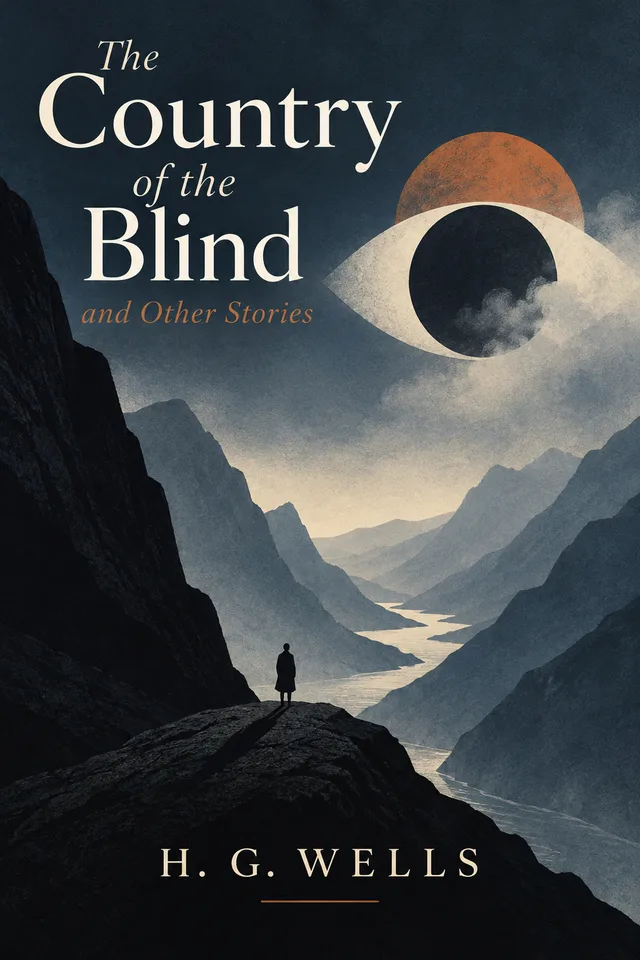
The Country of the Blind and Other Stories
Edición BooksWhale en inglés de H. G. Wells
Speculative tales of social experiments, strange worlds, scientific hazards, and the limits of human certainty.
- Vista previa
- Muestra del texto preparado
- Formatos
- Lector online, EPUB, PDF
- Acceso
- Claim de Biblioteca
Introducción del libro
The Country of the Blind and Other Stories
In The Country of the Blind and Other Stories, H. G. Wells brings together tales of strange discoveries, scientific accidents and unsettling transformations. The title story follows a sighted traveller into an isolated community where blindness is normal. Across the collection, imaginative situations expose the fragility of accepted knowledge and turn curiosity about progress into questions about society, power and human limits.
Edición BooksWhale
Cómo se preparó esta edición
Esta edición se basa en un texto de dominio público y fue preparada por BooksWhale para lectura digital.
Base de dominio público
Por qué puede compartirse
H. G. Wells died in 1946, and this collection was first published in English in 1911.
Leer vista previa
Muestra del texto preparado
Vista previa seleccionada del texto preparado.
Capítulo de vista previaFull textLeer vista previa
The Country of the Blind and Other Stories
H. G. Wells
Capítulo de vista previaINTRODUCTIONVista previa
The enterprise of Messrs. T. Nelson & Sons and the friendly accommodation of Messrs. Macmillan render possible this collection in one cover of all the short stories by me that I care for any one to read again. Except for the two series of linked incidents that make up the bulk of the book called Tales of Space and Time, no short story of mine of the slightest merit is excluded from this volume. Many of very questionable merit find a place; it is an inclusive and not an exclusive gathering. And the task of selection and revision brings home to me with something of the effect of discovery that I was once an industrious writer of short stories, and that I am no longer anything of the kind. I have not written one now for quite a long time, and in the past five or six years I have made scarcely one a year. The bulk of the fifty or sixty tales from which this present three-and-thirty have been chosen dates from the last century. This edition is more definitive than I supposed when first I arranged for it. In the presence of so conclusive an ebb and cessation an almost obituary manner seems justifiable.
I find it a little difficult to disentangle the causes that have restricted the flow of these inventions. It has happened, I remark, to others as well as to myself, and in spite of the kindliest encouragement to continue from editors and readers. There was a time when life bubbled with short stories; they were always coming to the surface of my mind, and it is no deliberate change of will that has thus restricted my production. It is rather, I think, a diversion of attention to more sustained and more exacting forms. It was my friend Mr. C.L. Hind who set that spring going. He urged me to write short stories for the Pall Mall Budget, and persuaded me by his simple and buoyant conviction that I could do what he desired. There existed at the time only the little sketch, "The Jilting of Jane," included in this volume—at least, that is the only tolerable fragment of fiction I find surviving from my pre-Lewis-Hind period. But I set myself, so encouraged, to the experiment of inventing moving and interesting things that could be given vividly in the little space of eight or ten such pages as this, and for a time I found it a very entertaining pursuit indeed. Mr. Hind's indicating finger had shown me an amusing possibility of the mind. I found that, taking almost anything as a starting-point and letting my thoughts play about it, there would presently come out of the darkness, in a manner quite inexplicable, some absurd or vivid little incident more or less relevant to that initial nucleus. Little men in canoes upon sunlit oceans would come floating out of nothingness, incubating the eggs of prehistoric monsters unawares; violent conflicts would break out amidst the flower-beds of suburban gardens; I would discover I was peering into remote and mysterious worlds ruled by an order logical indeed but other than our common sanity.
The 'nineties was a good and stimulating period for a short-story writer. Mr. Kipling had made his astonishing advent with a series of little blue-grey books, whose covers opened like window-shutters to reveal the dusty sun-glare and blazing colours of the East; Mr. Barrie had demonstrated what could be done in a little space through the panes of his Window in Thrums. The National Observer was at the climax of its career of heroic insistence upon lyrical brevity and a vivid finish, and Mr. Frank Harris was not only printing good short stories by other people, but writing still better ones himself in the dignified pages of the Fortnightly Review. Longman's Magazine, too, represented a clientèle of appreciative short-story readers that is now scattered. Then came the generous opportunities of the Yellow Book, and the National Observer died only to give birth to the New Review. No short story of the slightest distinction went for long unrecognised. The sixpenny popular magazines had still to deaden down the conception of what a short story might be to the imaginative limitation of the common reader—and a maximum length of six thousand words. Short stories broke out everywhere. Kipling was writing short stories; Barrie, Stevenson, Frank-Harris; Max Beerbohm wrote at least one perfect one, "The Happy Hypocrite"; Henry James pursued his wonderful and inimitable bent; and among other names that occur to me, like a mixed handful of jewels drawn from a bag, are George Street, Morley Roberts, George Gissing, Ella d'Arcy, Murray Gilchrist, E. Nesbit, Stephen Crane, Joseph Conrad, Edwin Pugh, Jerome K. Jerome, Kenneth Graham, Arthur Morrison, Marriott Watson, George Moore, Grant Allen, George Egerton, Henry Harland, Pett Ridge, W. W. Jacobs (who alone seems inexhaustible). I dare say I could recall as many more names with a little effort. I may be succumbing to the infirmities of middle age, but I do not think the present decade can produce any parallel to this list, or what is more remarkable, that the later achievements in this field of any of the survivors from that time, with the sole exception of Joseph Conrad, can compare with the work they did before 1900. It seems to me this outburst of short stories came not only as a phase in literary development, but also as a phase in the development of the individual writers concerned.
Capítulo de vista previaI. — THE JILTING OF JANE.Vista previa
As I sit writing in my study, I can hear our Jane bumping her way downstairs with a brush and dust-pan. She used in the old days to sing hymn tunes, or the British national song for the time being, to these instruments, but latterly she has been silent and even careful over her work. Time was when I prayed with fervour for such silence, and my wife with sighs for such care, but now they have come we are not so glad as we might have anticipated we should be. Indeed, I would rejoice secretly, though it may be unmanly weakness to admit it, even to hear Jane sing "Daisy," or, by the fracture of any plate but one of Euphemia's best green ones, to learn that the period of brooding has come to an end.
Yet how we longed to hear the last of Jane's young man before we heard the last of him! Jane was always very free with her conversation to my wife, and discoursed admirably in the kitchen on a variety of topics—so well, indeed, that I sometimes left my study door open—our house is a small one—to partake of it. But after William came, it was always William, nothing but William; William this and William that; and when we thought William was worked out and exhausted altogether, then William all over again. The engagement lasted altogether three years; yet how she got introduced to William, and so became thus saturated with him, was always a secret. For my part, I believe it was at the street corner where the Rev. Barnabas Baux used to hold an open-air service after evensong on Sundays. Young Cupids were wont to flit like moths round the paraffin flare of that centre of High Church hymn-singing. I fancy she stood singing hymns there, out of memory and her imagination, instead of coming home to get supper, and William came up beside her and said, "Hello!" "Hello yourself!" she said; and etiquette being satisfied, they proceeded to talk together.
As Euphemia has a reprehensible way of letting her servants talk to her, she soon heard of him. "He is such a respectable young man, ma'am," said Jane, "you don't know." Ignoring the slur cast on her acquaintance, my wife inquired further about this William.
"He is second porter at Maynard's, the draper's," said Jane, "and gets eighteen shillings—nearly a pound—a week, m'm; and when the head porter leaves he will be head porter. His relatives are quite superior people, m'm. Not labouring people at all. His father was a greengrosher, m'm, and had a churnor, and he was bankrup' twice. And one of his sisters is in a Home for the Dying. It will be a very good match for me, m'm," said Jane, "me being an orphan girl."
"Then you are engaged to him?" asked my wife.
"Not engaged, ma'am; but he is saving money to buy a ring—hammyfist."
"Well, Jane, when you are properly engaged to him you may ask him round here on Sunday afternoons, and have tea with him in the kitchen;" for my Euphemia has a motherly conception of her duty towards her maid-servants. And presently the amethystine ring was being worn about the house, even with ostentation, and Jane developed a new way of bringing in the joint so that this gage was evident. The elder Miss Maitland was aggrieved by it, and told my wife that servants ought not to wear rings. But my wife looked it up in Enquire Within and Mrs. Motherly's Book of Household Management, and found no prohibition. So Jane remained with this happiness added to her love.
The treasure of Jane's heart appeared to me to be what respectable people call a very deserving young man. "William, ma'am," said Jane one day suddenly, with ill-concealed complacency, as she counted out the beer bottles, "William, ma'am, is a teetotaller. Yes, m'm; and he don't smoke. Smoking, ma'am," said Jane, as one who reads the heart, "do make such a dust about. Beside the waste of money. And the smell. However, I suppose they got to do it—some of them..."
Índice
Dentro de esta edición
- 01Full text
- 02INTRODUCTION
- 03I. — THE JILTING OF JANE.
- 04II. — THE CONE.
- 05III. — THE STOLEN BACILLUS.
- 06IV. — THE FLOWERING OF THE STRANGE ORCHID.
- 07V. — IN THE AVU OBSERVATORY.
- 08VI. — AEPYORNIS ISLAND.
- 09VII. — THE REMARKABLE CASE OF DAVIDSON'S EYES.
- 10VIII. — THE LORD OF THE DYNAMOS.
- 11IX. — THE MOTH.
- 12X. — THE TREASURE IN THE FOREST.
- 13XI. — THE STORY OF THE LATE MR. ELVESHAM.
- 14XII. — UNDER THE KNIFE.
- 15XIII. — THE SEA RAIDERS.
- 16XIV. — THE OBLITERATED MAN.
- 17XV. — THE PLATTNER STORY.
- 18XVI. — THE RED ROOM.
- 19XVII. — THE PURPLE PILEUS
- 20XVIII. — A SLIP UNDER THE MICROSCOPE.
- 21XIX. — THE CRYSTAL EGG.
- 22XX. — THE STAR.
- 23XXI. — THE MAN WHO COULD WORK MIRACLES.
- 24XXII. — A VISION OF JUDGMENT.
- 25XXIII. — JIMMY GOGGLES THE GOD.
- 26XXIV. — MISS WINCHELSEA'S HEART.
- 27XXV. — A DREAM OF ARMAGEDDON.
- 28XXVI. — THE VALLEY OF SPIDERS.
- 29XXVII. — THE NEW ACCELERATOR.
- 30XXVIII. — THE TRUTH ABOUT PYECRAFT.
- 31XXIX. — THE MAGIC SHOP.
- 32XXX. — THE EMPIRE OF THE ANTS.
- 33XXXI. — THE DOOR IN THE WALL.
- 34XXXII. — THE COUNTRY OF THE BLIND.
- 35XXXIII. — THE BEAUTIFUL SUIT.
Disponibilidad de idiomas
Otros idiomas
Aún no hay otras ediciones lingüísticas publicadas. Esta sección enlazará las disponibles.
Solicitar otro idioma