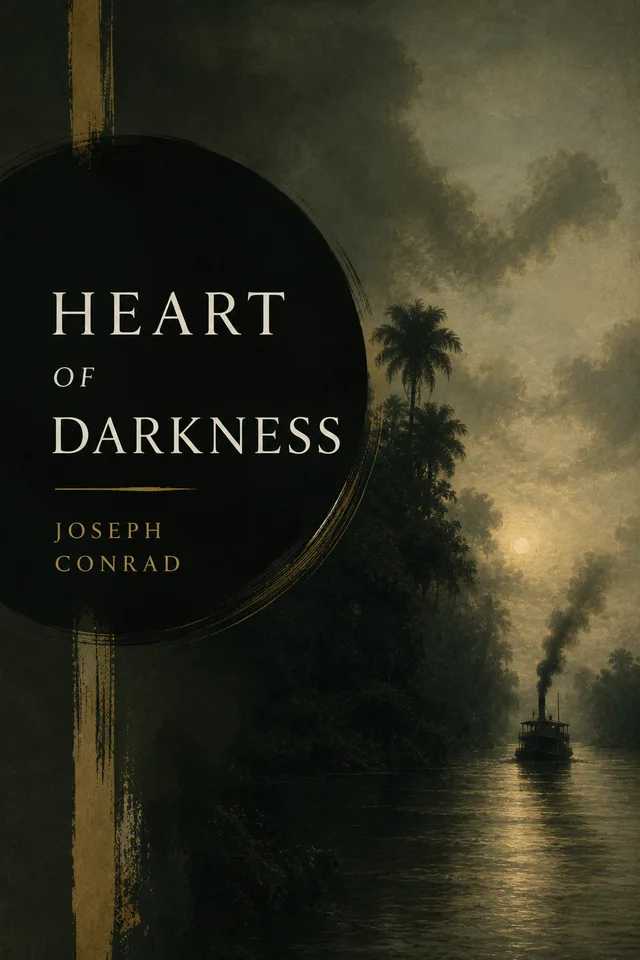
inglés Edición
Literatura
Heart of Darkness
Edición BooksWhale en inglés de Joseph Conrad
A dark novella of empire, violence, narration, and moral uncertainty.
- Vista previa
- Muestra del texto preparado
- Formatos
- Lector online, EPUB, PDF
- Acceso
- Claim de Biblioteca
Introducción del libro
Heart of Darkness
Heart of Darkness follows Marlow’s journey into the Congo and toward Kurtz, exposing imperial violence, psychological darkness, and the instability of civilized ideals.
Edición BooksWhale
Cómo se preparó esta edición
Esta edición se basa en un texto de dominio público y fue preparada por BooksWhale para lectura digital.
Base de dominio público
Por qué puede compartirse
Joseph Conrad died in 1924, and Heart of Darkness was first published in 1899; these dates support the public-domain basis for this English edition.
Leer vista previa
Muestra del texto preparado
Vista previa seleccionada del texto preparado.
Capítulo de vista previaFull textLeer vista previa
Heart of Darkness
Joseph Conrad
Capítulo de vista previaIVista previa
The Nellie, a cruising yawl, swung to her anchor without a flutter of the sails, and was at rest. The flood had made, the wind was nearly calm, and being bound down the river, the only thing for it was to come to and wait for the turn of the tide.
The sea-reach of the Thames stretched before us like the beginning of an interminable waterway. In the offing the sea and the sky were welded together without a joint, and in the luminous space the tanned sails of the barges drifting up with the tide seemed to stand still in red clusters of canvas sharply peaked, with gleams of varnished sprits. A haze rested on the low shores that ran out to sea in vanishing flatness. The air was dark above Gravesend, and farther back still seemed condensed into a mournful gloom, brooding motionless over the biggest, and the greatest, town on earth.
The Director of Companies was our captain and our host. We four affectionately watched his back as he stood in the bows looking to seaward. On the whole river there was nothing that looked half so nautical. He resembled a pilot, which to a seaman is trustworthiness personified. It was difficult to realize his work was not out there in the luminous estuary, but behind him, within the brooding gloom.
Between us there was, as I have already said somewhere, the bond of the sea. Besides holding our hearts together through long periods of separation, it had the effect of making us tolerant of each other’s yarns—and even convictions. The Lawyer—the best of old fellows—had, because of his many years and many virtues, the only cushion on deck, and was lying on the only rug. The Accountant had brought out already a box of dominoes, and was toying architecturally with the bones. Marlow sat cross-legged right aft, leaning against the mizzen-mast. He had sunken cheeks, a yellow complexion, a straight back, an ascetic aspect, and, with his arms dropped, the palms of hands outwards, resembled an idol. The director, satisfied the anchor had good hold, made his way aft and sat down amongst us. We exchanged a few words lazily. Afterwards there was silence on board the yacht. For some reason or other we did not begin that game of dominoes. We felt meditative, and fit for nothing but placid staring. The day was ending in a serenity of still and exquisite brilliance. The water shone pacifically; the sky, without a speck, was a benign immensity of unstained light; the very mist on the Essex marsh was like a gauzy and radiant fabric, hung from the wooded rises inland, and draping the low shores in diaphanous folds. Only the gloom to the west, brooding over the upper reaches, became more sombre every minute, as if angered by the approach of the sun.
And at last, in its curved and imperceptible fall, the sun sank low, and from glowing white changed to a dull red without rays and without heat, as if about to go out suddenly, stricken to death by the touch of that gloom brooding over a crowd of men.
Forthwith a change came over the waters, and the serenity became less brilliant but more profound. The old river in its broad reach rested unruffled at the decline of day, after ages of good service done to the race that peopled its banks, spread out in the tranquil dignity of a waterway leading to the uttermost ends of the earth. We looked at the venerable stream not in the vivid flush of a short day that comes and departs for ever, but in the august light of abiding memories. And indeed nothing is easier for a man who has, as the phrase goes, “followed the sea” with reverence and affection, than to evoke the great spirit of the past upon the lower reaches of the Thames. The tidal current runs to and fro in its unceasing service, crowded with memories of men and ships it had borne to the rest of home or to the battles of the sea. It had known and served all the men of whom the nation is proud, from Sir Francis Drake to Sir John Franklin, knights all, titled and untitled—the great knights-errant of the sea. It had borne all the ships whose names are like jewels flashing in the night of time, from the _Golden Hind_ returning with her rotund flanks full of treasure, to be visited by the Queen’s Highness and thus pass out of the gigantic tale, to the _Erebus_ and _Terror_, bound on other conquests—and that never returned. It had known the ships and the men. They had sailed from Deptford, from Greenwich, from Erith—the adventurers and the settlers; kings’ ships and the ships of men on ’Change; captains, admirals, the dark “interlopers” of the Eastern trade, and the commissioned “generals” of East India fleets. Hunters for gold or pursuers of fame, they all had gone out on that stream, bearing the sword, and often the torch, messengers of the might within the land, bearers of a spark from the sacred fire. What greatness had not floated on the ebb of that river into the mystery of an unknown earth!... The dreams of men, the seed of commonwealths, the germs of empires.
Capítulo de vista previaIIVista previa
“One evening as I was lying flat on the deck of my steamboat, I heard voices approaching—and there were the nephew and the uncle strolling along the bank. I laid my head on my arm again, and had nearly lost myself in a doze, when somebody said in my ear, as it were: ‘I am as harmless as a little child, but I don’t like to be dictated to. Am I the manager—or am I not? I was ordered to send him there. It’s incredible.’ ... I became aware that the two were standing on the shore alongside the forepart of the steamboat, just below my head. I did not move; it did not occur to me to move: I was sleepy. ‘It _is_ unpleasant,’ grunted the uncle. ‘He has asked the Administration to be sent there,’ said the other, ‘with the idea of showing what he could do; and I was instructed accordingly. Look at the influence that man must have. Is it not frightful?’ They both agreed it was frightful, then made several bizarre remarks: ‘Make rain and fine weather—one man—the Council—by the nose’—bits of absurd sentences that got the better of my drowsiness, so that I had pretty near the whole of my wits about me when the uncle said, ‘The climate may do away with this difficulty for you. Is he alone there?’ ‘Yes,’ answered the manager; ‘he sent his assistant down the river with a note to me in these terms: “Clear this poor devil out of the country, and don’t bother sending more of that sort. I had rather be alone than have the kind of men you can dispose of with me.” It was more than a year ago. Can you imagine such impudence!’ ‘Anything since then?’ asked the other hoarsely. ‘Ivory,’ jerked the nephew; ‘lots of it—prime sort—lots—most annoying, from him.’ ‘And with that?’ questioned the heavy rumble. ‘Invoice,’ was the reply fired out, so to speak. Then silence. They had been talking about Kurtz.
“I was broad awake by this time, but, lying perfectly at ease, remained still, having no inducement to change my position. ‘How did that ivory come all this way?’ growled the elder man, who seemed very vexed. The other explained that it had come with a fleet of canoes in charge of an English half-caste clerk Kurtz had with him; that Kurtz had apparently intended to return himself, the station being by that time bare of goods and stores, but after coming three hundred miles, had suddenly decided to go back, which he started to do alone in a small dugout with four paddlers, leaving the half-caste to continue down the river with the ivory. The two fellows there seemed astounded at anybody attempting such a thing. They were at a loss for an adequate motive. As to me, I seemed to see Kurtz for the first time. It was a distinct glimpse: the dugout, four paddling savages, and the lone white man turning his back suddenly on the headquarters, on relief, on thoughts of home—perhaps; setting his face towards the depths of the wilderness, towards his empty and desolate station. I did not know the motive. Perhaps he was just simply a fine fellow who stuck to his work for its own sake. His name, you understand, had not been pronounced once. He was ‘that man.’ The half-caste, who, as far as I could see, had conducted a difficult trip with great prudence and pluck, was invariably alluded to as ‘that scoundrel.’ The ‘scoundrel’ had reported that the ‘man’ had been very ill—had recovered imperfectly.... The two below me moved away then a few paces, and strolled back and forth at some little distance. I heard: ‘Military post—doctor—two hundred miles—quite alone now—unavoidable delays—nine months—no news—strange rumours.’ They approached again, just as the manager was saying, ‘No one, as far as I know, unless a species of wandering trader—a pestilential fellow, snapping ivory from the natives.’ Who was it they were talking about now? I gathered in snatches that this was some man supposed to be in Kurtz’s district, and of whom the manager did not approve. ‘We will not be free from unfair competition till one of these fellows is hanged for an example,’ he said. ‘Certainly,’ grunted the other; ‘get him hanged! Why not? Anything—anything can be done in this country. That’s what I say; nobody here, you understand, _here_, can endanger your position. And why? You stand the climate—you outlast them all. The danger is in Europe; but there before I left I took care to—’ They moved off and whispered, then their voices rose again. ‘The extraordinary series of delays is not my fault. I did my best.’ The fat man sighed. ‘Very sad.’ ‘And the pestiferous absurdity of his talk,’ continued the other; ‘he bothered me enough when he was here. “Each station should be like a beacon on the road towards better things, a centre for trade of course, but also for humanizing, improving, instructing.” Conceive you—that ass! And he wants to be manager! No, it’s—’ Here he got choked by excessive indignation, and I lifted my head the least bit. I was surprised to see how near they were—right under me. I could have spat upon their hats. They were looking on the ground, absorbed in thought. The manager was switching his leg with a slender twig: his sagacious relative lifted his head. ‘You have been well since you came out this time?’ he asked. The other gave a start. ‘Who? I? Oh! Like a charm—like a charm. But the rest—oh, my goodness! All sick. They die so quick, too, that I haven’t the time to send them out of the country—it’s incredible!’ ‘Hm’m. Just so,’ grunted the uncle. ‘Ah! my boy, trust to this—I say, trust to this.’ I saw him extend his short flipper of an arm for a gesture that took in the forest, the creek, the mud, the river—seemed to beckon with a dishonouring flourish before the sunlit face of the land a treacherous appeal to the lurking death, to the hidden evil, to the profound darkness of its heart. It was so startling that I leaped to my feet and looked back at the edge of the forest, as though I had expected an answer of some sort to that black display of confidence. You know the foolish notions that come to one sometimes. The high stillness confronted these two figures with its ominous patience, waiting for the passing away of a fantastic invasion.
Índice
Dentro de esta edición
- 01Full text
- 02I
- 03II
- 04III
Disponibilidad de idiomas
Otros idiomas

francés
francés Edición
Au cœur des ténèbres
Joseph Conrad · Literatura
Le récit sombre de Conrad sur le fleuve Congo, l’empire, Kurtz et les ténèbres morales de la modernité.

alemán
alemán Edición
Das Herz der Finsternis
Joseph Conrad · Literatura
Conrads Kongo-Erzählung in deutscher Übersetzung über Kolonialgewalt, Elfenbeinhandel und moralische Finsternis.

italiano
italiano Edición
Cuore di tenebra
Joseph Conrad · Literatura
Un viaggio lungo il Congo diventa un’indagine oscura sull’impero, sulla violenza, sulle illusioni morali e sui racconti europei della civiltà.