inglés Edición
Literatura
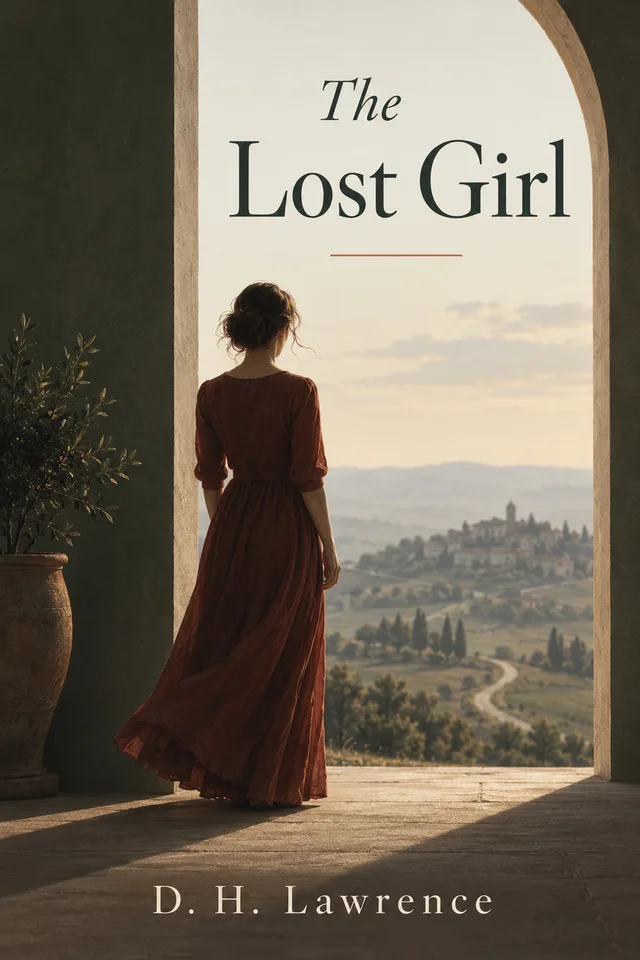
The Lost Girl
Edición BooksWhale en inglés de D. H. Lawrence
A young woman leaves a sheltered life and enters a world of travel, desire, work, and uncertain independence.
- Vista previa
- Muestra del texto preparado
- Formatos
- Lector online, EPUB, PDF
- Acceso
- Claim de Biblioteca
Introducción del libro
The Lost Girl
Alvina Houghton grows restless within the limits of a respectable English family and searches for a life beyond convention. D. H. Lawrence follows her through theatre, travel and an uncertain romance, exploring the conflict between desire and social expectation. The novel places a woman’s search for independence within a world of economic insecurity, changing loyalties and unfamiliar possibilities.
Edición BooksWhale
Cómo se preparó esta edición
Esta edición se basa en un texto de dominio público y fue preparada por BooksWhale para lectura digital.
Base de dominio público
Por qué puede compartirse
D. H. Lawrence died in 1930, and The Lost Girl was first published in English in 1920.
Leer vista previa
Muestra del texto preparado
Vista previa seleccionada del texto preparado.
Capítulo de vista previaFull textLeer vista previa
The Lost Girl
D. H. Lawrence
Capítulo de vista previaCHAPTER I THE DECLINE OF MANCHESTER HOUSEVista previa
Take a mining townlet like Woodhouse, with a population of ten thousand people, and three generations behind it. This space of three generations argues a certain well-established society. The old “County” has fled from the sight of so much disembowelled coal, to flourish on mineral rights in regions still idyllic. Remains one great and inaccessible magnate, the local coal owner: three generations old, and clambering on the bottom step of the “County,” kicking off the mass below. Rule him out.
A well established society in Woodhouse, full of fine shades, ranging from the dark of coal-dust to grit of stone-mason and sawdust of timber-merchant, through the lustre of lard and butter and meat, to the perfume of the chemist and the disinfectant of the doctor, on to the serene gold-tarnish of bank-managers, cashiers for the firm, clergymen and such-like, as far as the automobile refulgence of the general-manager of all the collieries. Here the ne plus ultra. The general manager lives in the shrubberied seclusion of the so-called Manor. The genuine Hall, abandoned by the “County,” has been taken over as offices by the firm.
Here we are then: a vast substratum of colliers; a thick sprinkling of tradespeople intermingled with small employers of labour and diversified by elementary schoolmasters and nonconformist clergy; a higher layer of bank-managers, rich millers and well-to-do ironmasters, episcopal clergy and the managers of collieries, then the rich and sticky cherry of the local coal-owner glistening over all.
Such the complicated social system of a small industrial town in the Midlands of England, in this year of grace 1920. But let us go back a little. Such it was in the last calm year of plenty, 1913.
A calm year of plenty. But one chronic and dreary malady: that of the odd women. Why, in the name of all prosperity, should every class but the lowest in such a society hang overburdened with Dead Sea fruit of odd women, unmarried, unmarriageable women, called old maids? Why is it that every tradesman, every school-master, every bank-manager, and every clergyman produces one, two, three or more old maids? Do the middle-classes, particularly the lower middle-classes, give birth to more girls than boys? Or do the lower middle-class men assiduously climb up or down, in marriage, thus leaving their true partners stranded? Or are middle-class women very squeamish in their choice of husbands?
However it be, it is a tragedy. Or perhaps it is not.
Perhaps these unmarried women of the middle-classes are the famous sexless-workers of our ant-industrial society, of which we hear so much. Perhaps all they lack is an occupation: in short, a job. But perhaps we might hear their own opinion, before we lay the law down.
In Woodhouse, there was a terrible crop of old maids among the “nobs,” the tradespeople and the clergy. The whole town of women, colliers’ wives and all, held its breath as it saw a chance of one of these daughters of comfort and woe getting off. They flocked to the well-to-do weddings with an intoxication of relief. For let class-jealousy be what it may, a woman hates to see another woman left stalely on the shelf, without a chance. They all wanted the middle-class girls to find husbands. Every one wanted it, including the girls themselves. Hence the dismalness.
Now James Houghton had only one child: his daughter Alvina. Surely Alvina Houghton—
But let us retreat to the early eighties, when Alvina was a baby: or even further back, to the palmy days of James Houghton. In his palmy days, James Houghton was crême de la crême of Woodhouse society. The house of Houghton had always been well-to-do: tradespeople, we must admit; but after a few generations of affluence, tradespeople acquire a distinct cachet. Now James Houghton, at the age of twenty-eight, inherited a splendid business in Manchester goods, in Woodhouse. He was a tall, thin, elegant young man with side-whiskers, genuinely refined, somewhat in the Bulwer style. He had a taste for elegant conversation and elegant literature and elegant Christianity: a tall, thin, brittle young man, rather fluttering in his manner, full of facile ideas, and with a beautiful speaking voice: most beautiful. Withal, of course, a tradesman. He courted a small, dark woman, older than himself, daughter of a Derbyshire squire. He expected to get at least ten thousand pounds with her. In which he was disappointed, for he got only eight hundred. Being of a romantic-commercial nature, he never forgave her, but always treated her with the most elegant courtesy. To seehim peel and prepare an apple for her was an exquisite sight. But that peeled and quartered apple was her portion. This elegant Adam of commerce gave Eve her own back, nicely cored, and had no more to do with her. Meanwhile Alvina was born.
Capítulo de vista previaCHAPTER II THE RISE OF ALVINA HOUGHTONVista previa
The heroine of this story is Alvina Houghton. If we leave her out of the first chapter of her own story it is because, during the first twenty-five years of her life, she really was left out of count, or so overshadowed as to be negligible. She and her mother were the phantom passengers in the ship of James Houghton’s fortunes.
In Manchester House, every voice lowered its tone. And so from the first Alvina spoke with a quiet, refined, almost convent voice. She was a thin child with delicate limbs and face, and wide, grey-blue, ironic eyes. Even as a small girl she had that odd ironic tilt of the eyelids which gave her a look as if she were hanging back in mockery. If she were, she was quite unaware of it, for under Miss Frost’s care she received no education in irony or mockery. Miss Frost was straightforward, good-humoured, and a little earnest. Consequently Alvina, or Vina as she was called, understood only the explicit mode of good-humoured straightforwardness.
It was doubtful which shadow was greater over the child: that of Manchester House, gloomy and a little sinister, or that of Miss Frost, benevolent and protective. Sufficient that the girl herself worshipped Miss Frost: or believed she did.
Alvina never went to school. She had her lessons from her beloved governess, she worked at the piano, she took her walks, and for social life she went to the Congregational Chapel, and to the functions connected with the chapel. While she was little, she went to Sunday School twice and to Chapel once on Sundays. Then occasionally there was a magic lantern or a penny reading, to which Miss Frost accompanied her. As she grew older she entered the choir at chapel, she attended Christian Endeavour and P.S.A., and the Literary Society on Monday evenings. Chapel provided her with a whole social activity, in the course of which she met certain groups of people, made certain friends, found opportunity for strolls into the country and jaunts to the local entertainments. Over and above this, every Thursday evening she went to the subscription library to change the week’s supply of books, and there again she met friends and acquaintances. It is hard to overestimate the value of church or chapel—but particularly chapel—as a social institution, in places like Woodhouse. The Congregational Chapel provided Alvina with a whole outer life, lacking which she would have been poor indeed. She was not particularly religious by inclination. Perhaps her father’s beautiful prayers put her off. So she neither questioned nor accepted, but just let be.
She grew up a slim girl, rather distinguished in appearance, with a slender face, a fine, slightly arched nose, and beautiful grey-blue eyes over which the lids tilted with a very odd, sardonic tilt. The sardonic quality was, however, quite in abeyance. She was ladylike, not vehement at all. In the street her walk had a delicate, lingering motion, her face looked still. In conversation she had rather a quick, hurried manner, with intervals of well-bred repose and attention. Her voice was like her father’s, flexible and curiously attractive.
Sometimes, however, she would have fits of boisterous hilarity, not quite natural, with a strange note half pathetic, half jeering. Her father tended to a supercilious, sneering tone. In Vina it came out in mad bursts of hilarious jeering. This made Miss Frost uneasy. She would watch the girl’s strange face, that could take on a gargoyle look. She would see the eyes rolling strangely under sardonic eyelids, and then Miss Frost would feel that never, never had she known anything so utterly alien and incomprehensible and unsympathetic as her own beloved Vina. For twenty years the strong, protective governess reared and tended her lamb, her dove, only to see the lamb open a wolf’s mouth, to hear the dove utter the wild cackle of a daw or a magpie, a strange sound of derision. At such times Miss Frost’s heart went cold within her. She dared not realize. And she chid and checked her ward, restored her to the usual impulsive, affectionate demureness. Then she dismissed the whole matter. It was just an accidental aberration on the girl’s part from her own true nature. Miss Frost taught Alvina thoroughly the qualities of her own true nature, and Alvina believed what she was taught. She remained for twenty years the demure, refined creature of her governess’ desire. But there was an odd, derisive look at the back of her eyes, a look of old knowledge and deliberate derision. She herself was unconscious of it. But it was there. And this it was, perhaps, that scared away the young men.
Índice
Dentro de esta edición
- 01Full text
- 02CHAPTER I THE DECLINE OF MANCHESTER HOUSE
- 03CHAPTER II THE RISE OF ALVINA HOUGHTON
- 04CHAPTER III THE MATERNITY NURSE
- 05CHAPTER IV TWO WOMEN DIE
- 06CHAPTER V THE BEAU
- 07CHAPTER VI HOUGHTON’S LAST ENDEAVOUR
- 08CHAPTER VII NATCHA-KEE-TAWARA
- 09CHAPTER VIII CICCIO
- 10CHAPTER IX ALVINA BECOMES ALLAYE
- 11CHAPTER X THE FALL OF MANCHESTER HOUSE
- 12CHAPTER XI HONOURABLE ENGAGEMENT
- 13CHAPTER XII ALLAYE ALSO IS ENGAGED
- 14CHAPTER XIII THE WEDDED WIFE
- 15CHAPTER XIV THE JOURNEY ACROSS
- 16CHAPTER XV THE PLACE CALLED CALIFANO
- 17CHAPTER XVI SUSPENSE
Disponibilidad de idiomas
Otros idiomas
Aún no hay otras ediciones lingüísticas publicadas. Esta sección enlazará las disponibles.
Solicitar otro idioma