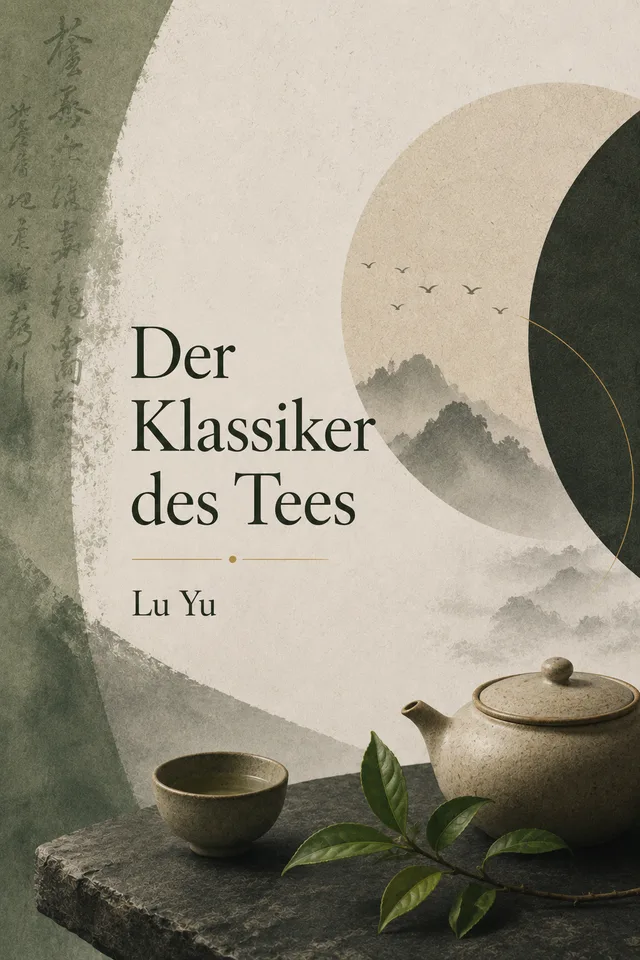
alemán Edición
Educación
Der Klassiker des Tees
Edición BooksWhale en alemán de Lu Yu
Título original: 茶经
Ein klassischer Text über Tee, Geräte, Zubereitung, Geschmack und Teekultur.
- Vista previa
- Muestra del texto preparado
- Formatos
- Lector online, EPUB, PDF
- Acceso
- Claim de Biblioteca
Introducción del libro
Der Klassiker des Tees
Der Klassiker des Tees stellt Lu Yus Gedanken zu Herkunft, Werkzeugen, Zubereitung, Kochen, Servieren und Bewertung von Tee vor. Diese deutsche Ausgabe macht einen Grundtext der chinesischen Teekultur zugänglich.
Edición BooksWhale
Cómo se preparó esta edición
Esta edición es una traducción asistida por IA y revisada por personas, preparada por BooksWhale para legibilidad, formato y coherencia.
Base de dominio público
Por qué puede compartirse
Der Klassiker des Tees ist ein chinesischer Text des 8. Jahrhunderts von Lu Yu. Diese deutsche Ausgabe wird als KI-unterstützte Übersetzung mit menschlicher Prüfung aus dem alten chinesischen gemeinfreien Text vorbereitet.
Leer vista previa
Muestra del texto preparado
Vista previa seleccionada del texto preparado.
Capítulo de vista previaFull textLeer vista previa
The Classic of Tea
Lu Yu
Capítulo de vista previaChapter 1: OriginVista previa
Tea is a fine woody plant of the southern regions. Its tree may be one chi high, two chi high, or even several tens of chi high. In the area of Bashan and the gorges and rivers, that is, present-day eastern Chongqing and western Hubei, there are large tea trees so thick that two people are needed to encircle them with their arms; their branches must be cut down before the leaves can be picked. The shape of the tea tree is like the gualu tree; its leaves are like gardenia leaves; its flowers are like white wild roses; its seeds are like palm seeds; its calyx is like the calyx of the clove; its roots are like the roots of the walnut tree. The gualu tree grows around Guangzhou; its leaves resemble tea leaves, and its taste is extremely bitter and astringent. The binglu belongs to the fan-palm type of plants, and its seeds resemble tea seeds. Both walnut trees and tea trees send their roots deep underground; when they encounter a hard layer of soil, the shoots begin to sprout and grow upward.
As for the character for tea, judging from its written form and radical, some forms belong to the grass radical, some to the wood radical, and some to both the grass and wood radicals. The form belonging to the grass radical should be written “茶,” which is recorded in Kaiyuan Wenzi Yinyi. The form belonging to the wood radical should be written “𣗪,” which appears in Bencao. The form belonging to both the grass and wood radicals is written “荼,” which appears in Erya.
Tea has several names: first, cha; second, jia; third, she; fourth, ming; fifth, chuan. The Duke of Zhou said, “Jia is bitter tu.” Yang Xiong said, “The people of southwestern Sichuan call tea she.” Guo Pu said, “What is picked early is called tu; what is picked late is called ming; some also call it chuan.”
As for the soil in which tea trees grow, the finest tea grows in accumulated soil among mountain rocks; medium tea grows in sandy loam; inferior tea grows in yellow clay. In general, when planting tea, if one sows seeds but does not tread the soil firm, or if one plants by transplanting, it rarely grows luxuriantly. Tea should be planted by the method used for melons; generally, after three years of planting, the leaves may be picked. Wild tea leaves are of good quality; those artificially cultivated in gardens and fields are inferior. For tea trees on sunny slopes shaded by forest trees, purple leaves are good and green leaves are poor; plump shoots like bamboo shoots are good, while new shoots spread out like tooth tablets are poor; shoots whose leaf edges curl backward are good, while those whose leaf edges are completely flat are poor. Tea trees growing on shady slopes or in valleys must not be picked. Because their nature is stagnant and congealed, drinking them will cause illnesses of abdominal lumps.
The function of tea is cold and cooling in nature and flavor. As a drink, it is most suitable for people of upright conduct who possess the virtues of thrift and humility. If people suffer from fever and thirst, chest oppression, headache, dry and irritated eyes, tired limbs, or stiff joints, drinking four or five mouthfuls of tea will have an effect comparable to the finest beverages, tihu and sweet dew.
If tea leaves are not picked in season, if their manufacture is not sufficiently refined, or if they are mixed with wild grasses and spoiled leaves, drinking them will cause illness. The harm that tea may do to people is like that of ginseng. Superior ginseng is produced in Shangdang; medium ginseng is produced in Baekje and Silla; inferior ginseng is produced in Goryeo. The ginseng produced in Zezhou, Yizhou, Youzhou, and Tanzhou has no therapeutic effect when used as medicine; how much less, then, those ginsengs inferior even to these? If one mistakenly takes jiní for ginseng, various illnesses will not be cured. If one understands the harm ginseng may do to people, the harm tea may do to people can also be understood.
Capítulo de vista previaChapter 2: ImplementsVista previa
Ying, pronounced with the fanqie jia-zhui, is also called lan, long, or ju. It is woven of bamboo and has a capacity of five sheng, or one dou, two dou, or three dou. Tea gatherers carry it on their backs when picking tea. Ying is pronounced ying in the Hanshu, where there is the saying, “A ying full of gold is not as good as one classic.” Yan Shigu comments: “Ying is a bamboo vessel with a capacity of four sheng.”
As for the stove, do not use one with a chimney, so that the force of the fire may be concentrated at the bottom of the pot. As for the cauldron, use one whose mouth turns outward and has a rim.
The zeng steamer may be made of wood or pottery. Its waist must not protrude; seal and plaster it with clay. Inside the steamer, place a bamboo basket as a water-separating device, and tie it with bamboo strips so that the basket can conveniently be put into and lifted out of the steamer. When steaming begins, put the tea leaves into the bamboo basket; when they are steamed through, pour the leaves out of the basket. When the water in the pot is nearly boiled dry, add water into it from the steamer. The waist of the zeng should not be bound round but sealed with clay. One should also use forked elm wood to make a three-pronged fork-like implement for shaking loose the steamed young shoots and leaves, so that the tea juice will not be lost.
The pestle and mortar, also called a dui, are best when they have been used frequently.
The gui, also called a mold or juan, is made of iron. It may be round, square, or flower-shaped.
The cheng, also called a stand or chopping block, is made of stone. If not, bury half a locust tree or mulberry tree trunk in the ground so that it cannot shake.
The yan, also called yi, may be made of oiled silk, or of a worn-out raincoat or unlined garment. Put the yan on the cheng, then put the gui on the yan, and the tea cakes can be pressed. Once pressed into cakes, they can easily be lifted up, and another one can be made.
Bili, pronounced pa-li, is also called yingzi or panglang. Use two small bamboo poles three chi long to make an implement with a body two chi five cun long, handles five cun long, and a width of two chi. It is woven with bamboo strips into a square-meshed bamboo tray, just like the soil sieve used by vegetable growers, and is used for placing newly made tea cakes.
Qi is also called an awl-knife. Its handle is made of solid wood, and it is used to pierce holes in tea cakes.
Pu is also called a whip. It is made of bamboo strips and is used to string tea cakes together for transport.
The bei roasting pit is dug in the ground, two chi deep, two chi five cun wide, and one zhang long. Low walls are built on it, two chi high, and plastered with clay.
The guan is shaved from bamboo, two chi five cun long, and is used to thread tea cakes together when roasting tea.
The peng, also called a rack, is made of wood and placed over the roasting pit. It is divided into two tiers, each one chi high, and is used to bake tea cakes. When the tea cakes are half dry, they are placed on the lower tier; when fully dry, they are moved up to the upper tier.
Chuan, pronounced chuan, is made in Jiangdong and Huainan by splitting bamboo. In the Bachuan and Xiashan regions, it is made from the bark of the paper mulberry tree. In Jiangdong, a string of tea weighing one jin is called an upper chuan; one weighing half a jin is called a middle chuan; one weighing four or five liang, under the sixteen-liang system, is called a small chuan. In the region within the gorges, one hundred and twenty jin is called an upper chuan, eighty jin a middle chuan, and fifty jin a small chuan. The character chuan was originally written with the character “钏,” as in hairpins and bracelets, or as the word for stringing together. Now it is different. Like the five characters mo, shan, tan, zuan, and feng, when written in prose it has the level tone and functions as a verb; when it denotes a noun, it should be read in the departing tone, and its meaning should be understood according to the departing tone. Its written form is therefore “穿.”
Índice
Dentro de esta edición
- 01Full text
- 02Chapter 1: Origin
- 03Chapter 2: Implements
- 04Chapter 3: Manufacture
- 05Chapter 4: Utensils
- 06The Wind Stove and Ash Tray
- 07Ju Basket
- 08Charcoal Poker
- 09Fire Tongs
- 10Fu Cauldron
- 11Folding Stand
- 12Tongs
- 13Paper Pouch
- 14Grinder and Powder Brush
- 15Sieve Box
- 16Measure
- 17Water Vessel
- 18Water-Filtering Bag
- 19Ladle
- 20Bamboo Stirrer
- 21Salt Casket and Scoop
- 22Cooked-Water Basin
- 23Bowls
- 24Basket and Paper Cloth
- 25Brush
- 26Waste-Water Vessel
- 27Dregs Vessel
- 28Cloth
- 29Utensil Rack
- 30General Basket
- 31Chapter 5: Boiling
- 32Chapter 6: Drinking
- 33Chapter 7: Events
- 34Chapter 8: Producing Areas
- 35Chapter 9: Omissions
- 36Chapter 10: Illustrations
Disponibilidad de idiomas
Otros idiomas
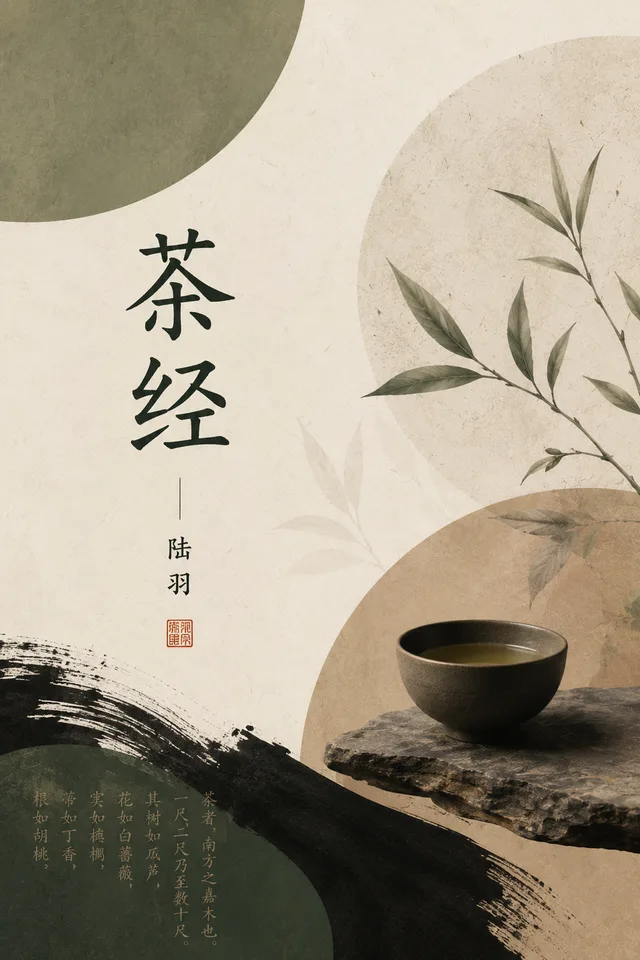
chino
chino Edición
茶经
Lu Yu · Educación
中国茶文化的奠基文本,论述茶事、器具、煮饮与品鉴。
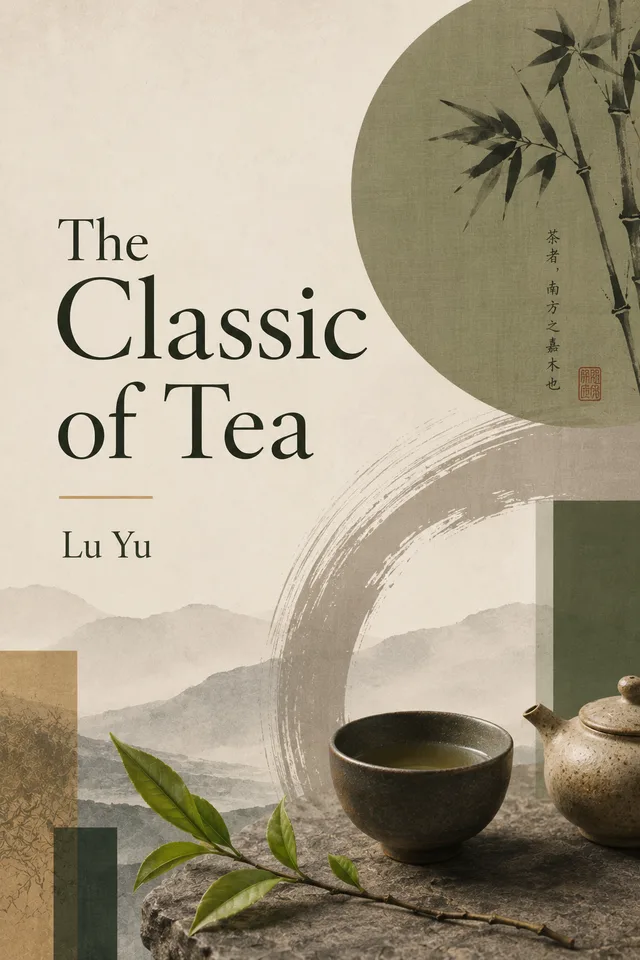
inglés
inglés Edición
The Classic of Tea
Lu Yu · Educación
A concise classic on tea, utensils, preparation, taste, and the culture of drinking tea.
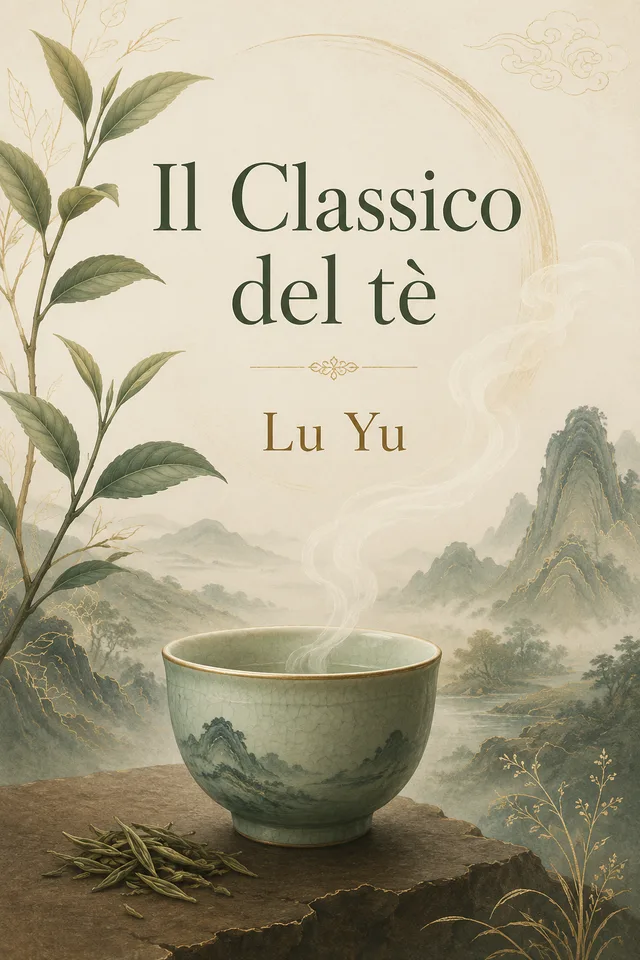
italiano
italiano Edición
Il Classico del tè
Lu Yu · Educación
Versione italiana del trattato cinese sul tè, dalla coltivazione agli utensili e alla degustazione.
portugués
portugués Edición
O Clássico do Chá
Lu Yu · Educación
Um clássico chinês sobre chá, utensílios, água, fervura, preparo, serviço e apreciação.