inglés Edición
Historia
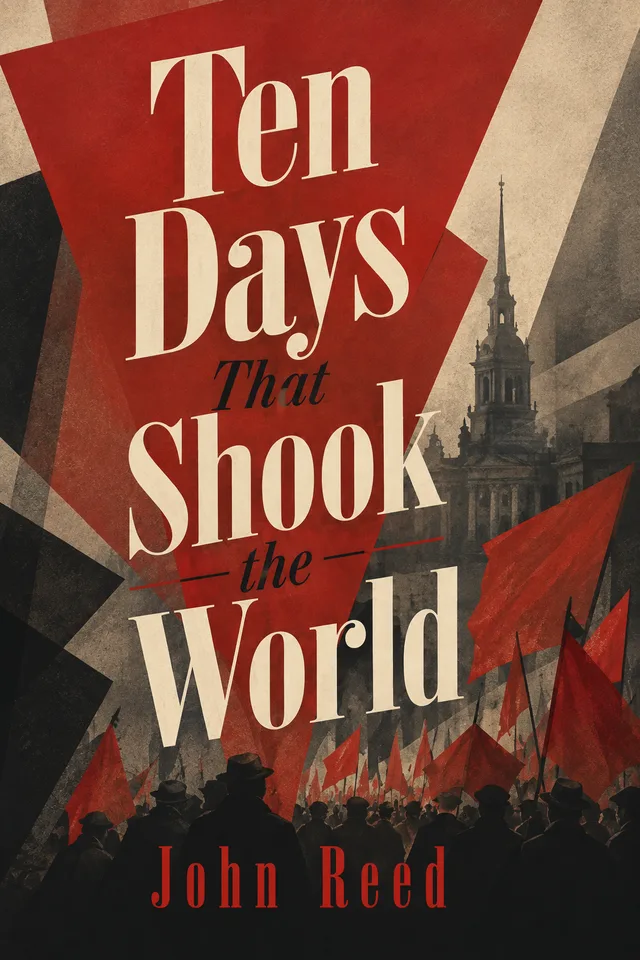
Ten Days That Shook the World
Edición BooksWhale en inglés de John Reed
John Reed’s vivid eyewitness account of the Russian Revolution, crowded with speeches, street scenes, and political drama.
- Vista previa
- Muestra del texto preparado
- Formatos
- Lector online, EPUB, PDF
- Acceso
- Claim de Biblioteca
Introducción del libro
Ten Days That Shook the World
Written by American journalist John Reed after witnessing the October Revolution, Ten Days That Shook the World combines reportage, manifesto, and historical narrative. It remains one of the most influential English-language accounts of revolutionary Petrograd and the birth of Soviet power.
Edición BooksWhale
Cómo se preparó esta edición
Esta edición se basa en un texto de dominio público y fue preparada por BooksWhale para lectura digital.
Base de dominio público
Por qué puede compartirse
John Reed died in 1920, and this work was first published in 1919. These dates support the public-domain basis for this English edition.
Leer vista previa
Muestra del texto preparado
Vista previa seleccionada del texto preparado.
Capítulo de vista previaPart 1Leer vista previa
Ten Days That Shook the World
John Reed
[Redactor's Note: The book is composed of text, footnotes, and appendices. The footnotes are included at the end of each chapter, while the Appendix No. and Section are referred to in the text in parentheses, the Appendices following the book text. There are 17 graphic figures in the text. These are indicated by a reference to the page number in the original book.]
Ten Days That Shook the World
by John Reed
Preface Notes and Explanations Chapter 1. Background Chapter 2. The Coming Storm Chapter 3. On the Eve Chapter 4. The Fall of the Provisional Government Chapter 5. Plunging Ahead Chapter 6. The Committee for Salvation Chapter 7. The Revolutionary Front Chapter 8. Counter-Revolution Chapter 9. Victory Chapter 10. Moscow Chapter 11. The Conquest of Power Chapter 12. The Peasants' Congress Appendices I - XII
Preface
This book is a slice of intensified history—history as I saw it. It does not pretend to be anything but a detailed account of the November Revolution, when the Bolsheviki, at the head of the workers and soldiers, seized the state power of Russia and placed it in the hands of the Soviets.
Naturally most of it deals with "Red Petrograd," the capital and heart of the insurrection. But the reader must realize that what took place in Petrograd was almost exactly duplicated, with greater or lesser intensity, at different intervals of time, all over Russia.
In this book, the first of several which I am writing, I must confine myself to a chronicle of those events which I myself observed and experienced, and those supported by reliable evidence; preceded by two chapters briefly outlining the background and causes of the November Revolution. I am aware that these two chapters make difficult reading, but they are essential to an understanding of what follows.
Many questions will suggest themselves to the mind of the reader. What is Bolshevism? What kind of a governmental structure did the Bolsheviki set up? If the Bolsheviki championed the Constituent Assembly before the November Revolution, why did they disperse it by force of arms afterward? And if the bourgeoisie opposed the Constituent Assembly until the danger of Bolshevism became apparent, why did they champion it afterward?
These and many other questions cannot be answered here. In another volume, "Kornilov to Brest-Litovsk," I trace the course of the Revolution up to and including the German peace. There I explain the origin and functions of the Revolutionary organisations, the evolution of popular sentiment, the dissolution of the Constituent Assembly, the structure of the Soviet state, and the course and outcome of the Brest-Litovsk negotiations….
In considering the rise of the Bolsheviki it is necessary to understand that Russian economic life and the Russian army were not disorganised on November 7th, 1917, but many months before, as the logical result of a process which began as far back as 1915. The corrupt reactionaries in control of the Tsar's Court deliberately undertook to wreck Russia in order to make a separate peace with Germany. The lack of arms on the front, which had caused the great retreat of the summer of 1915, the lack of food in the army and in the great cities, the break-down of manufactures and transportation in 1916—all these we know now were part of a gigantic campaign of sabotage. This was halted just in time by the March Revolution.
For the first few months of the new régime, in spite of the confusion incident upon a great Revolution, when one hundred and sixty millions of the world's most oppressed peoples suddenly achieved liberty, both the internal situation and the combative power of the army actually improved.
But the "honeymoon" was short. The propertied classes wanted merely a political revolution, which would take the power from the Tsar and give it to them. They wanted Russia to be a constitutional Republic, like France or the United States; or a constitutional Monarchy, like England. On the other hand, the masses of the people wanted real industrial and agrarian democracy.
Capítulo de vista previaPart 2Vista previa
a. _Left Socialist Revolutionaries._ Although theoretically sharing the Bolshevik programme of dictatorship of the working-class, at first were reluctant to follow the ruthless Bolshevik tactics. However, the _Left Socialist Revolutionaries_ remained in the Soviet Government, sharing the Cabinet portfolios, especially that of Agriculture. They withdrew from the Government several times, but always returned. As the peasants left the ranks of the _Essaires_ in increasing numbers, they joined the _Left Socialist Revolutionary party,_ which became the great peasant party supporting the Soviet Government, standing for confiscation without compensation of the great landed estates, and their disposition by the peasants themselves. Among the leaders: Spiridonova, Karelin, Kamkov, Kalagayev.
b. _Maximalists._ An off-shoot of the _Socialist Revolutionary party_ in the Revolution of 1905, when it was a powerful peasant movement, demanding the immediate application of the maximum Socialist programme. Now an insignificant group of peasant anarchists.
Parliamentary Procedure
Russian meetings and conventions are organised after the continental model rather than our own. The first action is usually the election of officers and the _presidium._
The _presidium_ is a presiding committee, composed of representatives of the groups and political factions represented in the assembly, in proportion to their numbers. The _presidium_ arranges the Order of Business, and its members can be called upon by the President to take the chair _pro tem._
Each question (_vopros_) is stated in a general way and then debated, and at the close of the debate resolutions are submitted by the different factions, and each one voted on separately. The Order of Business can be, and usually is, smashed to pieces in the first half hour. On the plea of "emergency," which the crowd almost always grants, anybody from the floor can get up and say anything on any subject. The crowd controls the meeting, practically the only functions of the speaker being to keep order by ringing a little bell, and to recognise speakers. Almost all the real work of the session is done in caucuses of the different groups and political factions, which almost always cast their votes in a body and are represented by floor-leaders. The result is, however, that at every important new point, or vote, the session takes a recess to enable the different groups and political factions to hold a caucus.
The crowd is extremely noisy, cheering or heckling speakers, over-riding the plans of the _presidium._ Among the customary cries are: _"Prosim!_ Please! Go on!" _"Pravilno!"_ or _"Eto vierno!_ That's true! Right!" _"Do volno!_ Enough!" _"Doloi!_ Down with him!" _"Posor!_ Shame!" and _"Teesche!_ Silence! Not so noisy!"
Popular Organisations
1. _Soviet._ The word _soviet_ means "council." Under the Tsar the Imperial Council of State was called _Gosudarstvennyi Soviet._ Since the Revolution, however, the term _Soviet_ has come to be associated with a certain type of parliament elected by members of working-class economic organisations—the Soviet of Workers', of Soldiers', or of Peasants' Deputies. I have therefore limited the word to these bodies, and wherever else it occurs I have translated it "Council."
Besides the local _Soviets,_ elected in every city, town and village of Russia—and in large cities, also Ward _(Raionny) Soviets_—there are also the _oblastne_ or _gubiernsky_ (district or provincial) _Soviets,_ and the Central Executive Committee of the All-Russian _Soviets_ in the capital, called from its initials _Tsay-ee-kah._ (See below, "Central Committees").
Almost everywhere the _Soviets_ of Workers' and of Soldiers' Deputies combined very soon after the March Revolution. In special matters concerning their peculiar interests, however, the Workers' and the Soldiers' Sections continued to meet separately. The _Soviets_ of Peasants' Deputies did not join the other two until after the Bolshevik _coup d'etat._ They, too, were organised like the workers and soldiers, with an Executive Committee of the All-Russian Peasants' _Soviets_ in the capital.
2. _Trade Unions._ Although mostly industrial in form, the Russian labour unions were still called Trade Unions, and at the time of the Bolshevik Revolution had from three to four million members. These Unions were also organised in an All-Russian body, a sort of Russian Federation of Labour, which had its Central Executive Committee in the capital.
Capítulo de vista previaPart 3Vista previa
The Bolsheviki, then a small political sect, put themselves at the head of the movement. As a result of the disastrous failure of the rising, public opinion turned against them, and their leaderless hordes slunk back into the Viborg Quarter, which is Petrograd's _St. Antoine._ Then followed a savage hunt of the Bolsheviki; hundreds were imprisoned, among them Trotzky, Madame Kollontai and Kameniev; Lenin and Zinoviev went into hiding, fugitives from justice; the Bolshevik papers were suppressed. Provocators and reactionaries raised the cry that the Bolsheviki were German agents, until people all over the world believed it.
But the Provisional Government found itself unable to substantiate its accusations; the documents proving pro-German conspiracy were discovered to be forgeries;[1] and one by one the Bolsheviki were released from prison without trial, on nominal or no bail-until only six remained. The impotence and indecision of the ever-changing Provisional Government was an argument nobody could refute. The Bolsheviki raised again the slogan so dear to the masses, "All Power to the Soviets!"—and they were not merely self-seeking, for at that time the majority of the Soviets was "moderate" Socialist, their bitter enemy.
[1] Part of the famous "Sisson Documents".
But more potent still, they took the crude, simple desires of the workers, soldiers and peasants, and from them built their immediate programme. And so, while the _oborontsi_ Mensheviki and Socialist Revolutionaries involved themselves in compromise with the bourgeoisie, the Bolsheviki rapidly captured the Russian masses. In July they were hunted and despised; by September the metropolitan workmen, the sailors of the Baltic Fleet, and the soldiers, had been won almost entirely to their cause. The September municipal elections in the large cities (See App. I, Sect. 4) were significant; only 18 per cent of the returns were Menshevik and Socialist Revolutionary, against more than 70 per cent in June….
There remains a phenomenon which puzzled foreign observers: the fact that the Central Executive Committees of the Soviets, the Central Army and Fleet Committees,[2] and the Central Committees of some of the Unions—notably, the Post and Telegraph Workers and the Railway Workers—opposed the Bolsheviki with the utmost violence. These Central Committees had all been elected in the middle of the summer, or even before, when the Mensheviki and Socialist Revolutionaries had an enormous following; and they delayed or prevented any new elections. Thus, according to the constitution of the Soviets of Workers' and Soldiers' Deputies, the All-Russian Congress _should have been called in September;_ but the _Tsay-ee-kah_[2] would not call the meeting, on the ground that the Constituent Assembly was only two months away, at which time, they hinted, the Soviets would abdicate. Meanwhile, one by one, the Bolsheviki were winning in the local Soviets all over the country, in the Union branches and the ranks of the soldiers and sailors. The Peasants' Soviets remained still conservative, because in the sluggish rural districts political consciousness developed slowly, and the Socialist Revolutionary party had been for a generation the party which had agitated among the peasants…. But even among the peasants a revolutionary wing was forming. It showed itself clearly in October, when the left wing of the Socialist Revolutionaries split off, and formed a new political faction, the Left Socialist Revolutionaries.
[2] See Notes and Explanations.
At the same time there were signs everywhere that the forces of reaction were gaining confidence.(See App. I, Sect. 5) At the Troitsky Farce theatre in Petrograd, for example, a burlesque called _Sins of the Tsar_ was interrupted by a group of Monarchists, who threatened to lynch the actors for "insulting the Emperor." Certain newspapers began to sigh for a "Russian Napoleon." It was the usual thing among bourgeois _intelligentzia_ to refer to the Soviets of Workers' Deputies (Rabotchikh Deputatov) as _Sabatchikh_ Deputatov—Dogs' Deputies.
On October 15th I had a conversation with a great Russian capitalist, Stepan Georgevitch Lianozov, known as the "Russian Rockefeller"—a Cadet by political faith.
Índice
Dentro de esta edición
- 01Part 1
- 02Part 2
- 03Part 3
- 04Part 4
- 05Part 5
- 06Part 6
- 07Part 7
- 08Part 8
- 09Part 9
- 10Part 10
- 11Part 11
- 12Part 12
- 13Part 13
- 14Part 14
- 15Part 15
- 16Part 16
- 17Part 17
- 18Part 18
- 19Part 19
- 20Part 20
- 21Part 21
- 22Part 22
- 23Part 23
- 24Part 24
- 25Part 25
- 26Part 26
- 27Part 27
- 28Part 28
- 29Part 29
- 30Part 30
- 31Part 31
- 32Part 32
- 33Part 33
- 34Part 34
- 35Part 35
- 36Part 36
- 37Part 37
- 38Part 38
- 39Part 39
- 40Part 40
Disponibilidad de idiomas
Otros idiomas
Aún no hay otras ediciones lingüísticas publicadas. Esta sección enlazará las disponibles.
Solicitar otro idioma