inglés Edición
Literatura
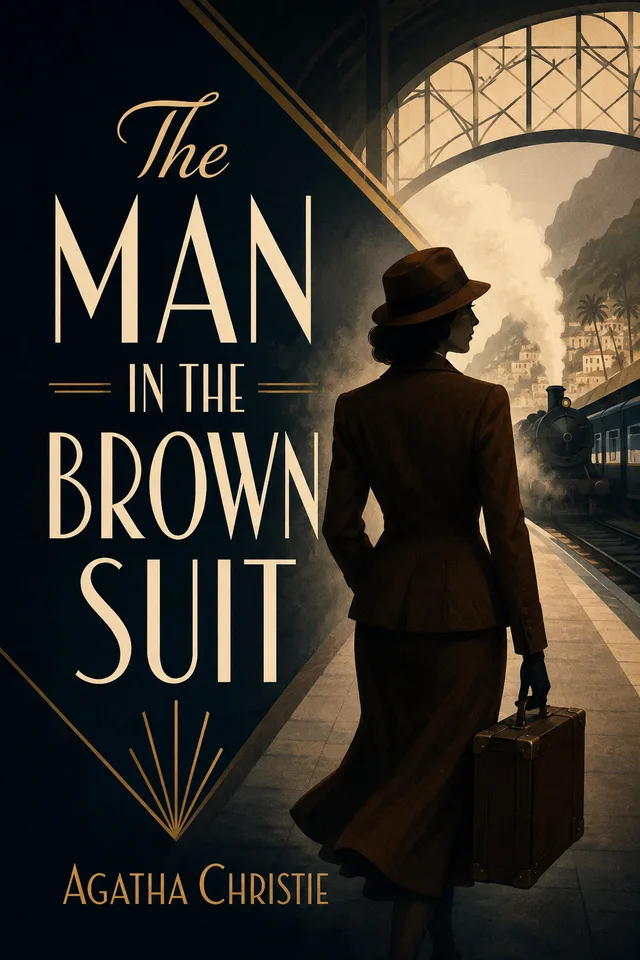
The Man in the Brown Suit
Edición BooksWhale en inglés de Agatha Christie
An early Agatha Christie adventure mystery combining murder, travel, espionage, romance, and fast-paced puzzle plotting.
- Vista previa
- Muestra del texto preparado
- Formatos
- Lector online, EPUB, PDF
- Acceso
- Claim de Biblioteca
Introducción del libro
The Man in the Brown Suit
The Man in the Brown Suit is a carefully selected public-domain literature work by Agatha Christie. An early Agatha Christie adventure mystery combining murder, travel, espionage, romance, and fast-paced puzzle plotting. This BooksWhale edition is prepared for readers looking for classic works with clean metadata, searchable titles, and reliable publication context.
Edición BooksWhale
Cómo se preparó esta edición
Esta edición se basa en un texto de dominio público y fue preparada por BooksWhale para lectura digital.
Base de dominio público
Por qué puede compartirse
The Man in the Brown Suit was first published in 1924. The selected edition uses public-domain text suitable for BooksWhale publication, with any translation source limited to public-domain material.
Leer vista previa
Muestra del texto preparado
Vista previa seleccionada del texto preparado.
Capítulo de vista previaFull textLeer vista previa
The Man in the Brown Suit
Agatha Christie
Capítulo de vista previaCHAPTER IVista previa
Everybody has been at me, right and left, to write this story from the great (represented by Lord Nasby) to the small (represented by our late maid of all work, Emily, whom I saw when I was last in England. “Lor’, miss, what a beyewtiful book you might make out of it all—just like the pictures!”).
I’ll admit that I’ve certain qualifications for the task. I was mixed up in the affair from the very beginning, I was in the thick of it all through, and I was triumphantly “in at the death.” Very fortunately, too, the gaps that I cannot supply from my own knowledge are amply covered by Sir Eustace Pedler’s diary, of which he has kindly begged me to make use.
So here goes. Anne Beddingfeld starts to narrate her adventures.
I’d always longed for adventures. You see, my life had such a dreadful sameness. My father, Professor Beddingfeld, was one of England’s greatest living authorities on Primitive Man. He really was a genius—every one admits that. His mind dwelt in Palaeolithic times, and the inconvenience of life for him was that his body inhabited the modern world. Papa did not care for modern man—even Neolithic Man he despised as a mere herder of cattle, and he did not rise to enthusiasm until he reached the Mousterian period.
Unfortunately one cannot entirely dispense with modern men. One is forced to have some kind of truck with butchers and bakers and milkmen and greengrocers. Therefore, Papa being immersed in the past, Mamma having died when I was a baby, it fell to me to undertake the practical side of living. Frankly, I hate Palaeolithic Man, be he Aurignacian, Mousterian, Chellian, or anything else, and though I typed and revised most of Papa’s _Neanderthal Man and his Ancestors,_ Neanderthal men themselves fill me with loathing, and I always reflect what a fortunate circumstance it was that they became extinct in remote ages.
I do not know whether Papa guessed my feelings on the subject, probably not, and in any case he would not have been interested. The opinion of other people never interested him in the slightest degree. I think it was really a sign of his greatness. In the same way, he lived quite detached from the necessities of daily life. He ate what was put before him in an exemplary fashion, but seemed mildly pained when the question of paying for it arose. We never seemed to have any money. His celebrity was not of the kind that brought in a cash return. Although he was a fellow of almost every important society, and had rows of letters after his name, the general public scarcely knew of his existence, and his long learned books, though adding signally to the sum-total of human knowledge, had no attraction for the masses. Only on one occasion did he leap into the public gaze. He had read a paper before some society on the subject of the young of the chimpanzee. The young of the human race show some anthropoid features, whereas the young of the chimpanzee approach more nearly to the human than the adult chimpanzee does. That seems to show that whereas our ancestors were more Simian than we are, the chimpanzee’s were of a higher type than the present species—in other words, the chimpanzee is a degenerate. That enterprising newspaper, the _Daily Budget,_ being hard up for something spicy, immediately brought itself out with large headlines. “We are not descended from monkeys, but are monkeys descended from _us?_ Eminent Professor says chimpanzees are decadent humans.” Shortly afterwards a reporter called to see Papa, and endeavoured to induce him to write a series of popular articles on the theory. I have seldom seen Papa so angry. He turned the reporter out of the house with scant ceremony, much to my secret sorrow, as we were particularly short of money at the moment. In fact, for a moment I meditated running after the young man and informing him that my father had changed his mind and would send the articles in question. I could easily have written them myself, and the probabilities were that Papa would never have learnt of the transaction, not being a reader of the _Daily Budget._ However, I rejected this course as being too risky, so I merely put on my best hat and went sadly down the village to interview our justly irate grocer.
Capítulo de vista previaCHAPTER IIVista previa
Every one was very kind to me. Dazed as I was, I appreciated that. I felt no overwhelming grief. Papa had never loved me, I knew that well enough. If he had, I might have loved him in return. No, there had not been love between us, but we had belonged together, and I had looked after him, and had secretly admired his learning and his uncompromising devotion to science. And it hurt me that Papa should have died just when the interest of life was at its height for him. I should have felt happier if I could have buried him in a cave, with paintings of reindeer and flint implements, but the force of public opinion constrained a neat tomb (with marble slab) in our hideous local churchyard. The vicar’s consolations, though well meant, did not console me in the least.
It took some time to dawn upon me that the thing I had always longed for—freedom—was at last mine. I was an orphan, and practically penniless, but free. At the same time I realized the extraordinary kindness of all these good people. The vicar did his best to persuade me that his wife was in urgent need of a companion help. Our tiny local library suddenly made up its mind to have an assistant librarian. Finally, the doctor called upon me, and after making various ridiculous excuses for failing to send in a proper bill, he hummed and hawed a good deal and suddenly suggested that I should marry him.
I was very much astonished. The doctor was nearer forty than thirty, and a round, tubby little man. He was not at all like the hero of “The Perils of Pamela,” and even less like a stern and silent Rhodesian. I reflected a minute and then asked him why he wanted to marry me. That seemed to fluster him a good deal, and he murmured that a wife was a great help to a General Practitioner. The position seemed even more unromantic than before, and yet something in me urged towards its acceptance. Safety, that was what I was being offered. Safety—and a Comfortable Home. Thinking it over now, I believe I did the little man an injustice. He was honestly in love with me, but a mistaken delicacy prevented him from pressing his suit on those lines. Anyway, my love of romance rebelled.
“It’s extremely kind of you,” I said. “But it’s impossible. I could never marry a man unless I loved him madly.”
“You don’t think——?”
“No, I don’t,” I said firmly.
He sighed.
“But, my dear child, what do you propose to do?”
“Have adventures and see the world,” I replied, without the least hesitation.
“Miss Anne, you are very much of a child still. You don’t understand——”
“The practical difficulties? Yes, I do, doctor. I’m not a sentimental schoolgirl—I’m a hard-headed mercenary shrew! You’d know it if you married me!”
“I wish you would reconsider——”
“I can’t.”
He sighed again.
“I have another proposal to make. An aunt of mine who lives in Wales is in want of a young lady to help her. How would that suit you?”
“No, doctor, I’m going to London. If things happen anywhere, they happen in London. I shall keep my eyes open and you’ll see, something will turn up! You’ll hear of me next in China or Timbuctoo.”
My next visitor was Mr. Flemming, Papa’s London solicitor. He came down specially from town to see me. An ardent anthropologist himself, he was a great admirer of Papa’s works. He was a tall, spare man with a thin face and grey hair. He rose to meet me as I entered the room and, taking both my hands in his, patted them affectionately.
“My poor child,” he said. “My poor, poor child.”
Índice
Dentro de esta edición
- 01Full text
- 02CHAPTER I
- 03CHAPTER II
- 04CHAPTER III
- 05EXTRAORDINARY SEQUEL TO TUBE ACCIDENT.
- 06WOMAN FOUND STABBED IN LONELY HOUSE.
- 07CHAPTER IV
- 08CHAPTER V
- 09CHAPTER VI
- 10CHAPTER VII
- 11CHAPTER VIII
- 12CHAPTER IX
- 13CHAPTER X
- 14CHAPTER XI
- 15CHAPTER XII
- 16CHAPTER XIII
- 17CHAPTER XIV
- 18CHAPTER XV
- 19CHAPTER XVI
- 20CHAPTER XVII
- 21CHAPTER XVIII
- 22CHAPTER XIX
- 23CHAPTER XX
- 24CHAPTER XXI
- 25CHAPTER XXII
- 26CHAPTER XXIII
- 27CHAPTER XXIV
- 28CHAPTER XXV
- 29CHAPTER XXVI
- 30CHAPTER XXVII
- 31CHAPTER XXVIII
- 32CHAPTER XXIX
- 33CHAPTER XXX
- 34CHAPTER XXXI
- 35CHAPTER XXXII
- 36CHAPTER XXXIII
- 37CHAPTER XXXIV
- 38CHAPTER XXXV
- 39CHAPTER XXXVI
- 40THE END
Disponibilidad de idiomas
Otros idiomas
Aún no hay otras ediciones lingüísticas publicadas. Esta sección enlazará las disponibles.
Solicitar otro idioma