inglés Edición
Literatura
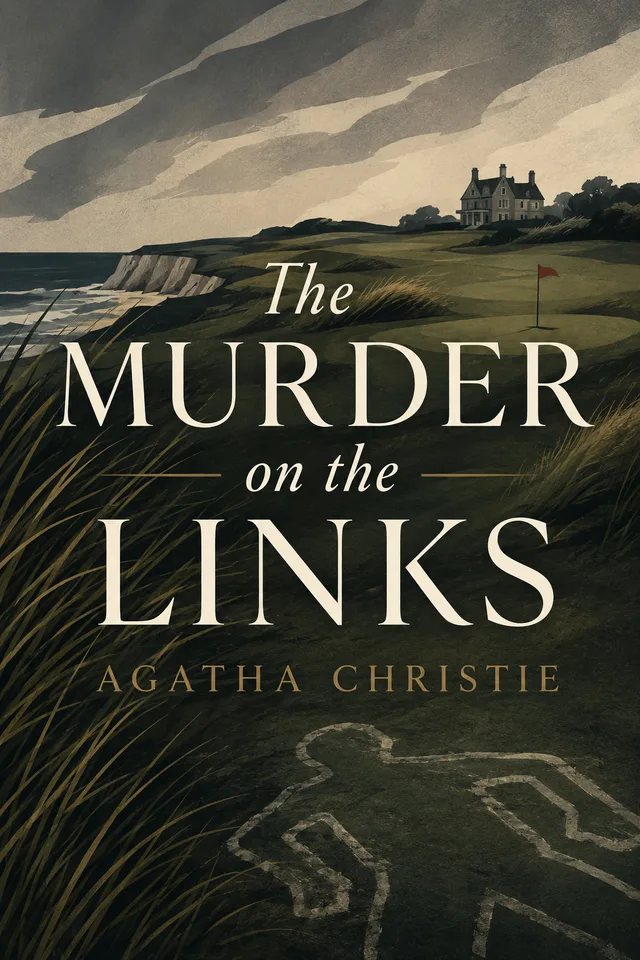
The Murder on the Links
Edición BooksWhale en inglés de Agatha Christie
A Hercule Poirot mystery built around a French crime scene, mistaken identities, clues, rivalry, and Christie’s classic misdirection.
- Vista previa
- Muestra del texto preparado
- Formatos
- Lector online, EPUB, PDF
- Acceso
- Claim de Biblioteca
Introducción del libro
The Murder on the Links
The Murder on the Links is a carefully selected public-domain literature work by Agatha Christie. A Hercule Poirot mystery built around a French crime scene, mistaken identities, clues, rivalry, and Christie’s classic misdirection. This BooksWhale edition is prepared for readers looking for classic works with clean metadata, searchable titles, and reliable publication context.
Edición BooksWhale
Cómo se preparó esta edición
Esta edición se basa en un texto de dominio público y fue preparada por BooksWhale para lectura digital.
Base de dominio público
Por qué puede compartirse
The Murder on the Links was first published in 1923. The selected edition uses public-domain text suitable for BooksWhale publication, with any translation source limited to public-domain material.
Leer vista previa
Muestra del texto preparado
Vista previa seleccionada del texto preparado.
Capítulo de vista previaFull textLeer vista previa
The Murder on the Links
Agatha Christie
1 A Fellow Traveller 2 An Appeal for Help 3 At the Villa Geneviève 4 The Letter Signed “Bella” 5 Mrs. Renauld’s Story 6 The Scene of the Crime 7 The Mysterious Madame Daubreuil 8 An Unexpected Meeting 9 M. Giraud Finds Some Clues 10 Gabriel Stonor 11 Jack Renauld 12 Poirot Elucidates Certain Points 13 The Girl with the Anxious Eyes 14 The Second Body 15 A Photograph 16 The Beroldy Case 17 We Make Further Investigations 18 Giraud Acts 19 I Use My Grey Cells 20 An Amazing Statement 21 Hercule Poirot on the Case! 22 I Find Love 23 Difficulties Ahead 24 “Save Him!” 25 An Unexpected Dénouement 26 I Receive a Letter 27 Jack Renauld’s Story 28 Journey’s End
1 A Fellow Traveller
I believe that a well-known anecdote exists to the effect that a young writer, determined to make the commencement of his story forcible and original enough to catch and rivet the attention of the most blasé of editors, penned the following sentence:
“‘Hell!’ said the Duchess.”
Strangely enough, this tale of mine opens in much the same fashion. Only the lady who gave utterance to the exclamation was not a Duchess!
It was a day in early June. I had been transacting some business in Paris and was returning by the morning service to London where I was still sharing rooms with my old friend, the Belgian ex-detective, Hercule Poirot.
The Calais express was singularly empty—in fact, my own compartment held only one other traveller. I had made a somewhat hurried departure from the hotel and was busy assuring myself that I had duly collected all my traps when the train started. Up till then I had hardly noticed my companion, but I was now violently recalled to the fact of her existence. Jumping up from her seat, she let down the window and stuck her head out, withdrawing it a moment later with the brief and forcible ejaculation “Hell!”
Now I am old-fashioned. A woman, I consider, should be womanly. I have no patience with the modern neurotic girl who jazzes from morning to night, smokes like a chimney, and uses language which would make a Billingsgate fishwoman blush!
I looked up now, frowning slightly, into a pretty, impudent face, surmounted by a rakish little red hat. A thick cluster of black curls hid each ear. I judged that she was little more than seventeen, but her face was covered with powder, and her lips were quite impossibly scarlet.
Nothing abashed, she returned my glance, and executed an expressive grimace.
“Dear me, we’ve shocked the kind gentleman!” she observed to an imaginary audience. “I apologize for my language! Most unladylike, and all that, but Oh, Lord, there’s reason enough for it! Do you know I’ve lost my only sister?”
“Really?” I said politely. “How unfortunate.”
“He disapproves!” remarked the lady. “He disapproves utterly—of me, and my sister—which last is unfair, because he hasn’t seen her!”
I opened my mouth, but she forestalled me.
“Say no more! Nobody loves me! I shall go into the garden and eat worms! Boohoo! I am crushed!”
She buried herself behind a large comic French paper. In a minute or two I saw her eyes stealthily peeping at me over the top. In spite of myself I could not help smiling, and in a minute she had tossed the paper aside, and had burst into a merry peal of laughter.
“I knew you weren’t such a mutt as you looked,” she cried.
Her laughter was so infectious that I could not help joining in, though I hardly cared for the word “mutt.” The girl was certainly all that I most disliked, but that was no reason why I should make myself ridiculous by my attitude. I prepared to unbend. After all, she was decidedly pretty.…
Capítulo de vista previa“MARTHE DAUBREUIL.”Vista previa
I handed it back, moved.
“You will go?”
“At once. We will command an auto.”
Half an hour later saw us at the Villa Marguerite. Marthe was at the door to meet us, and led Poirot in, clinging with both hands to one of his.
“Ah, you have come—it is good of you. I have been in despair, not knowing what to do. They will not let me go to see him in prison even. I suffer horribly, I am nearly mad. Is it true what they say, that he does not deny the crime? But that is madness. It is impossible that he should have done it! Never for one minute will I believe it.”
“Neither do I believe it, mademoiselle,” said Poirot gently.
“But then why does he not speak? I do not understand.”
“Perhaps because he is screening some one,” suggested Poirot, watching her.
Marthe frowned.
“Screening some one? Do you mean his mother? Ah, from the beginning I have suspected her. Who inherits all that vast fortune? She does. It is easy to wear widow’s weeds and play the hypocrite. And they say that when he was arrested she fell down—like _that___.” She made a dramatic gesture. “And without doubt, M. Stonor, the secretary, he helped her. They are thick as thieves, those two. It is true she is older than he—but what do men care—if a woman is rich!”
There was a hint of bitterness in her tone.
“Stonor was in England,” I put in.
“He says so—but who knows?”
“Mademoiselle,” said Poirot quietly, “if we are to work together, you and I, we must have things clear. First, I will ask you a question.”
“Yes, monsieur?”
“Are you aware of your mother’s real name?”
Marthe looked at him for a minute, then, letting her head fall forward on her arms, she burst into tears.
“There, there,” said Poirot, patting her on the shoulder. “Calm yourself, _petite___, I see that you know. Now a second question, did you know who M. Renauld was?”
“M. Renauld,” she raised her head from her hands and gazed at him wonderingly.
“Ah, I see you do not know that. Now listen to me carefully.”
Step by step, he went over the case, much as he had done to me on the day of our departure for England. Marthe listened spellbound. When he had finished, she drew a long breath.
“But you are wonderful—magnificent! You are the greatest detective in the world.”
With a swift gesture she slipped off her chair and knelt before him with an abandonment that was wholly French.
“Save him, monsieur,” she cried. “I love him so. Oh, save him, save him—save him!”
25 An Unexpected Dénouement
We were present the following morning at the examination of Jack Renauld. Short as the time had been, I was shocked at the change that had taken place in the young prisoner. His cheeks had fallen in, there were deep black circles round his eyes, and he looked haggard and distraught, as one who had wooed sleep in vain for several nights. He betrayed no emotion at seeing us.
The prisoner and his counsel, Maître Grosíer, were accommodated with chairs. A formidable guard with resplendent sabre stood before the door. The patient _greffier___ sat at his desk. The examination began.
“Renauld,” began the magistrate, “do you deny that you were in Merlinville on the night of the crime?”
Jack did not reply at once, then he said with a hesitancy of manner which was piteous:
“I—I—told you that I was in Cherbourg.”
Maître Grosíer frowned and sighed. I realized at once that Jack Renauld was obstinately bent on conducting his own case as he wished, to the despair of his legal representative.
The magistrate turned sharply.
“Send in the station witnesses.”
In a moment or two the door opened to admit a man whom I recognized as being a porter at Merlinville station.
Índice
Dentro de esta edición
- 01Full text
- 02“MARTHE DAUBREUIL.”
Disponibilidad de idiomas
Otros idiomas
Aún no hay otras ediciones lingüísticas publicadas. Esta sección enlazará las disponibles.
Solicitar otro idioma