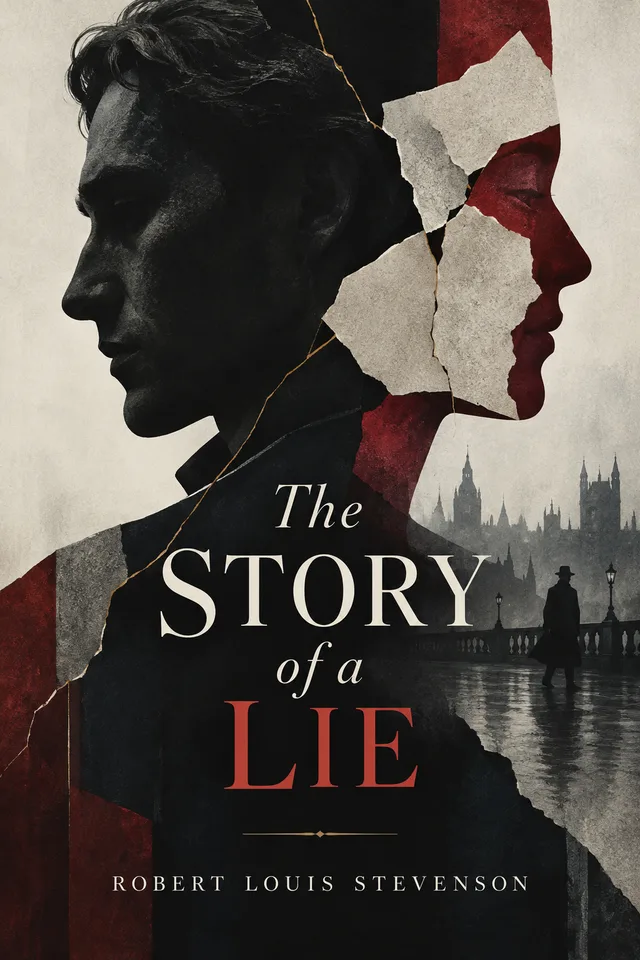
inglés Edición
Literatura
The Story of a Lie
Edición BooksWhale en inglés de Robert Louis Stevenson
The Story of a Lie presents a focused classic of literature and cultural history.
- Vista previa
- Muestra del texto preparado
- Formatos
- Lector online, EPUB, PDF
- Acceso
- Claim de Biblioteca
Introducción del libro
The Story of a Lie
The Story of a Lie by Robert Louis Stevenson brings its central world, characters and themes into view, offering a distinctive entry to the period and tradition that shaped it.
Edición BooksWhale
Cómo se preparó esta edición
Esta edición se basa en un texto de dominio público y fue preparada por BooksWhale para lectura digital.
Base de dominio público
Por qué puede compartirse
Public-domain original text; historical author or anonymous source.
Leer vista previa
Muestra del texto preparado
Vista previa seleccionada del texto preparado.
Capítulo de vista previaCHAPTER I — INTRODUCES THE ADMIRALLeer vista previa
When Dick Naseby was in Paris he made some odd acquaintances, for he was
one of those who have ears to hear, and can use their eyes no less than
their intelligence. He made as many thoughts as Stuart Mill; but his
philosophy concerned flesh and blood, and was experimental as to its
method. He was a type-hunter among mankind. He despised small game and
insignificant personalities, whether in the shape of dukes or bagmen,
letting them go by like sea-weed; but show him a refined or powerful
face, let him hear a plangent or a penetrating voice, fish for him with
a living look in some one's eye, a passionate gesture, a meaning or
ambiguous smile, and his mind was instantaneously awakened. "There was a
man, there was a woman," he seemed to say, and he stood up to the task
of comprehension with the delight of an artist in his art.
And indeed, rightly considered, this interest of his was an artistic
interest. There is no science in the personal study of human nature. All
comprehension is creation; the woman I love is somewhat of my handiwork;
and the great lover, like the great painter, is he that can so embellish
his subject as to make her more than human, whilst yet by a cunning art
he has so based his apotheosis on the nature of the case that the woman
can go on being a true woman, and give her character free play, and show
littleness, or cherish spite, or be greedy of common pleasures, and he
continue to worship without a thought of incongruity. To love a
character is only the heroic way of understanding it. When we love, by
some noble method of our own or some nobility of mien or nature in the
other, we apprehend the loved one by what is noblest in ourselves. When
we are merely studying an eccentricity, the method of our study is but a
series of allowances. To begin to understand is to begin to sympathise;
for comprehension comes only when we have stated another's faults and
virtues in terms of our own. Hence the proverbial toleration of artists
for their own evil creations. Hence, too, it came about that Dick
Naseby, a high-minded creature, and as scrupulous and brave a gentleman
as you would want to meet, held in a sort of affection the various human
creeping things whom he had met and studied.
One of these was Mr. Peter Van Tromp, an English-speaking, two-legged
animal of the international genus, and by profession of general and more
than equivocal utility. Years before he had been a painter of some
standing in a colony, and portraits signed "Van Tromp" had celebrated
the greatness of colonial governors and judges. In those days he had
been married, and driven his wife and infant daughter in a pony trap.
What were the steps of his declension? No one exactly knew. Here he was
at least, and had been, any time these past ten years, a sort of dismal
parasite upon the foreigner in Paris.
It would be hazardous to specify his exact industry. Coarsely followed,
it would have merited a name grown somewhat unfamiliar to our ears.
Followed as he followed it, with a skilful reticence, in a kind of
social chiaroscuro, it was still possible for the polite to call him a
professional painter. His lair was in the Grand Hotel and the gaudiest
cafés. There he might be seen jotting off a sketch with an air of some
inspiration; and he was always affable, and one of the easiest of men to
fall in talk withal. A conversation usually ripened into a peculiar sort
of intimacy, and it was extraordinary how many little services Van Tromp
contrived to render in the course of six-and-thirty hours. He occupied
a position between a friend and a courier, which made him worse than
Capítulo de vista previaCHAPTER II — A LETTER TO THE PAPERSVista previa
Old Mr. Naseby had the sturdy, untutored nature of the upper middle
class. The universe seemed plain to him. "The thing's right," he would
say, or "the thing's wrong"; and there was an end of it. There was a
contained, prophetic energy in his utterances, even on the slightest
affairs; he _saw_ the damned thing; if you did not, it must be from
perversity of will, and this sent the blood to his head. Apart from
this, which made him an exacting companion, he was one of the most
upright, hot-tempered old gentlemen in England. Florid, with white hair,
the face of an old Jupiter, and the figure of an old fox-hunter, he
enlivened the vale of Thyme from end to end on his big, cantering
chestnut.
He had a hearty respect for Dick as a lad of parts. Dick had a respect
for his father as the best of men, tempered by the politic revolt of a
youth who has to see to his own independence. Whenever the pair argued,
they came to an open rupture; and arguments were frequent, for they were
both positive, and both loved the work of the intelligence. It was a
treat to hear Mr. Naseby defending the Church of England in a volley of
oaths, or supporting ascetic morals with an enthusiasm not entirely
innocent of port wine. Dick used to wax indignant, and none the less so
because, as his father was a skilful disputant, he found himself not
seldom in the wrong. On these occasions, he would redouble in energy,
and declare that black was white, and blue yellow, with much conviction
and heat of manner; but in the morning such a licence of debate weighed
upon him like a crime, and he would seek out his father, where he walked
before breakfast on a terrace overlooking all the vale of Thyme.
"I have to apologise, sir, for last night----" he would begin.
"Of course you have," the old gentleman would cut in cheerfully. "You
spoke like a fool. Say no more about it."
"You do not understand me, sir. I refer to a particular point. I confess
there is much force in your argument from the doctrine of
possibilities."
"Of course there is," returned his father. "Come down and look at the
stables. Only," he would add, "bear this in mind, and do remember that a
man of my age and experience knows more about what he is saying than a
raw boy."
He would utter the word "boy" even more offensively than the average of
fathers, and the light way in which he accepted these apologies cut Dick
to the heart. The latter drew slighting comparisons, and remembered that
he was the only one who ever apologised. This gave him a high station in
his own esteem, and thus contributed indirectly to his better behaviour;
for he was scrupulous as well as high-spirited, and prided himself on
nothing more than on a just submission.
So things went on until the famous occasion when Mr. Naseby, becoming
engrossed in securing the election of a sound party candidate to
Parliament, wrote a flaming letter to the papers. The letter had about
every demerit of party letters in general: it was expressed with the
energy of a believer; it was personal; it was a little more than half
unfair, and about a quarter untrue. The old man did not mean to say what
was untrue, you may be sure; but he had rashly picked up gossip, as his
prejudice suggested, and now rashly launched it on the public with the
sanction of his name.
"The Liberal candidate," he concluded, "is thus a public turncoat. Is
that the sort of man we want? He has been given the lie, and has
swallowed the insult. Is that the sort of man we want? I answer, No!
With all the force of my conviction, I answer, _No_!"
Capítulo de vista previaCHAPTER III — IN THE ADMIRAL'S NAMEVista previa
There was no return to the subject. Dick and his father were henceforth
on terms of coldness. The upright old gentleman grew more upright when
he met his son, buckrammed with immortal anger; he asked after Dick's
health, and discussed the weather and the crops with an appalling
courtesy; his pronunciation was _point-de-vice_, his voice was distant,
distinct, and sometimes almost trembling with suppressed indignation.
As for Dick, it seemed to him as if his life had come abruptly to an
end. He came out of his theories and clevernesses; his premature
man-of-the-worldness, on which he had prided himself on his travels,
"shrank like a thing ashamed" before this real sorrow. Pride, wounded
honour, pity and respect tussled together daily in his heart; and now he
was within an ace of throwing himself upon his father's mercy, and now
of slipping forth at night and coming back no more to Naseby House. He
suffered from the sight of his father, nay, even from the neighbourhood
of this familiar valley, where every corner had its legend, and he was
besieged with memories of childhood. If he fled into a new land, and
among none but strangers, he might escape his destiny, who knew? and
begin again light-heartedly. From that chief peak of the hills, that now
and then, like an uplifted finger, shone in an arrow of sunlight through
the broken clouds, the shepherd in clear weather might perceive the
shining of the sea. There, he thought, was hope. But his heart failed
him when he saw the Squire; and he remained. His fate was not that of
the voyager by sea and land; he was to travel in the spirit, and begin
his journey sooner than he supposed.
For it chanced one day that his walk led him into a portion of the
uplands which was almost unknown to him. Scrambling through some rough
woods, he came out upon a moorland reaching towards the hills. A few
lofty Scots firs grew hard by upon a knoll; a clear fountain near the
foot of the knoll sent up a miniature streamlet which meandered in the
heather. A shower had just skimmed by, but now the sun shone brightly,
and the air smelt of the pines and the grass. On a stone under the trees
sat a young lady sketching. We have learned to think of women in a sort
of symbolic transfiguration, based on clothes; and one of the readiest
ways in which we conceive our mistress is as a composite thing,
principally petticoats. But humanity has triumphed over clothes; the
look, the touch of a dress has become alive; and the woman who stitched
herself into these material integuments has now permeated right through
and gone out to the tip of her skirt. It was only a black dress that
caught Dick Naseby's eye; but it took possession of his mind, and all
other thoughts departed. He drew near, and the girl turned round. Her
face startled him; it was a face he wanted; and he took it in at once
like breathing air.
"I beg your pardon," he said, taking off his hat, "you are sketching."
"Oh!" she exclaimed, "for my own amusement. I despise the thing."
"Ten to one you do yourself injustice," returned Dick. "Besides, it's a
freemasonry. I sketch myself, and you know what that implies."
"No. What?" she asked.
"Two things," he answered. "First, that I am no very difficult critic;
and second, that I have a right to see your picture."
She covered the block with both her hands. "Oh, no," she said; "I am
ashamed."
"Indeed, I might give you a hint," said Dick. "Although no artist
myself, I have known many; in Paris I had many for friends, and used to
prowl among studios."
"In Paris?" she cried, with a leap of light into her eyes. "Did you ever
meet Mr. Van Tromp?"
Índice
Dentro de esta edición
- 01CHAPTER I — INTRODUCES THE ADMIRAL
- 02CHAPTER II — A LETTER TO THE PAPERS
- 03CHAPTER III — IN THE ADMIRAL'S NAME
- 04CHAPTER IV — ESTHER ON THE FILIAL RELATION
- 05CHAPTER V — THE PRODIGAL FATHER MAKES HIS DÉBUT AT HOME
- 06CHAPTER VI — THE PRODIGAL FATHER GOES ON FROM STRENGTH TO STRENGTH
- 07CHAPTER VII — THE ELOPEMENT
- 08CHAPTER VIII — BATTLE ROYAL
- 09CHAPTER IX — IN WHICH THE LIBERAL EDITOR APPEARS AS "DEUS EX MACHINÂ"
Disponibilidad de idiomas
Otros idiomas
Aún no hay otras ediciones lingüísticas publicadas. Esta sección enlazará las disponibles.
Solicitar otro idioma