inglés Edición
Literatura
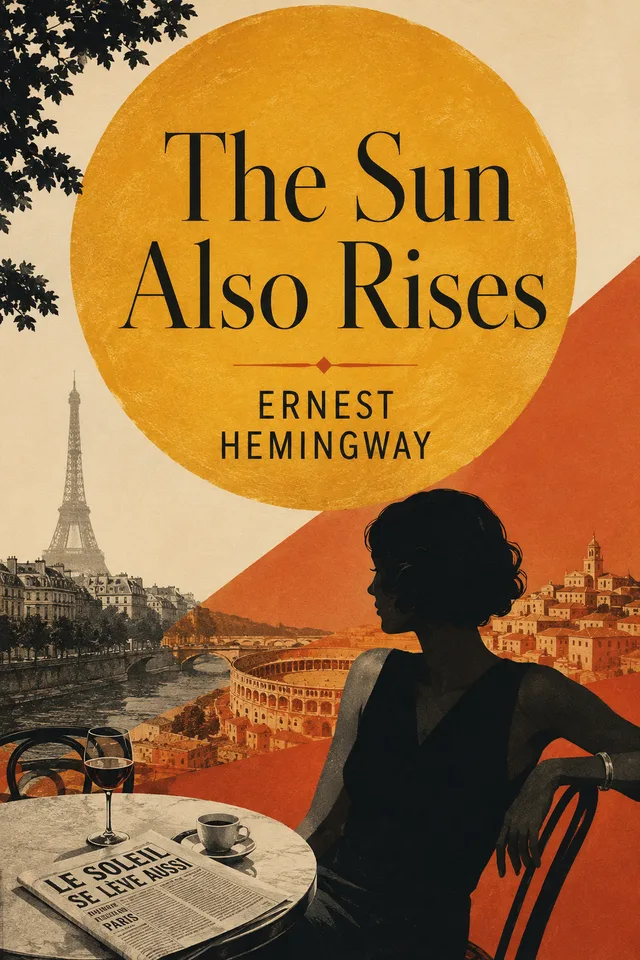
The Sun Also Rises
Edición BooksWhale en inglés de Ernest Hemingway
Hemingway’s defining Lost Generation novel of exile, love, style, and disillusion after war.
- Vista previa
- Muestra del texto preparado
- Formatos
- Lector online, EPUB, PDF
- Acceso
- Claim de Biblioteca
Introducción del libro
The Sun Also Rises
The Sun Also Rises follows American and British expatriates from Paris to Pamplona, where desire, injury, masculinity, and aimlessness come into sharp focus. Hemingway’s lean prose helped define modern fiction and the mood of the postwar generation.
Edición BooksWhale
Cómo se preparó esta edición
Esta edición se basa en un texto de dominio público y fue preparada por BooksWhale para lectura digital.
Base de dominio público
Por qué puede compartirse
The Sun Also Rises was first published in 1926. Its pre-1931 publication date supports the public-domain basis for this original English text in the United States.
Leer vista previa
Muestra del texto preparado
Vista previa seleccionada del texto preparado.
Capítulo de vista previaFull textLeer vista previa
The Sun Also Rises
Ernest Hemingway
Capítulo de vista previaBOOK IVista previa
BOOK I
Capítulo de vista previaCHAPTERVista previa
Robert Cohn was once middleweight boxing champion of Princeton. Do not
think that I am very much impressed by that as a boxing title, but it
meant a lot to Cohn. He cared nothing for boxing, in fact he disliked
it, but he learned it painfully and thoroughly to counteract the feeling
of inferiority and shyness he had felt on being treated as a Jew at
Princeton. There was a certain inner comfort in knowing he could knock
down anybody who was snooty to him, although, being very shy and a
thoroughly nice boy, he never fought except in the gym. He was Spider
Kelly’s star pupil. Spider Kelly taught all his young gentlemen to box
like featherweights, no matter whether they weighed one hundred and five
or two hundred and five pounds. But it seemed to fit Cohn. He was really
very fast. He was so good that Spider promptly overmatched him and got
his nose permanently flattened. This increased Cohn’s distaste for
boxing, but it gave him a certain satisfaction of some strange sort, and
it certainly improved his nose. In his last year at Princeton he read
too much and took to wearing spectacles. I never met any one of his
class who remembered him. They did not even remember that he was
middleweight boxing champion.
I mistrust all frank and simple people, especially when their stories
hold together, and I always had a suspicion that perhaps Robert Cohn had
never been middleweight boxing champion, and that perhaps a horse had
stepped on his face, or that maybe his mother had been frightened or
seen something, or that he had, maybe, bumped into something as a young
child, but I finally had somebody verify the story from Spider Kelly.
Spider Kelly not only remembered Cohn. He had often wondered what had
become of him.
Robert Cohn was a member, through his father, of one of the richest
Jewish families in New York, and through his mother of one of the
oldest. At the military school where he prepped for Princeton, and
played a very good end on the football team, no one had made him
race-conscious. No one had ever made him feel he was a Jew, and hence
any different from anybody else, until he went to Princeton. He was a
nice boy, a friendly boy, and very shy, and it made him bitter. He took
it out in boxing, and he came out of Princeton with painful
self-consciousness and the flattened nose, and was married by the first
girl who was nice to him. He was married five years, had three children,
lost most of the fifty thousand dollars his father left him, the balance
of the estate having gone to his mother, hardened into a rather
unattractive mould under domestic unhappiness with a rich wife; and just
when he had made up his mind to leave his wife she left him and went off
with a miniature-painter. As he had been thinking for months about
leaving his wife and had not done it because it would be too cruel to
deprive her of himself, her departure was a very healthful shock.
The divorce was arranged and Robert Cohn went out to the Coast. In
California he fell among literary people and, as he still had a little
of the fifty thousand left, in a short time he was backing a review of
the Arts. The review commenced publication in Carmel, California, and
finished in Provincetown, Massachusetts. By that time Cohn, who had been
regarded purely as an angel, and whose name had appeared on the
editorial page merely as a member of the advisory board, had become the
sole editor. It was his money and he discovered he liked the authority
of editing. He was sorry when the magazine became too expensive and he
had to give it up.
By that time, though, he had other things to worry about. He had been
Índice
Dentro de esta edición
- 01Full text
- 02BOOK I
- 03CHAPTER
- 04CHAPTER
- 05book too.
- 06CHAPTER
- 07CHAPTER
- 08CHAPTER
- 09CHAPTER
- 10CHAPTER
- 11BOOK II
- 12CHAPTER
- 13CHAPTER
- 14CHAPTER
- 15CHAPTER
- 16CHAPTER
- 17book was something by A. E. W. Mason, and I was reading a wonderful
- 18CHAPTER
- 19DEAR JAKE,
- 20MICHAEL.
- 21CHAPTER
- 22CHAPTER
- 23CHAPTER
- 24CHAPTER
- 25CHAPTER
- 26BOOK III
- 27CHAPTER
- 28COULD YOU COME HOTEL MONTANA MADRID
- 29AM RATHER IN TROUBLE BRETT.
- 30COULD YOU COME HOTEL MONTANA MADRID
- 31AM RATHER IN TROUBLE BRETT.
- 32LADY ASHLEY HOTEL MONTANA MADRID
- 33ARRIVING SUD EXPRESS TOMORROW LOVE
- 34THE END
Disponibilidad de idiomas
Otros idiomas
Aún no hay otras ediciones lingüísticas publicadas. Esta sección enlazará las disponibles.
Solicitar otro idioma