anglais Édition
Littérature
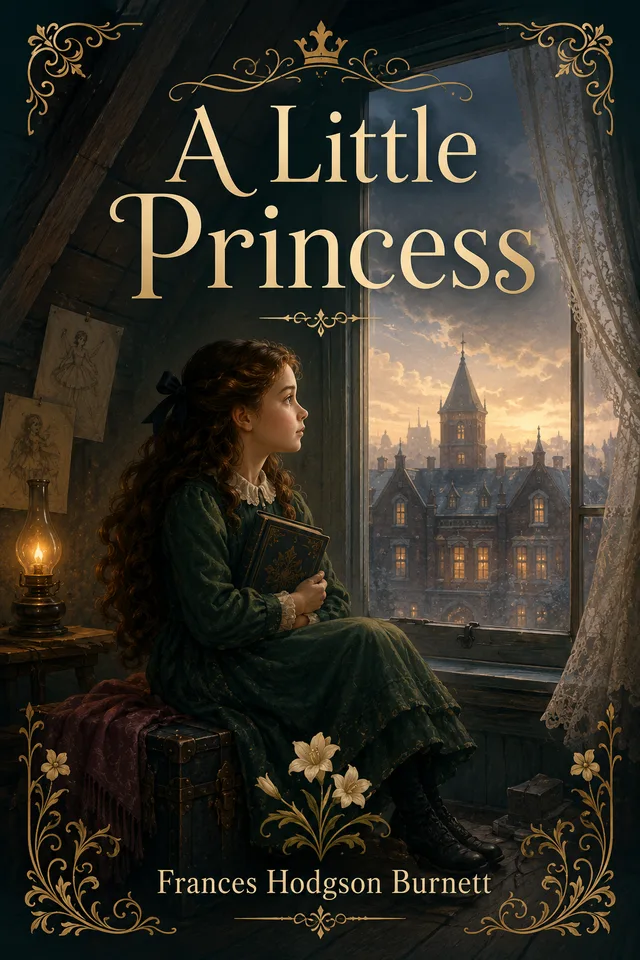
A Little Princess
Édition BooksWhale en anglais par Frances Hodgson Burnett
A children’s classic of imagination, hardship, kindness, dignity, and inner courage.
- Aperçu
- Extrait du texte préparé
- Formats
- Lecteur en ligne, EPUB, PDF
- Accès
- Claim Bibliothèque
Introduction du livre
A Little Princess
A Little Princess follows Sara Crewe through privilege, loss, cruelty, and imaginative resilience. Frances Hodgson Burnett’s beloved English novel remains a classic of childhood, generosity, and moral strength.
Édition BooksWhale
Préparation de cette édition
Cette édition repose sur un texte du domaine public et a été préparée par BooksWhale pour la lecture numérique.
Base du domaine public
Pourquoi cette édition peut être partagée
Frances Hodgson Burnett died in 1924, and A Little Princess was first published in 1905. These dates support the public-domain basis for this English original-language edition.
Lire l'aperçu
Extrait du texte préparé
Aperçu sélectionné depuis le texte de lecture préparé.
Chapitre d'aperçuPart 1Lire l'aperçu
A Little Princess
Sara
Once on a dark winter's day, when the yellow fog hung so thick and heavy in the streets of London that the lamps were lighted and the shop windows blazed with gas as they do at night, an odd-looking little girl sat in a cab with her father and was driven rather slowly through the big thoroughfares.
She sat with her feet tucked under her, and leaned against her father, who held her in his arm, as she stared out of the window at the passing people with a queer old-fashioned thoughtfulness in her big eyes.
She was such a little girl that one did not expect to see such a look on her small face. It would have been an old look for a child of twelve, and Sara Crewe was only seven. The fact was, however, that she was always dreaming and thinking odd things and could not herself remember any time when she had not been thinking things about grown-up people and the world they belonged to. She felt as if she had lived a long, long time.
At this moment she was remembering the voyage she had just made from Bombay with her father, Captain Crewe. She was thinking of the big ship, of the Lascars passing silently to and fro on it, of the children playing about on the hot deck, and of some young officers' wives who used to try to make her talk to them and laugh at the things she said.
Principally, she was thinking of what a queer thing it was that at one time one was in India in the blazing sun, and then in the middle of the ocean, and then driving in a strange vehicle through strange streets where the day was as dark as the night. She found this so puzzling that she moved closer to her father.
"Papa," she said in a low, mysterious little voice which was almost a whisper, "papa."
"What is it, darling?" Captain Crewe answered, holding her closer and looking down into her face. "What is Sara thinking of?"
"Is this the place?" Sara whispered, cuddling still closer to him. "Is it, papa?"
"Yes, little Sara, it is. We have reached it at last." And though she was only seven years old, she knew that he felt sad when he said it.
It seemed to her many years since he had begun to prepare her mind for "the place," as she always called it. Her mother had died when she was born, so she had never known or missed her. Her young, handsome, rich, petting father seemed to be the only relation she had in the world. They had always played together and been fond of each other. She only knew he was rich because she had heard people say so when they thought she was not listening, and she had also heard them say that when she grew up she would be rich, too. She did not know all that being rich meant. She had always lived in a beautiful bungalow, and had been used to seeing many servants who made salaams to her and called her "Missee Sahib," and gave her her own way in everything. She had had toys and pets and an ayah who worshipped her, and she had gradually learned that people who were rich had these things. That, however, was all she knew about it.
During her short life only one thing had troubled her, and that thing was "the place" she was to be taken to some day. The climate of India was very bad for children, and as soon as possible they were sent away from it--generally to England and to school. She had seen other children go away, and had heard their fathers and mothers talk about the letters they received from them. She had known that she would be obliged to go also, and though sometimes her father's stories of the voyage and the new country had attracted her, she had been troubled by the thought that he could not stay with her.
Chapitre d'aperçuPart 2Aperçu
The next day he took her to Miss Minchin's and left her there. He was to sail away the next morning. He explained to Miss Minchin that his solicitors, Messrs. Barrow & Skipworth, had charge of his affairs in England and would give her any advice she wanted, and that they would pay the bills she sent in for Sara's expenses. He would write to Sara twice a week, and she was to be given every pleasure she asked for.
"She is a sensible little thing, and she never wants anything it isn't safe to give her," he said.
Then he went with Sara into her little sitting room and they bade each other good-by. Sara sat on his knee and held the lapels of his coat in her small hands, and looked long and hard at his face.
"Are you learning me by heart, little Sara?" he said, stroking her hair.
"No," she answered. "I know you by heart. You are inside my heart." And they put their arms round each other and kissed as if they would never let each other go.
When the cab drove away from the door, Sara was sitting on the floor of her sitting room, with her hands under her chin and her eyes following it until it had turned the corner of the square. Emily was sitting by her, and she looked after it, too. When Miss Minchin sent her sister, Miss Amelia, to see what the child was doing, she found she could not open the door.
"I have locked it," said a queer, polite little voice from inside. "I want to be quite by myself, if you please."
Miss Amelia was fat and dumpy, and stood very much in awe of her sister. She was really the better-natured person of the two, but she never disobeyed Miss Minchin. She went downstairs again, looking almost alarmed.
"I never saw such a funny, old-fashioned child, sister," she said. "She has locked herself in, and she is not making the least particle of noise."
"It is much better than if she kicked and screamed, as some of them do," Miss Minchin answered. "I expected that a child as much spoiled as she is would set the whole house in an uproar. If ever a child was given her own way in everything, she is."
"I've been opening her trunks and putting her things away," said Miss Amelia. "I never saw anything like them--sable and ermine on her coats, and real Valenciennes lace on her underclothing. You have seen some of her clothes. What DO you think of them?"
"I think they are perfectly ridiculous," replied Miss Minchin, sharply; "but they will look very well at the head of the line when we take the schoolchildren to church on Sunday. She has been provided for as if she were a little princess."
And upstairs in the locked room Sara and Emily sat on the floor and stared at the corner round which the cab had disappeared, while Captain Crewe looked backward, waving and kissing his hand as if he could not bear to stop.
A French Lesson
When Sara entered the schoolroom the next morning everybody looked at her with wide, interested eyes. By that time every pupil--from Lavinia Herbert, who was nearly thirteen and felt quite grown up, to Lottie Legh, who was only just four and the baby of the school--had heard a great deal about her. They knew very certainly that she was Miss Minchin's show pupil and was considered a credit to the establishment. One or two of them had even caught a glimpse of her French maid, Mariette, who had arrived the evening before. Lavinia had managed to pass Sara's room when the door was open, and had seen Mariette opening a box which had arrived late from some shop.
"It was full of petticoats with lace frills on them--frills and frills," she whispered to her friend Jessie as she bent over her geography. "I saw her shaking them out. I heard Miss Minchin say to Miss Amelia that her clothes were so grand that they were ridiculous for a child. My mamma says that children should be dressed simply. She has got one of those petticoats on now. I saw it when she sat down."
Chapitre d'aperçuPart 3Aperçu
"It isn't funny, really," she said between her teeth, as she bent over her book. "They ought not to laugh."
When lessons were over and the pupils gathered together in groups to talk, Sara looked for Miss St. John, and finding her bundled rather disconsolately in a window-seat, she walked over to her and spoke. She only said the kind of thing little girls always say to each other by way of beginning an acquaintance, but there was something friendly about Sara, and people always felt it.
"What is your name?" she said.
To explain Miss St. John's amazement one must recall that a new pupil is, for a short time, a somewhat uncertain thing; and of this new pupil the entire school had talked the night before until it fell asleep quite exhausted by excitement and contradictory stories. A new pupil with a carriage and a pony and a maid, and a voyage from India to discuss, was not an ordinary acquaintance.
"My name's Ermengarde St. John," she answered.
"Mine is Sara Crewe," said Sara. "Yours is very pretty. It sounds like a story book."
"Do you like it?" fluttered Ermengarde. "I--I like yours."
Miss St. John's chief trouble in life was that she had a clever father. Sometimes this seemed to her a dreadful calamity. If you have a father who knows everything, who speaks seven or eight languages, and has thousands of volumes which he has apparently learned by heart, he frequently expects you to be familiar with the contents of your lesson books at least; and it is not improbable that he will feel you ought to be able to remember a few incidents of history and to write a French exercise. Ermengarde was a severe trial to Mr. St. John. He could not understand how a child of his could be a notably and unmistakably dull creature who never shone in anything.
"Good heavens!" he had said more than once, as he stared at her, "there are times when I think she is as stupid as her Aunt Eliza!"
If her Aunt Eliza had been slow to learn and quick to forget a thing entirely when she had learned it, Ermengarde was strikingly like her. She was the monumental dunce of the school, and it could not be denied.
"She must be MADE to learn," her father said to Miss Minchin.
Consequently Ermengarde spent the greater part of her life in disgrace or in tears. She learned things and forgot them; or, if she remembered them, she did not understand them. So it was natural that, having made Sara's acquaintance, she should sit and stare at her with profound admiration.
"You can speak French, can't you?" she said respectfully.
Sara got on to the window-seat, which was a big, deep one, and, tucking up her feet, sat with her hands clasped round her knees.
"I can speak it because I have heard it all my life," she answered. "You could speak it if you had always heard it."
"Oh, no, I couldn't," said Ermengarde. "I NEVER could speak it!"
"Why?" inquired Sara, curiously.
Ermengarde shook her head so that the pigtail wobbled.
"You heard me just now," she said. "I'm always like that. I can't SAY the words. They're so queer."
She paused a moment, and then added with a touch of awe in her voice, "You are CLEVER, aren't you?"
Sara looked out of the window into the dingy square, where the sparrows were hopping and twittering on the wet, iron railings and the sooty branches of the trees. She reflected a few moments. She had heard it said very often that she was "clever," and she wondered if she was--and IF she was, how it had happened.
"I don't know," she said. "I can't tell." Then, seeing a mournful look on the round, chubby face, she gave a little laugh and changed the subject.
Table des matières
Dans cette édition
- 01Part 1
- 02Part 2
- 03Part 3
- 04Part 4
- 05Part 5
- 06Part 6
- 07Part 7
- 08Part 8
- 09Part 9
- 10Part 10
- 11Part 11
- 12Part 12
- 13Part 13
- 14Part 14
- 15Part 15
- 16Part 16
- 17Part 17
- 18Part 18
- 19Part 19
- 20Part 20
- 21Part 21
- 22Part 22
Disponibilité linguistique
Autres langues
Aucune autre édition linguistique n'est encore publiée. Cette section les reliera lorsqu'elles seront disponibles.
Demander une autre langue