anglais Édition
Littérature
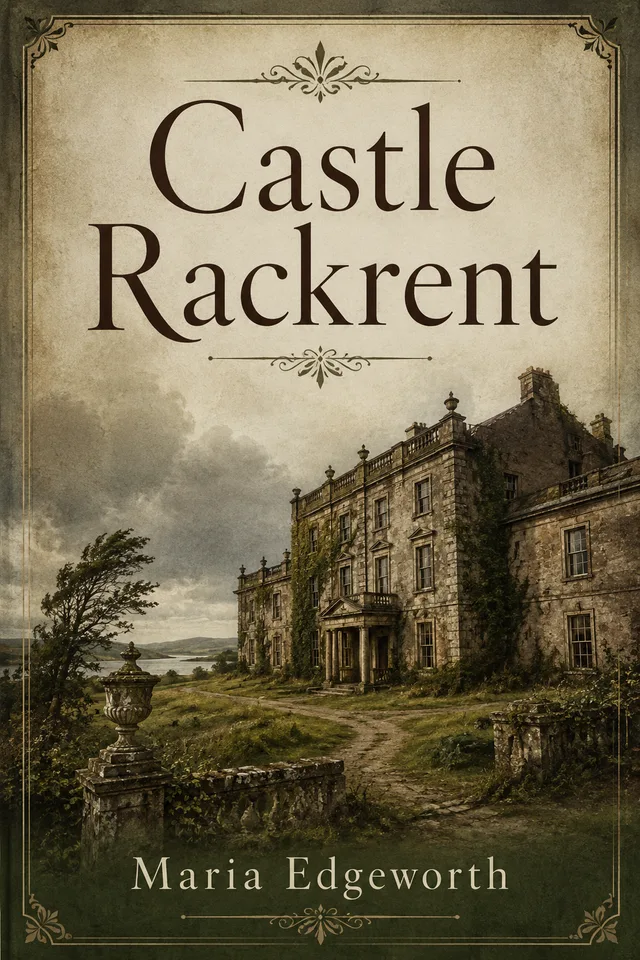
Castle Rackrent
Édition BooksWhale en anglais par Maria Edgeworth
A sharp Anglo-Irish novel of estate decline, unreliable narration, family power, and social change.
- Aperçu
- Extrait du texte préparé
- Formats
- Lecteur en ligne, EPUB, PDF
- Accès
- Claim Bibliothèque
Introduction du livre
Castle Rackrent
Castle Rackrent is Maria Edgeworth’s compact and influential Anglo-Irish novel, narrated with irony through the fortunes and failures of a landed family. This BooksWhale edition preserves the public-domain English original for readers interested in Irish literature, estate fiction, satire, and early realism.
Édition BooksWhale
Préparation de cette édition
Cette édition repose sur un texte du domaine public et a été préparée par BooksWhale pour la lecture numérique.
Base du domaine public
Pourquoi cette édition peut être partagée
Maria Edgeworth died in 1849, and Castle Rackrent was first published in 1800. These dates support the public-domain basis for this English original edition.
Lire l'aperçu
Extrait du texte préparé
Aperçu sélectionné depuis le texte de lecture préparé.
Chapitre d'aperçuFull textLire l'aperçu
Castle Rackrent
Maria Edgeworth
Chapitre d'aperçuAUTHOR’S PREFACEAperçu
The Prevailing taste of the public for anecdote has been censured and ridiculed by critics who aspire to the character of superior wisdom; but if we consider it in a proper point of view, this taste is an incontestable proof of the good sense and profoundly philosophic temper of the present times. Of the numbers who study, or at least who read history, how few derive any advantage from their labours! The heroes of history are so decked out by the fine fancy of the professed historian; they talk in such measured prose, and act from such sublime or such diabolical motives, that few have sufficient taste, wickedness, or heroism, to sympathise in their fate. Besides, there is much uncertainty even in the best authenticated ancient or modern histories; and that love of truth, which in some minds is innate and immutable, necessarily leads to a love of secret memoirs and private anecdotes. We cannot judge either of the feelings or of the characters of men with perfect accuracy, from their actions or their appearance in public; it is from their careless conversations, their half-finished sentences, that we may hope with the greatest probability of success to discover their real characters. The life of a great or of a little man written by himself, the familiar letters, the diary of any individual published by his friends or by his enemies, after his decease, are esteemed important literary curiosities. We are surely justified, in this eager desire, to collect the most minute facts relative to the domestic lives, not only of the great and good, but even of the worthless and insignificant, since it is only by a comparison of their actual happiness or misery in the privacy of domestic life that we can form a just estimate of the real reward of virtue, or the real punishment of vice. That the great are not as happy as they seem, that the external circumstances of fortune and rank do not constitute felicity, is asserted by every moralist: the historian can seldom, consistently with his dignity, pause to illustrate this truth; it is therefore to the biographer we must have recourse. After we have beheld splendid characters playing their parts on the great theatre of the world, with all the advantages of stage effect and decoration, we anxiously beg to be admitted behind the scenes, that we may take a nearer view of the actors and actresses.
Some may perhaps imagine that the value of biography depends upon the judgment and taste of the biographer; but on the contrary it may be maintained, that the merits of a biographer are inversely as the extent of his intellectual powers and of his literary talents. A plain unvarnished tale is preferable to the most highly ornamented narrative. Where we see that a man has the power, we may naturally suspect that he has the will to deceive us; and those who are used to literary manufacture know how much is often sacrificed to the rounding of a period, or the pointing of an antithesis.
That the ignorant may have their prejudices as well as the learned cannot be disputed; but we see and despise vulgar errors: we never bow to the authority of him who has no great name to sanction his absurdities. The partiality which blinds a biographer to the defects of his hero, in proportion as it is gross, ceases to be dangerous; but if it be concealed by the appearance of candour, which men of great abilities best know how to assume, it endangers our judgment sometimes, and sometimes our morals. If her Grace the Duchess of Newcastle, instead of penning her lord’s elaborate eulogium, had undertaken to write the life of Savage, we should not have been in any danger of mistaking an idle, ungrateful libertine for a man of genius and virtue. The talents of a biographer are often fatal to his reader. For these reasons the public often judiciously countenance those who, without sagacity to discriminate character, without elegance of style to relieve the tediousness of narrative, without enlargement of mind to draw any conclusions from the facts they relate, simply pour forth anecdotes, and retail conversations, with all the minute prolixity of a gossip in a country town.
Chapitre d'aperçu1800.Aperçu
1800.
Table des matières
Dans cette édition
- 01Full text
- 02AUTHOR’S PREFACE
- 031800.
- 04CASTLE RACKRENT
- 05CONTINUATION OF THE MEMOIRS OF THE RACKRENT FAMILY
- 06HISTORY OF SIR CONOLLY RACKRENT
- 07GLOSSARY
Disponibilité linguistique
Autres langues
Aucune autre édition linguistique n'est encore publiée. Cette section les reliera lorsqu'elles seront disponibles.
Demander une autre langue