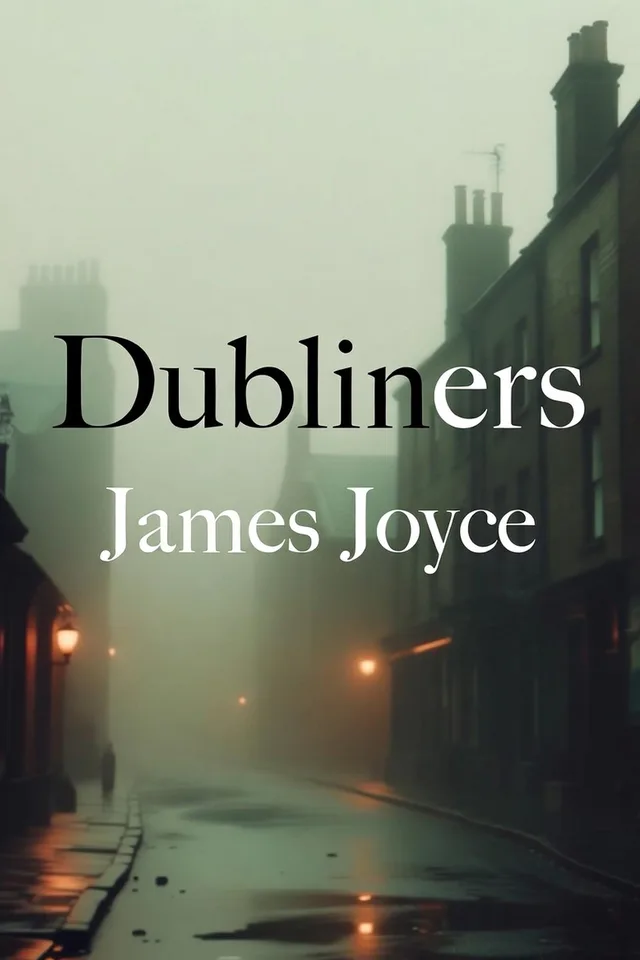
anglais Édition
Littérature
Dubliners
Édition BooksWhale en anglais par James Joyce
A landmark story collection portraying ordinary Dublin lives with restraint and emotional force.
- Aperçu
- Extrait du texte préparé
- Formats
- Lecteur en ligne, EPUB, PDF
- Accès
- Claim Bibliothèque
Introduction du livre
Dubliners
Dubliners gathers stories of childhood, work, love, paralysis, and revelation in early twentieth-century Dublin. Joyce’s precise style gives everyday moments a lasting moral and emotional charge.
Édition BooksWhale
Préparation de cette édition
Cette édition repose sur un texte du domaine public et a été préparée par BooksWhale pour la lecture numérique.
Base du domaine public
Pourquoi cette édition peut être partagée
James Joyce died in 1941, and Dubliners was first published in 1914; these dates support the public-domain basis for this English edition.
Lire l'aperçu
Extrait du texte préparé
Aperçu sélectionné depuis le texte de lecture préparé.
Chapitre d'aperçuFull textLire l'aperçu
Dubliners
James Joyce
Chapitre d'aperçuThe SistersAperçu
There was no hope for him this time: it was the third stroke. Night after night I had passed the house (it was vacation time) and studied the lighted square of window: and night after night I had found it lighted in the same way, faintly and evenly. If he was dead, I thought, I would see the reflection of candles on the darkened blind for I knew that two candles must be set at the head of a corpse. He had often said to me: “I am not long for this world,” and I had thought his words idle. Now I knew they were true. Every night as I gazed up at the window I said softly to myself the word paralysis. It had always sounded strangely in my ears, like the word gnomon in the Euclid and the word simony in the Catechism. But now it sounded to me like the name of some maleficent and sinful being. It filled me with fear, and yet I longed to be nearer to it and to look upon its deadly work.
Old Cotter was sitting at the fire, smoking, when I came downstairs to supper. While my aunt was ladling out my stirabout he said, as if returning to some former remark of his:
“No, I wouldn’t say he was exactly ... but there was something queer ... there was something uncanny about him. I’ll tell you my opinion....”
He began to puff at his pipe, no doubt arranging his opinion in his mind. Tiresome old fool! When we knew him first he used to be rather interesting, talking of faints and worms; but I soon grew tired of him and his endless stories about the distillery.
“I have my own theory about it,” he said. “I think it was one of those ... peculiar cases.... But it’s hard to say....”
He began to puff again at his pipe without giving us his theory. My uncle saw me staring and said to me:
“Well, so your old friend is gone, you’ll be sorry to hear.”
“Who?” said I.
“Father Flynn.”
“Is he dead?”
“Mr Cotter here has just told us. He was passing by the house.”
I knew that I was under observation so I continued eating as if the news had not interested me. My uncle explained to old Cotter.
“The youngster and he were great friends. The old chap taught him a great deal, mind you; and they say he had a great wish for him.”
“God have mercy on his soul,” said my aunt piously.
Old Cotter looked at me for a while. I felt that his little beady black eyes were examining me but I would not satisfy him by looking up from my plate. He returned to his pipe and finally spat rudely into the grate.
“I wouldn’t like children of mine,” he said, “to have too much to say to a man like that.”
“How do you mean, Mr Cotter?” asked my aunt.
“What I mean is,” said old Cotter, “it’s bad for children. My idea is: let a young lad run about and play with young lads of his own age and not be.... Am I right, Jack?”
“That’s my principle, too,” said my uncle. “Let him learn to box his corner. That’s what I’m always saying to that Rosicrucian there: take exercise. Why, when I was a nipper every morning of my life I had a cold bath, winter and summer. And that’s what stands to me now. Education is all very fine and large.... Mr Cotter might take a pick of that leg mutton,” he added to my aunt.
“No, no, not for me,” said old Cotter.
My aunt brought the dish from the safe and put it on the table.
“But why do you think it’s not good for children, Mr Cotter?” she asked.
Chapitre d'aperçuAn EncounterAperçu
It was Joe Dillon who introduced the Wild West to us. He had a little library made up of old numbers of The Union Jack, Pluck and The Halfpenny Marvel. Every evening after school we met in his back garden and arranged Indian battles. He and his fat young brother Leo, the idler, held the loft of the stable while we tried to carry it by storm; or we fought a pitched battle on the grass. But, however well we fought, we never won siege or battle and all our bouts ended with Joe Dillon’s war dance of victory. His parents went to eight-o’clock mass every morning in Gardiner Street and the peaceful odour of Mrs Dillon was prevalent in the hall of the house. But he played too fiercely for us who were younger and more timid. He looked like some kind of an Indian when he capered round the garden, an old tea-cosy on his head, beating a tin with his fist and yelling:
“Ya! yaka, yaka, yaka!”
Everyone was incredulous when it was reported that he had a vocation for the priesthood. Nevertheless it was true.
A spirit of unruliness diffused itself among us and, under its influence, differences of culture and constitution were waived. We banded ourselves together, some boldly, some in jest and some almost in fear: and of the number of these latter, the reluctant Indians who were afraid to seem studious or lacking in robustness, I was one. The adventures related in the literature of the Wild West were remote from my nature but, at least, they opened doors of escape. I liked better some American detective stories which were traversed from time to time by unkempt fierce and beautiful girls. Though there was nothing wrong in these stories and though their intention was sometimes literary they were circulated secretly at school. One day when Father Butler was hearing the four pages of Roman History clumsy Leo Dillon was discovered with a copy of The Halfpenny Marvel.
“This page or this page? This page? Now, Dillon, up! ‘Hardly had the day’.... Go on! What day? ‘Hardly had the day dawned’.... Have you studied it? What have you there in your pocket?”
Everyone’s heart palpitated as Leo Dillon handed up the paper and everyone assumed an innocent face. Father Butler turned over the pages, frowning.
“What is this rubbish?” he said. “The Apache Chief! Is this what you read instead of studying your Roman History? Let me not find any more of this wretched stuff in this college. The man who wrote it, I suppose, was some wretched fellow who writes these things for a drink. I’m surprised at boys like you, educated, reading such stuff. I could understand it if you were ... National School boys. Now, Dillon, I advise you strongly, get at your work or....”
This rebuke during the sober hours of school paled much of the glory of the Wild West for me and the confused puffy face of Leo Dillon awakened one of my consciences. But when the restraining influence of the school was at a distance I began to hunger again for wild sensations, for the escape which those chronicles of disorder alone seemed to offer me. The mimic warfare of the evening became at last as wearisome to me as the routine of school in the morning because I wanted real adventures to happen to myself. But real adventures, I reflected, do not happen to people who remain at home: they must be sought abroad.
The summer holidays were near at hand when I made up my mind to break out of the weariness of school-life for one day at least. With Leo Dillon and a boy named Mahony I planned a day’s miching. Each of us saved up sixpence. We were to meet at ten in the morning on the Canal Bridge. Mahony’s big sister was to write an excuse for him and Leo Dillon was to tell his brother to say he was sick. We arranged to go along the Wharf Road until we came to the ships, then to cross in the ferryboat and walk out to see the Pigeon House. Leo Dillon was afraid we might meet Father Butler or someone out of the college; but Mahony asked, very sensibly, what would Father Butler be doing out at the Pigeon House. We were reassured: and I brought the first stage of the plot to an end by collecting sixpence from the other two, at the same time showing them my own sixpence. When we were making the last arrangements on the eve we were all vaguely excited. We shook hands, laughing, and Mahony said:
Table des matières
Dans cette édition
- 01Full text
- 02The Sisters
- 03An Encounter
- 04Araby
- 05Eveline
- 06After the Race
- 07Two Gallants
- 08The Boarding House
- 09A Little Cloud
- 10Counterparts
- 11Clay
- 12A Painful Case
- 13Ivy Day in the Committee Room
- 14A Mother
- 15Grace
- 16The Dead
Disponibilité linguistique
Autres langues
Aucune autre édition linguistique n'est encore publiée. Cette section les reliera lorsqu'elles seront disponibles.
Demander une autre langue