anglais Édition
Éducation
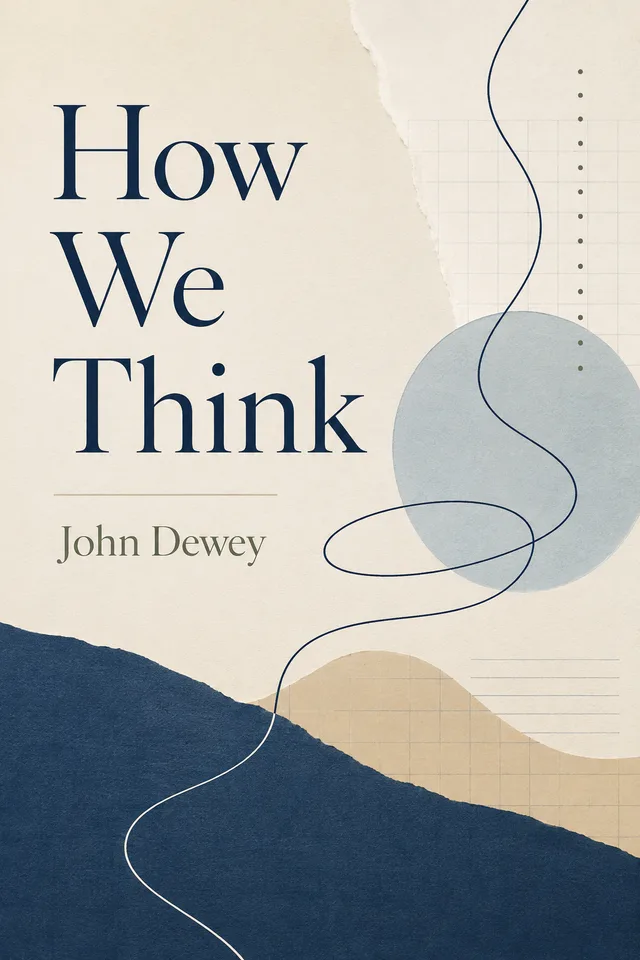
How We Think
Édition BooksWhale en anglais par John Dewey
Dewey’s practical classic on reflective thought, education, judgment, inquiry, habit, and disciplined learning.
- Aperçu
- Extrait du texte préparé
- Formats
- Lecteur en ligne, EPUB, PDF
- Accès
- Claim Bibliothèque
Introduction du livre
How We Think
How We Think explains reflective thinking as a trainable habit: observation, doubt, inference, evidence, and judgment. John Dewey connects philosophy, psychology, and classroom practice in a clear English work central to modern education and critical thinking.
Édition BooksWhale
Préparation de cette édition
Cette édition repose sur un texte du domaine public et a été préparée par BooksWhale pour la lecture numérique.
Base du domaine public
Pourquoi cette édition peut être partagée
John Dewey died in 1952, and How We Think was first published in 1910. Its publication history supports the public-domain basis for this English original edition.
Lire l'aperçu
Extrait du texte préparé
Aperçu sélectionné depuis le texte de lecture préparé.
Chapitre d'aperçuFull textLire l'aperçu
How We Think
John Dewey
Chapitre d'aperçuPREFACEAperçu
Our schools are troubled with a multiplication of studies, each in turn having its own multiplication of materials and principles. Our teachers find their tasks made heavier in that they have come to deal with pupils individually and not merely in mass. Unless these steps in advance are to end in distraction, some clew of unity, some principle that makes for simplification, must be found. This book represents the conviction that the needed steadying and centralizing factor is found in adopting as the end of endeavor that attitude of mind, that habit of thought, which we call scientific. This scientific attitude of mind might, conceivably, be quite irrelevant to teaching children and youth. But this book also represents the conviction that such is not the case; that the native and unspoiled attitude of childhood, marked by ardent curiosity, fertile imagination, and love of experimental inquiry, is near, very near, to the attitude of the scientific mind. If these pages assist any to appreciate this kinship and to consider seriously how its recognition in educational practice would make for individual happiness and the reduction of social waste, the book will amply have served its purpose.
It is hardly necessary to enumerate the authors to whom I am indebted. My fundamental indebtedness is to my wife, by whom the ideas of this book were inspired, and through whose work in connection with the Laboratory School, existing in Chicago between 1896 and 1903, the ideas attained such concreteness as comes from embodiment and testing in practice. It is a pleasure, also, to acknowledge indebtedness to the intelligence and sympathy of those who cooeperated as teachers and supervisors in the conduct of that school, and especially to Mrs. Ella Flagg Young, then a colleague in the University, and now Superintendent of the Schools of Chicago.
Chapitre d'aperçuHOW WE THINKAperçu
HOW WE THINK
Table des matières
Dans cette édition
- 01Full text
- 02PREFACE
- 03HOW WE THINK
- 04PART ONE: THE PROBLEM OF TRAINING THOUGHT
- 05CHAPTER ONE
- 06WHAT IS THOUGHT?
- 07CHAPTER TWO
- 08THE NEED FOR TRAINING THOUGHT
- 09CHAPTER THREE
- 10NATURAL RESOURCES IN THE TRAINING OF THOUGHT
- 11CHAPTER FOUR
- 12SCHOOL CONDITIONS AND THE TRAINING OF THOUGHT
- 13CHAPTER FIVE
- 14THE MEANS AND END OF MENTAL TRAINING: THE PSYCHOLOGICAL AND THE LOGICAL
- 15PART TWO: LOGICAL CONSIDERATIONS
- 16CHAPTER SIX
- 17THE ANALYSIS OF A COMPLETE ACT OF THOUGHT
- 18CHAPTER SEVEN
- 19SYSTEMATIC INFERENCE: INDUCTION AND DEDUCTION
- 20CHAPTER EIGHT
- 21JUDGMENT: THE INTERPRETATION OF FACTS
- 22CHAPTER NINE
- 23MEANING: OR CONCEPTIONS AND UNDERSTANDING
- 24I. MEANING AND UNDERSTANDING
- 25II. DIRECT AND INDIRECT UNDERSTANDING
- 26CHAPTER TEN
- 27CONCRETE AND ABSTRACT THINKING
- 28CHAPTER ELEVEN
- 29EMPIRICAL AND SCIENTIFIC THINKING
- 30PART THREE: THE TRAINING OF THOUGHT
- 31CHAPTER TWELVE
- 32ACTIVITY AND THE TRAINING OF THOUGHT
- 33CHAPTER THIRTEEN
- 34LANGUAGE AND THE TRAINING OF THOUGHT
- 35CHAPTER FOURTEEN
- 36OBSERVATION AND INFORMATION IN THE TRAINING OF MIND
- 37CHAPTER FIFTEEN
- 38THE RECITATION AND THE TRAINING OF THOUGHT
- 39CHAPTER SIXTEEN
- 40SOME GENERAL CONCLUSIONS
Disponibilité linguistique
Autres langues
Aucune autre édition linguistique n'est encore publiée. Cette section les reliera lorsqu'elles seront disponibles.
Demander une autre langue