anglais Édition
Histoire
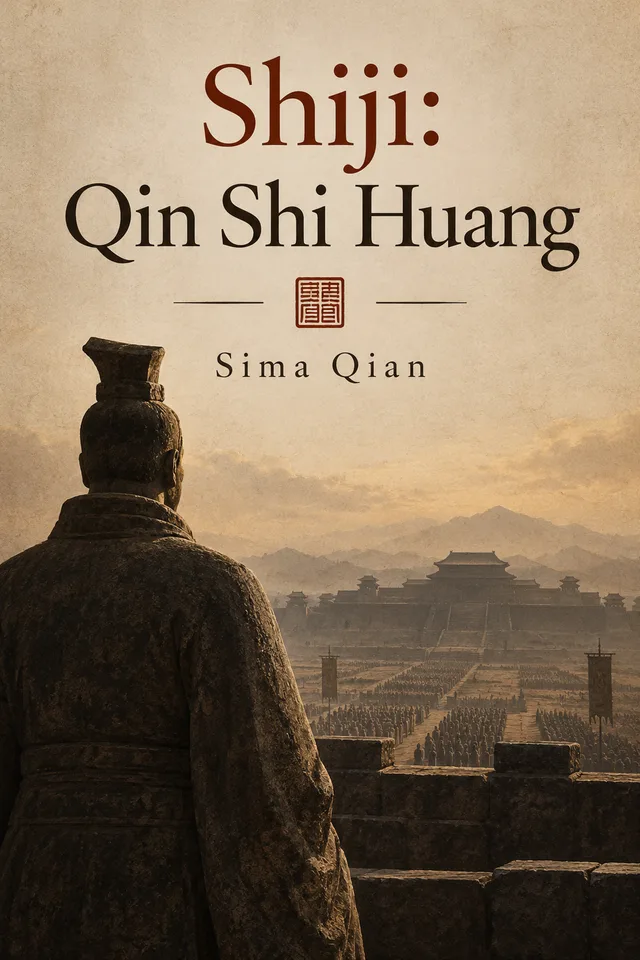
Shiji: Qin Shi Huang
Édition BooksWhale en anglais par Sima Qian
Titre original: 史记:秦始皇
Sima Qian’s account of Qin’s First Emperor is joined by biographies of Wang Jian, Lü Buwei, and Li Si.
- Aperçu
- Extrait du texte préparé
- Formats
- Lecteur en ligne, EPUB, PDF
- Accès
- Claim Bibliothèque
Introduction du livre
Shiji: Qin Shi Huang
This new English translation brings together four parts of Sima Qian’s Shiji: the account of Qin Shi Huang and the biographies of Wang Jian, Lü Buwei, and Li Si. Military campaigns, court alliances, administrative decisions, and succession struggles reveal the people who shaped Qin’s rise and collapse. The imperial narrative and three biographies offer connected perspectives on conquest, unification, political power, and personal responsibility.
Édition BooksWhale
Préparation de cette édition
Cette édition est une traduction assistée par IA et revue par des humains, préparée par BooksWhale pour la lisibilité, la mise en forme et la cohérence.
Base du domaine public
Pourquoi cette édition peut être partagée
Sima Qian’s Shiji was compiled in the first century BCE. This edition presents the account of Qin Shi Huang and the biographies of Wang Jian, Lü Buwei, and Li Si in a new AI-assisted English translation reviewed by the publisher.
Lire l'aperçu
Extrait du texte préparé
Aperçu sélectionné depuis le texte de lecture préparé.
Chapitre d'aperçuFull textLire l'aperçu
Shiji: Qin Shi Huang
Chapitre d'aperçuQin Shi HuangAperçu
Qin Shi Huang, the First Emperor of Qin, was the son of King Zhuangxiang of Qin. When King Zhuangxiang was serving as a hostage of Qin in the state of Zhao, he met one of Lü Buwei's concubines and was greatly attracted to her. He married her, and she gave birth to the First Emperor. The First Emperor was born in Handan in the first month of the forty-eighth year of King Zhao of Qin. At birth, he was given the personal name Zheng and the surname Zhao.
When Zheng was thirteen years old, King Zhuangxiang died, and Zheng succeeded him as King of Qin. By this time, Qin had already annexed Ba, Shu, and Hanzhong. Its territory had extended beyond Wan to occupy Ying, where Nanjun Commandery had been established. In the north, Qin had taken the lands east of Shangjun and occupied the commanderies of Hedong, Taiyuan, and Shangdang. In the east, it had advanced as far as Xingyang, destroyed both the Eastern and Western Zhou states, and established Sanchuan Commandery.
Lü Buwei served as chancellor and received a fief containing 100,000 households, together with the title Marquis Wenxin. He recruited guests and wandering scholars, hoping to rely on their assistance in annexing the entire realm. Li Si served as a household retainer, while Meng Ao, Wang He, Biao Gong, and others served as generals. Because the King of Qin was young and had only recently ascended the throne, affairs of state were entrusted to his ministers.
A rebellion broke out in Jinyang County.
In the first year of the king's reign, General Meng Ao attacked the rebels and suppressed the uprising.
In the second year, Biao Gong led troops against Juancheng in the state of Wei and took 30,000 enemy heads.
In the third year, Meng Ao attacked the state of Han and captured thirteen cities. Wang He died that year. In the tenth month, General Meng Ao attacked the Wei territories of Chang and Yougui. A severe famine occurred that year.
In the fourth year, Chang and Yougui were captured. In the third month, the military advance was halted. The Qin hostage returned from Zhao, while the crown prince of Zhao departed Qin and returned to his own country. On the gengyin day of the tenth month, swarms of locusts arrived from the east, obscuring the sun and sky. An epidemic spread throughout the realm. Any commoner who contributed one thousand shi of millet to the government could receive one rank of nobility.
In the fifth year, General Meng Ao attacked Wei and subdued Suanzao. Yan, Xu, Changping, Yongqiu, Shanyang, and other cities were all captured, making twenty cities in total. Qin established Dongjun Commandery for the first time. During the winter, the unusual phenomenon of thunder occurred.
In the sixth year, Han, Wei, Zhao, Wey, and Chu joined forces to attack Qin and seized Shouling. Qin dispatched troops in response, and the allied army of the five states dispersed. Qin forces captured territory belonging to Wey and advanced toward Dongjun. Jiao, ruler of Wey, led his clansmen to Yewang, where he relied on the mountainous terrain to maintain a defensive position in the Henei region of Wei.
In the seventh year, a comet first appeared in the east, then in the north, and in the fifth month appeared again in the west. General Meng Ao died. Qin subsequently sent troops to attack the cities of Long, Gu, and Qingdu, and, on the return march, attacked Ji. At that time the comet appeared once more in the west and remained visible for sixteen days. Empress Dowager Xia died.
In the eighth year, the king's younger brother Chengjiao, Lord Chang'an, led troops to attack Zhao. He rebelled against Qin and died in Tunliu. The military officers who had joined the rebellion were all executed by beheading, and the local population was relocated to Lintao. General Bi, who had come to suppress Chengjiao's rebellion, also died. Soldiers stationed at Tunliu and Puhu rebelled again, and his corpse was subjected to flogging and mutilation. The Yellow River flooded, causing large numbers of fish to be washed onto its banks. Many people consequently drove their carts and horses eastward, fleeing famine and seeking another means of livelihood.
Chapitre d'aperçuWang JianAperçu
Wang Jian was a native of Dongxiang in Pinyang. He had been interested in military affairs since his youth and had served Qin Shi Huang.
In the eleventh year of Qin Shi Huang's reign, Wang Jian led troops against Eyu in the state of Zhao. After capturing it, he went on to seize nine more cities.
In the eighteenth year of Qin Shi Huang's reign, Wang Jian led an army against Zhao. After more than a year of campaigning, he finally defeated Zhao. The King of Zhao surrendered, and all the territory of Zhao was pacified and reorganized into commanderies.
The following year, the state of Yan sent Jing Ke to Qin to carry out an assassination. Qin Shi Huang dispatched Wang Jian to attack Yan. King Ji Xi of Yan fled to Liaodong, and Wang Jian returned after pacifying Ji, the capital of Yan.
Qin then sent Wang Jian's son, Wang Ben, to attack Chu, whose army was defeated. Wang Ben subsequently turned his forces against Wei. The King of Wei surrendered, and Wang Ben finally pacified all the territory of Wei.
Qin Shi Huang had already destroyed the three states of Han, Zhao, and Wei, driven away the King of Yan, and repeatedly defeated the armies of Chu.
Among Qin's generals was Li Xin, a young and courageous commander. He had once led several thousand soldiers in pursuit of Crown Prince Ji Dan of Yan, chasing him all the way to the Yan River and finally capturing him alive. Qin Shi Huang considered Li Xin capable and brave.
At that time, Qin Shi Huang asked Li Xin:
"I wish to conquer Chu. In your estimation, General, how many men would be sufficient?"
Li Xin replied:
"No more than two hundred thousand."
Qin Shi Huang then asked Wang Jian, who answered:
"Nothing less than six hundred thousand will suffice."
Qin Shi Huang said:
"General Wang has grown old! Why has he become so timid? General Li is resolute and courageous. His assessment is correct."
He therefore dispatched Li Xin and Meng Tian with two hundred thousand soldiers to attack Chu in the south.
Since Wang Jian's advice had not been accepted, he pleaded illness and retired to his home in Pinyang on account of his age.
Li Xin attacked Pingyu, while Meng Tian attacked Qinyi, and both inflicted crushing defeats upon the Chu forces.
Li Xin then attacked Yan and Ying, capturing both cities. He subsequently led his troops westward to join Meng Tian at Chengfu.
The Chu army seized the opportunity to follow the Qin forces closely, pursuing them without pause for three days and three nights. It inflicted a devastating defeat upon Li Xin's army, broke through two fortified camps, and killed seven commandants. The Qin army fled.
When Qin Shi Huang heard the news, he was furious. He personally drove his carriage at great speed to Pinyang, where he apologized to Wang Jian face-to-face:
"Because I did not follow your advice, General, Li Xin has indeed brought disgrace upon the Qin army. Now I hear that the Chu forces are advancing westward every day. Although you are ill, General, can you really bear to abandon me?"
Wang Jian declined, saying:
"I am an old servant, weak and frequently ill, and my mind has grown confused. I hope Your Majesty will choose another capable general."
Qin Shi Huang urged him again:
"Enough, General! Do not refuse me any longer!"
Wang Jian replied:
"If Your Majesty insists upon employing me, I cannot undertake the campaign with fewer than six hundred thousand men."
Qin Shi Huang said:
"Then we shall follow your plan, General."
Wang Jian accordingly set out at the head of an army of six hundred thousand soldiers. Qin Shi Huang personally accompanied him as far as Bashang to see him off.
Before departing, Wang Jian requested extensive grants of fertile fields, residences, gardens, and ponds.
Qin Shi Huang said:
Table des matières
Dans cette édition
- 01Full text
- 02Qin Shi Huang
- 03Wang Jian
- 04Lü Buwei
- 05Li Si
Disponibilité linguistique
Autres langues
Aucune autre édition linguistique n'est encore publiée. Cette section les reliera lorsqu'elles seront disponibles.
Demander une autre langue