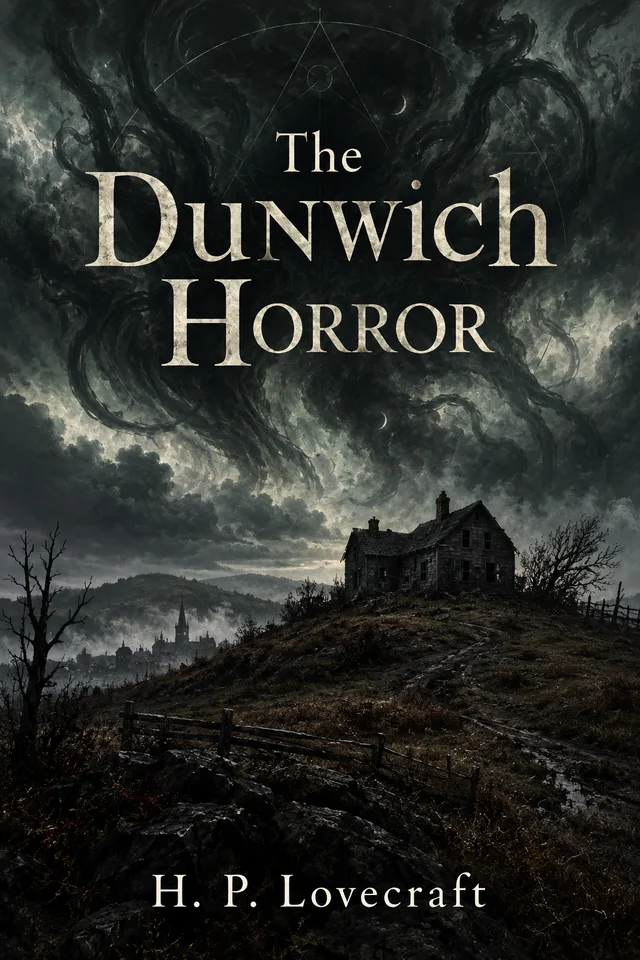
anglais Édition
Littérature
The Dunwich Horror
Édition BooksWhale en anglais par H. P. Lovecraft
A rural Massachusetts family attempts to bring an impossible birth and an older-than-human power into the world.
- Aperçu
- Extrait du texte préparé
- Formats
- Lecteur en ligne, EPUB, PDF
- Accès
- Claim Bibliothèque
Introduction du livre
The Dunwich Horror
In the isolated village of Dunwich, secret rituals and forbidden books surround the strange Wilbur Whateley. The story combines folk horror, occult scholarship, and cosmic terror as ordinary people confront a force that cannot be contained by language or science.
Édition BooksWhale
Préparation de cette édition
Cette édition repose sur un texte du domaine public et a été préparée par BooksWhale pour la lecture numérique.
Base du domaine public
Pourquoi cette édition peut être partagée
The author died before 1955 and the work was first published before 1931; the original English text is treated as public-domain source material for this edition.
Lire l'aperçu
Extrait du texte préparé
Aperçu sélectionné depuis le texte de lecture préparé.
Chapitre d'aperçuPart 1Lire l'aperçu
The Dunwich Horror
H. P. Lovecraft
"Gorgons, and Hydras, and Chimeras—dire stories of Celæno and the Harpies—may reproduce themselves in the brain of superstition—but they were there before. They are transcripts, types—the archetypes are in us, and eternal. How else should the recital of that which we know in a waking sense to be false come to affect us at all? Is it that we naturally conceive terror from such objects, considered in their capacity of being able to inflict upon us bodily injury? Oh, least of all! These terrors are of older standing. They date beyond body—or without the body, they would have been the same.... That the kind of fear here treated is purely spiritual—that it is strong in proportion as it is objectless on earth, that it predominates in the period of our sinless infancy—are difficulties the solution of which might afford some probable insight into our ante-mundane condition, and a peep at least into the shadowland of pre-existence."—Charles Lamb: Witches and Other Night-Fears.
When a traveler in north central Massachusetts takes the wrong fork at the junction of the Aylesbury pike just beyond Dean's Corners he comes upon a lonely and curious country. The ground gets higher, and the brier-bordered stone walls press closer and closer against the ruts of the dusty, curving road. The trees of the frequent forest belts seem too large, and the wild weeds, brambles, and grasses attain a luxuriance not often found in settled regions. At the same time the planted fields appear singularly few and barren; while the sparsely scattered houses wear a surprizing uniform aspect of age, squalor, and dilapidation. Without knowing why, one hesitates to ask directions from the gnarled, solitary figures spied now and then on crumbling doorsteps or in the sloping, rock-strewn meadows. Those figures are so silent and furtive that one feels somehow confronted by forbidden things, with which it would be better to have nothing to do. When a rise in the road brings the mountains in view above the deep woods, the feeling of strange uneasiness is increased. The summits are too rounded and symmetrical to give a sense of comfort and naturalness, and sometimes the sky silhouettes with especial clearness the queer circles of tall stone pillars with which most of them are crowned.
Gorges and ravines of problematical depth intersect the way, and the crude wooden bridges always seem of dubious safety. When the road dips again there are stretches of marshland that one instinctively dislikes, and indeed almost fears at evening when unseen whippoorwills chatter and the fireflies come out in abnormal profusion to dance to the raucous, creepily insistent rhythms of stridently piping bullfrogs. The thin, shining line of the Miskatonic's upper reaches has an oddly serpentlike suggestion as it winds close to the feet of the domed hills among which it rises.
As the hills draw nearer, one heeds their wooded sides more than their stone-crowned tops. Those sides loom up so darkly and precipitously that one wishes they would keep their distance, but there is no road by which to escape them. Across a covered bridge one sees a small village huddled between the stream and the vertical slope of Round Mountain, and wonders at the cluster of rotting gambrel roofs bespeaking an earlier architectural period than that of the neighboring region. It is not reassuring to see, on a closer glance, that most of the houses are deserted and falling to ruin, and that the broken-steepled church now harbors the one slovenly mercantile establishment of the hamlet. One dreads to trust the tenebrous tunnel of the bridge, yet there is no way to avoid it. Once across, it is hard to prevent the impression of a faint, malign odor about the village street, as of the massed mold and decay of centuries. It is always a relief to get clear of the place, and to follow the narrow road around the base of the hills and across the level country beyond till it rejoins the Aylesbury pike. Afterward one sometimes learns that one has been through Dunwich.
Chapitre d'aperçuPart 2Aperçu
"I made some use of 'em," he would say as he tried to mend a torn black-letter page with paste prepared on the rusty kitchen stove, "but the boy's fitten to make better use of 'em. He'd orter hev 'em as well sot as he kin for they're goin' to be all of his larnin'."
When Wilbur was a year and seven months old—in September of 1914—his size and accomplishments were almost alarming. He had grown as large as a child of four, and was a fluent and incredibly intelligent talker. He ran freely about the fields and hills, and accompanied his mother on all her wanderings. At home he would pore diligently over the queer pictures and charts in his grandfather's books, while Old Whateley would instruct and catechize him through long, hushed afternoons. By this time the restoration of the house was finished, and those who watched it wondered why one of the upper windows had been made into a solid plank door. It was a window in the rear of the east gable end, close against the hill; and no one could imagine why a cleated wooden runway was built up to it from the ground. About the period of this work's completion people noticed that the old tool-house, tightly locked and windowlessly clapboarded since Wilbur's birth, had been abandoned again. The door swung listlessly open, and when Earl Sawyer once stepped within after a cattle-selling call on Old Whateley he was quite discomposed by the singular odor he encountered—such a stench, he averred, as he had never before smelt in all his life except near the Indian circles on the hills, and which could not come from anything sane or of this earth. But then, the homes and sheds of Dunwich folk have never been remarkable for olfactory immaculateness.
The following months were void of visible events, save that everyone swore to a slow but steady increase in the mysterious hill noises. On May Eve of 1915 there were tremors which even the Aylesbury people felt, whilst the following Hallowe'en produced an underground rumbling queerly synchronized with bursts of flame—"them witch Whateleys' doin's"—from the summit of Sentinel Hill. Wilbur was growing up uncannily, so that he looked like a boy of ten as he entered his fourth year. He read avidly by himself now; but talked much less than formerly. A settled taciturnity was absorbing him, and for the first time people began to speak specifically of the dawning look of evil in his goatish face. He would sometimes mutter an unfamiliar jargon, and chant in bizarre rhythms which chilled the listener with a sense of unexplainable terror. The aversion displayed toward him by dogs had now become a matter of wide remark, and he was obliged to carry a pistol in order to traverse the countryside in safety. His occasional use of the weapon did not enhance his popularity amongst the owners of canine guardians.
The few callers at the house would often find Lavinia alone on the ground floor, while odd cries and footsteps resounded in the boarded-up second story. She would never tell what her father and the boy were doing up there, though once she turned pale and displayed an abnormal degree of fear when a jocose fish-peddler tried the locked door leading to the stairway. That peddler told the store loungers at Dunwich Village that he thought he heard a horse stamping on that floor above. The loungers reflected, thinking of the door and runway, and of the cattle that so swiftly disappeared. Then they shuddered as they recalled tales of Old Whateley's youth, and of the strange things that are called out of the earth when a bullock is sacrificed at the proper time to certain heathen gods. It had for some time been noticed that dogs had begun to hate and fear the whole Whateley place as violently as they hated and feared young Wilbur personally.
Chapitre d'aperçuPart 3Aperçu
Presently Wilbur raised his head and began speaking in that strange, resonant fashion which hinted at sound-producing organs unlike the run of mankind's.
"Mr. Armitage," he said, "I calc'late I've got to take that book home. They's things in it I've got to try under sarten conditions that I can't git here, an' it 'ud be a mortal sin to let a red-tape rule hold me up. Let me take it along, sir, an' I'll swar they wun't nobody know the difference. I dun't need to tell ye I'll take good keer of it. It wa'n't me that put this Dee copy in the shape it is...."
He stopped as he saw firm denial on the librarian's face, and his own goatish features grew crafty. Armitage, half ready to tell him he might make a copy of what parts he needed, thought suddenly of the possible consequences and checked himself. There was too much responsibility in giving such a being the key to such blasphemous outer spheres. Whateley saw how things stood, and tried to answer lightly.
"Wal, all right, ef ye feel that way abaout it. Maybe Harvard wun't be so fussy as yew be." And without saying more he rose and strode out of the building, stooping at each doorway.
Armitage heard the savage yelping of the great watchdog, and studied Whateley's gorilla-like lope as he crossed the bit of campus visible from the window. He thought of the wild tales he had heard, and recalled the old Sunday stories in the Advertiser; these things, and the lore he had picked up from Dunwich rustics and villagers during his one visit there. Unseen things not of earth—or at least not of tri-dimensional earth—rushed fetid and horrible through New England's glens, and brooded obscenely on the mountain tops. Of this he had long felt certain. Now he seemed to sense the close presence of some terrible part of the intruding horror, and to glimpse a hellish advance in the black dominion of the ancient and once passive nightmare. He locked away the Necronomicon with a shudder of disgust, but the room still reeked with an unholy and unidentifiable stench. "As a foulness shall ye know them," he quoted. Yes—the odor was the same as that which had sickened him at the Whateley farmhouse less than three years before. He thought of Wilbur, goatish and ominous, once again, and laughed mockingly at the village rumors of his parentage.
"Inbreeding?" Armitage muttered half aloud to himself. "Great God, what simpletons! Show them Arthur Machen's Great God Pan and they'll think it a common Dunwich scandal! But what thing—what cursed shapeless influence on or off this three-dimensioned earth—was Wilbur Whateley's father? Born on Candlemas—nine months after May Eve of 1912, when the talk about the queer earth noises reached clear to Arkham—what walked on the mountains that May Night? What Roodmas horror fastened itself on the world in half-human flesh and blood?"
During the ensuing weeks Dr. Armitage set about to collect all possible data on Wilbur Whateley and the formless presences around Dunwich. He got in communication with Dr. Houghton of Aylesbury, who had attended Old Whateley in his last illness, and found much to ponder over in the grandfather's last words as quoted by the physician. A visit to Dunwich Village failed to bring out much that was new; but a close survey of the Necronomicon, in those parts which Wilbur had sought so avidly, seemed to supply new and terrible clues to the nature, methods, and desires of the strange evil so vaguely threatening this planet. Talks with several students of archaic lore in Boston, and letters to many others elsewhere, gave him a growing amazement which passed slowly through varied degrees of alarm to a state of really acute spiritual fear. As the summer drew on he felt dimly that something ought to be done about the lurking terrors of the upper Miskatonic valley, and about the monstrous being known to the human world as Wilbur Whateley.
Table des matières
Dans cette édition
- 01Part 1
- 02Part 2
- 03Part 3
- 04Part 4
- 05Part 5
- 06Part 6
Disponibilité linguistique
Autres langues
Aucune autre édition linguistique n'est encore publiée. Cette section les reliera lorsqu'elles seront disponibles.
Demander une autre langue