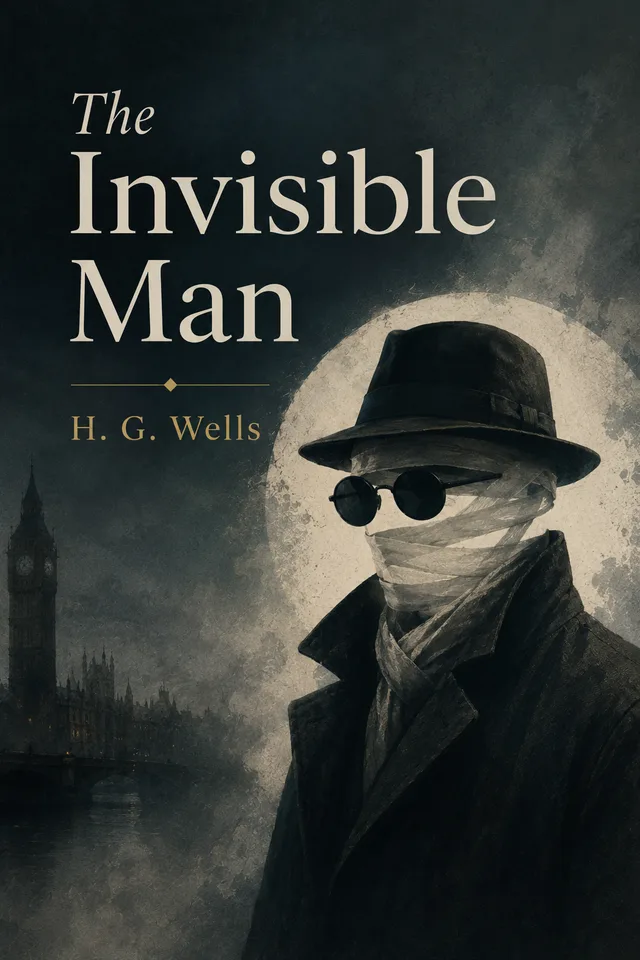
anglais Édition
Littérature
The Invisible Man
Édition BooksWhale en anglais par H. G. Wells
A tense science-fiction novel about invisibility, isolation, power, and moral collapse.
- Aperçu
- Extrait du texte préparé
- Formats
- Lecteur en ligne, EPUB, PDF
- Accès
- Claim Bibliothèque
Introduction du livre
The Invisible Man
The Invisible Man follows Griffin, a scientist whose experiment gives him power while stripping away restraint and connection. Wells combines scientific fantasy with social and psychological suspense.
Édition BooksWhale
Préparation de cette édition
Cette édition repose sur un texte du domaine public et a été préparée par BooksWhale pour la lecture numérique.
Base du domaine public
Pourquoi cette édition peut être partagée
H. G. Wells died in 1946, and The Invisible Man was first published in 1897; these dates support the public-domain basis for this English edition.
Lire l'aperçu
Extrait du texte préparé
Aperçu sélectionné depuis le texte de lecture préparé.
Chapitre d'aperçuFull textLire l'aperçu
The Invisible Man
H. G. Wells
CHAPTER I. THE STRANGE MAN’S ARRIVAL
The stranger came early in February, one wintry day, through a biting wind and a driving snow, the last snowfall of the year, over the down, walking from Bramblehurst railway station, and carrying a little black portmanteau in his thickly gloved hand. He was wrapped up from head to foot, and the brim of his soft felt hat hid every inch of his face but the shiny tip of his nose; the snow had piled itself against his shoulders and chest, and added a white crest to the burden he carried. He staggered into the “Coach and Horses” more dead than alive, and flung his portmanteau down. “A fire,” he cried, “in the name of human charity! A room and a fire!” He stamped and shook the snow from off himself in the bar, and followed Mrs. Hall into her guest parlour to strike his bargain. And with that much introduction, that and a couple of sovereigns flung upon the table, he took up his quarters in the inn.
Mrs. Hall lit the fire and left him there while she went to prepare him a meal with her own hands. A guest to stop at Iping in the wintertime was an unheard-of piece of luck, let alone a guest who was no “haggler,” and she was resolved to show herself worthy of her good fortune. As soon as the bacon was well under way, and Millie, her lymphatic maid, had been brisked up a bit by a few deftly chosen expressions of contempt, she carried the cloth, plates, and glasses into the parlour and began to lay them with the utmost éclat. Although the fire was burning up briskly, she was surprised to see that her visitor still wore his hat and coat, standing with his back to her and staring out of the window at the falling snow in the yard. His gloved hands were clasped behind him, and he seemed to be lost in thought. She noticed that the melting snow that still sprinkled his shoulders dripped upon her carpet. “Can I take your hat and coat, sir?” she said, “and give them a good dry in the kitchen?”
“No,” he said without turning.
She was not sure she had heard him, and was about to repeat her question.
He turned his head and looked at her over his shoulder. “I prefer to keep them on,” he said with emphasis, and she noticed that he wore big blue spectacles with sidelights, and had a bush side-whisker over his coat-collar that completely hid his cheeks and face.
“Very well, sir,” she said. “As you like. In a bit the room will be warmer.”
He made no answer, and had turned his face away from her again, and Mrs. Hall, feeling that her conversational advances were ill-timed, laid the rest of the table things in a quick staccato and whisked out of the room. When she returned he was still standing there, like a man of stone, his back hunched, his collar turned up, his dripping hat-brim turned down, hiding his face and ears completely. She put down the eggs and bacon with considerable emphasis, and called rather than said to him, “Your lunch is served, sir.”
“Thank you,” he said at the same time, and did not stir until she was closing the door. Then he swung round and approached the table with a certain eager quickness.
As she went behind the bar to the kitchen she heard a sound repeated at regular intervals. Chirk, chirk, chirk, it went, the sound of a spoon being rapidly whisked round a basin. “That girl!” she said. “There! I clean forgot it. It’s her being so long!” And while she herself finished mixing the mustard, she gave Millie a few verbal stabs for her excessive slowness. She had cooked the ham and eggs, laid the table, and done everything, while Millie (help indeed!) had only succeeded in delaying the mustard. And him a new guest and wanting to stay! Then she filled the mustard pot, and, putting it with a certain stateliness upon a gold and black tea-tray, carried it into the parlour.
Chapitre d'aperçuThe EpilogueAperçu
So ends the story of the strange and evil experiments of the Invisible Man. And if you would learn more of him you must go to a little inn near Port Stowe and talk to the landlord. The sign of the inn is an empty board save for a hat and boots, and the name is the title of this story. The landlord is a short and corpulent little man with a nose of cylindrical proportions, wiry hair, and a sporadic rosiness of visage. Drink generously, and he will tell you generously of all the things that happened to him after that time, and of how the lawyers tried to do him out of the treasure found upon him.
“When they found they couldn’t prove whose money was which, I’m blessed,” he says, “if they didn’t try to make me out a blooming treasure trove! Do I look like a Treasure Trove? And then a gentleman gave me a guinea a night to tell the story at the Empire Music ’All—just to tell ’em in my own words—barring one.”
And if you want to cut off the flow of his reminiscences abruptly, you can always do so by asking if there weren’t three manuscript books in the story. He admits there were and proceeds to explain, with asseverations that everybody thinks he has ’em! But bless you! he hasn’t. “The Invisible Man it was took ’em off to hide ’em when I cut and ran for Port Stowe. It’s that Mr. Kemp put people on with the idea of my having ’em.”
And then he subsides into a pensive state, watches you furtively, bustles nervously with glasses, and presently leaves the bar.
He is a bachelor man—his tastes were ever bachelor, and there are no women folk in the house. Outwardly he buttons—it is expected of him—but in his more vital privacies, in the matter of braces for example, he still turns to string. He conducts his house without enterprise, but with eminent decorum. His movements are slow, and he is a great thinker. But he has a reputation for wisdom and for a respectable parsimony in the village, and his knowledge of the roads of the South of England would beat Cobbett.
And on Sunday mornings, every Sunday morning, all the year round, while he is closed to the outer world, and every night after ten, he goes into his bar parlour, bearing a glass of gin faintly tinged with water, and having placed this down, he locks the door and examines the blinds, and even looks under the table. And then, being satisfied of his solitude, he unlocks the cupboard and a box in the cupboard and a drawer in that box, and produces three volumes bound in brown leather, and places them solemnly in the middle of the table. The covers are weather-worn and tinged with an algal green—for once they sojourned in a ditch and some of the pages have been washed blank by dirty water. The landlord sits down in an armchair, fills a long clay pipe slowly—gloating over the books the while. Then he pulls one towards him and opens it, and begins to study it—turning over the leaves backwards and forwards.
His brows are knit and his lips move painfully. “Hex, little two up in the air, cross and a fiddle-de-dee. Lord! what a one he was for intellect!”
Presently he relaxes and leans back, and blinks through his smoke across the room at things invisible to other eyes. “Full of secrets,” he says. “Wonderful secrets!”
“Once I get the haul of them—Lord!”
“I wouldn’t do what he did; I’d just—well!” He pulls at his pipe.
So he lapses into a dream, the undying wonderful dream of his life. And though Kemp has fished unceasingly, no human being save the landlord knows those books are there, with the subtle secret of invisibility and a dozen other strange secrets written therein. And none other will know of them until he dies.
Table des matières
Dans cette édition
- 01Full text
- 02The Epilogue
Disponibilité linguistique
Autres langues
Aucune autre édition linguistique n'est encore publiée. Cette section les reliera lorsqu'elles seront disponibles.
Demander une autre langue