anglais Édition
Littérature
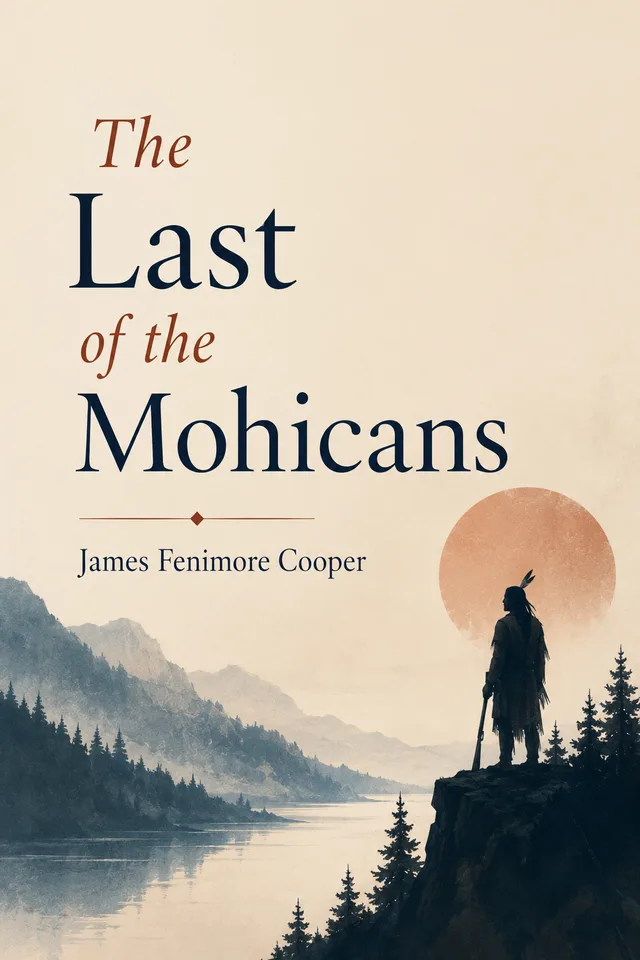
The Last of the Mohicans
Édition BooksWhale en anglais par James Fenimore Cooper
A frontier adventure of conflict, loyalty, survival, and historical imagination.
- Aperçu
- Extrait du texte préparé
- Formats
- Lecteur en ligne, EPUB, PDF
- Accès
- Claim Bibliothèque
Introduction du livre
The Last of the Mohicans
The Last of the Mohicans follows pursuit, alliance, danger, and loss during the French and Indian War. Cooper’s novel is one of the most influential frontier romances in American literature.
Édition BooksWhale
Préparation de cette édition
Cette édition repose sur un texte du domaine public et a été préparée par BooksWhale pour la lecture numérique.
Base du domaine public
Pourquoi cette édition peut être partagée
James Fenimore Cooper died in 1851, and The Last of the Mohicans was first published in 1826; these dates support the public-domain basis for this English edition.
Lire l'aperçu
Extrait du texte préparé
Aperçu sélectionné depuis le texte de lecture préparé.
Chapitre d'aperçuFull textLire l'aperçu
The Last of the Mohicans
James Fenimore Cooper
Chapitre d'aperçuIntroductionAperçu
It is believed that the scene of this tale, and most of the information necessary to understand its allusions, are rendered sufficiently obvious to the reader in the text itself, or in the accompanying notes. Still there is so much obscurity in the Indian traditions, and so much confusion in the Indian names, as to render some explanation useful.
Few men exhibit greater diversity, or, if we may so express it, greater antithesis of character, than the native warrior of North America. In war, he is daring, boastful, cunning, ruthless, self-denying, and self-devoted; in peace, just, generous, hospitable, revengeful, superstitious, modest, and commonly chaste. These are qualities, it is true, which do not distinguish all alike; but they are so far the predominating traits of these remarkable people as to be characteristic.
It is generally believed that the Aborigines of the American continent have an Asiatic origin. There are many physical as well as moral facts which corroborate this opinion, and some few that would seem to weigh against it.
The color of the Indian, the writer believes, is peculiar to himself, and while his cheek-bones have a very striking indication of a Tartar origin, his eyes have not. Climate may have had great influence on the former, but it is difficult to see how it can have produced the substantial difference which exists in the latter. The imagery of the Indian, both in his poetry and in his oratory, is oriental; chastened, and perhaps improved, by the limited range of his practical knowledge. He draws his metaphors from the clouds, the seasons, the birds, the beasts, and the vegetable world. In this, perhaps, he does no more than any other energetic and imaginative race would do, being compelled to set bounds to fancy by experience; but the North American Indian clothes his ideas in a dress which is different from that of the African, and is oriental in itself. His language has the richness and sententious fullness of the Chinese. He will express a phrase in a word, and he will qualify the meaning of an entire sentence by a syllable; he will even convey different significations by the simplest inflections of the voice.
Philologists have said that there are but two or three languages, properly speaking, among all the numerous tribes which formerly occupied the country that now composes the United States. They ascribe the known difficulty one people have to understand another to corruptions and dialects. The writer remembers to have been present at an interview between two chiefs of the Great Prairies west of the Mississippi, and when an interpreter was in attendance who spoke both their languages. The warriors appeared to be on the most friendly terms, and seemingly conversed much together; yet, according to the account of the interpreter, each was absolutely ignorant of what the other said. They were of hostile tribes, brought together by the influence of the American government; and it is worthy of remark, that a common policy led them both to adopt the same subject. They mutually exhorted each other to be of use in the event of the chances of war throwing either of the parties into the hands of his enemies. Whatever may be the truth, as respects the root and the genius of the Indian tongues, it is quite certain they are now so distinct in their words as to possess most of the disadvantages of strange languages; hence much of the embarrassment that has arisen in learning their histories, and most of the uncertainty which exists in their traditions.
Like nations of higher pretensions, the American Indian gives a very different account of his own tribe or race from that which is given by other people. He is much addicted to overestimating his own perfections, and to undervaluing those of his rival or his enemy; a trait which may possibly be thought corroborative of the Mosaic account of the creation.
Chapitre d'aperçuCHAPTER I.Aperçu
“Mine ear is open, and my heart prepared:
The worst is worldly loss thou canst unfold:—
Say, is my kingdom lost?”—Shakespeare
It was a feature peculiar to the colonial wars of North America, that the toils and dangers of the wilderness were to be encountered before the adverse hosts could meet. A wide and apparently an impervious boundary of forests severed the possessions of the hostile provinces of France and England. The hardy colonist, and the trained European who fought at his side, frequently expended months in struggling against the rapids of the streams, or in effecting the rugged passes of the mountains, in quest of an opportunity to exhibit their courage in a more martial conflict. But, emulating the patience and self-denial of the practiced native warriors, they learned to overcome every difficulty; and it would seem that, in time, there was no recess of the woods so dark, nor any secret place so lovely, that it might claim exemption from the inroads of those who had pledged their blood to satiate their vengeance, or to uphold the cold and selfish policy of the distant monarchs of Europe.
Perhaps no district throughout the wide extent of the intermediate frontiers can furnish a livelier picture of the cruelty and fierceness of the savage warfare of those periods than the country which lies between the head waters of the Hudson and the adjacent lakes.
The facilities which nature had there offered to the march of the combatants were too obvious to be neglected. The lengthened sheet of the Champlain stretched from the frontiers of Canada, deep within the borders of the neighboring province of New York, forming a natural passage across half the distance that the French were compelled to master in order to strike their enemies. Near its southern termination, it received the contributions of another lake, whose waters were so limpid as to have been exclusively selected by the Jesuit missionaries to perform the typical purification of baptism, and to obtain for it the title of lake “du Saint Sacrément.” The less zealous English thought they conferred a sufficient honor on its unsullied fountains, when they bestowed the name of their reigning prince, the second of the house of Hanover. The two united to rob the untutored possessors of its wooded scenery of their native right to perpetuate its original appellation of “Horican.”
As each nation of the Indians had its language or its dialect, they usually gave different names to the same places, though nearly all of their appellations were descriptive of the object. Thus a literal translation of the name of this beautiful sheet of water, used by the tribe that dwelt on its banks, would be “The Tail of the Lake.” Lake George, as it is vulgarly, and now, indeed, legally, called, forms a sort of tail to Lake Champlain, when viewed on the map. Hence, the name.
Winding its way among countless islands, and imbedded in mountains, the “holy lake” extended a dozen leagues still further to the south. With the high plain that there interposed itself to the further passage of the water, commenced a portage of as many miles, which conducted the adventurer to the banks of the Hudson, at a point where, with the usual obstructions of the rapids, or rifts, as they were then termed in the language of the country, the river became navigable to the tide.
While, in the pursuit of their daring plans of annoyance, the restless enterprise of the French even attempted the distant and difficult gorges of the Alleghany, it may easily be imagined that their proverbial acuteness would not overlook the natural advantages of the district we have just described. It became, emphatically, the bloody arena, in which most of the battles for the mastery of the colonies were contested. Forts were erected at the different points that commanded the facilities of the route, and were taken and retaken, razed and rebuilt, as victory alighted on the hostile banners. While the husbandman shrank back from the dangerous passes, within the safer boundaries of the more ancient settlements, armies larger than those that had often disposed of the scepters of the mother countries, were seen to bury themselves in these forests, whence they rarely returned but in skeleton bands, that were haggard with care or dejected by defeat. Though the arts of peace were unknown to this fatal region, its forests were alive with men; its shades and glens rang with the sounds of martial music, and the echoes of its mountains threw back the laugh, or repeated the wanton cry, of many a gallant and reckless youth, as he hurried by them, in the noontide of his spirits, to slumber in a long night of forgetfulness.
Table des matières
Dans cette édition
- 01Full text
- 02Introduction
- 03CHAPTER I.
- 04CHAPTER II.
- 05CHAPTER III.
- 06CHAPTER IV.
- 07CHAPTER V.
- 08CHAPTER VI.
- 09CHAPTER VII.
- 10CHAPTER VIII.
- 11CHAPTER IX.
- 12CHAPTER X.
- 13CHAPTER XI.
- 14CHAPTER XII.
- 15CHAPTER XIII.
- 16CHAPTER XIV.
- 17CHAPTER XV.
- 18CHAPTER XVI.
- 19CHAPTER XVII.
- 20CHAPTER XVIII.
- 21CHAPTER XIX.
- 22CHAPTER XX.
- 23CHAPTER XXI.
- 24CHAPTER XXII.
- 25CHAPTER XXIII.
- 26CHAPTER XXIV.
- 27CHAPTER XXV.
- 28CHAPTER XXVI.
- 29CHAPTER XXVII.
- 30CHAPTER XXVIII.
- 31CHAPTER XXIX.
- 32CHAPTER XXX.
- 33CHAPTER XXXI.
- 34CHAPTER XXXII.
- 35CHAPTER XXXIII.
Disponibilité linguistique
Autres langues
Aucune autre édition linguistique n'est encore publiée. Cette section les reliera lorsqu'elles seront disponibles.
Demander une autre langue