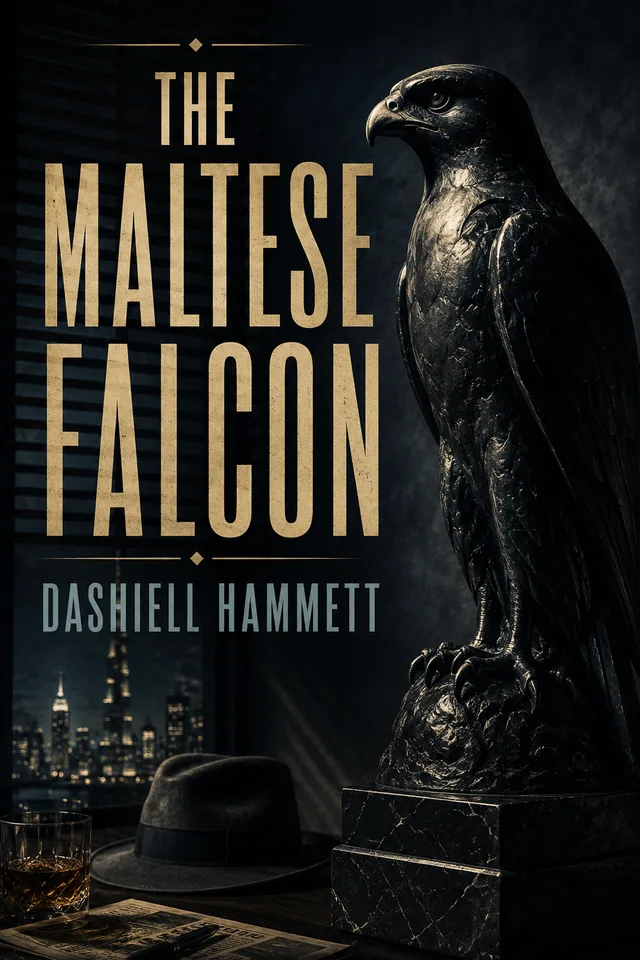
anglais Édition
Littérature
The Maltese Falcon
Édition BooksWhale en anglais par Dashiell Hammett
A hardboiled detective classic of greed, betrayal, crime, and razor-sharp dialogue.
- Aperçu
- Extrait du texte préparé
- Formats
- Lecteur en ligne, EPUB, PDF
- Accès
- Claim Bibliothèque
Introduction du livre
The Maltese Falcon
The Maltese Falcon follows Sam Spade through murder, deception, and the hunt for a legendary treasure. Hammett’s clean style, urban tension, and morally ambiguous characters helped shape the modern detective novel.
Édition BooksWhale
Préparation de cette édition
Cette édition repose sur un texte du domaine public et a été préparée par BooksWhale pour la lecture numérique.
Base du domaine public
Pourquoi cette édition peut être partagée
The Maltese Falcon was first published in 1930. Its pre-1931 publication date supports the public-domain basis for this original English text in the United States.
Lire l'aperçu
Extrait du texte préparé
Aperçu sélectionné depuis le texte de lecture préparé.
Chapitre d'aperçuFull textLire l'aperçu
The Maltese Falcon
Dashiell Hammett
Chapitre d'aperçuSPADE & ARCHERAperçu
SAMUEL SPADE’S jaw was long and bony, his chin a jutting v under the
more flexible v of his mouth. His nostrils curved back to make another,
smaller, v. His yellow-grey eyes were horizontal. The v motif was
picked up again by thickish brows rising outward from twin creases above
a hooked nose, and his pale brown hair grew down—from high flat
temples—in a point on his forehead. He looked rather pleasantly like a
blond satan.
He said to Effie Perine: “Yes, sweetheart?”
She was a lanky sunburned girl whose tan dress of thin woolen stuff
clung to her with an effect of dampness. Her eyes were brown and playful
in a shiny boyish face. She finished shutting the door behind her,
leaned against it, and said: “There’s a girl wants to see you. Her
name’s Wonderly.”
“A customer?”
“I guess so. You’ll want to see her anyway: she’s a knockout.”
“Shoo her in, darling,” said Spade. “Shoo her in.”
Effie Perine opened the door again, following it back into the outer
office, standing with a hand on the knob while saying: “Will you come
in, Miss Wonderly?”
A voice said, “Thank you,” so softly that only the purest articulation
made the words intelligible, and a young woman came through the doorway.
She advanced slowly, with tentative steps, looking at Spade with
cobalt-blue eyes that were both shy and probing.
She was tall and pliantly slender, without angularity anywhere. Her body
was erect and high-breasted, her legs long, her hands and feet narrow.
She wore two shades of blue that had been selected because of her eyes.
The hair curling from under her blue hat was darkly red, her full lips
more brightly red. White teeth glistened in the crescent her timid smile
made.
Spade rose bowing and indicating with a thick-fingered hand the oaken
armchair beside his desk. He was quite six feet tall. The steep rounded
slope of his shoulders made his body seem almost conical—no broader
than it was thick—and kept his freshly pressed grey coat from fitting
very well.
Miss Wonderly murmured, “Thank you,” softly as before and sat down on
the edge of the chair’s wooden seat.
Spade sank into his swivel-chair, made a quarter-turn to face her,
smiled politely. He smiled without separating his lips. All the v’s in
his face grew longer.
The tappity-tap-tap and the thin bell and muffled whir of Effie Perine’s
typewriting came through the closed door. Somewhere in a neighboring
office a power-driven machine vibrated dully. On Spade’s desk a limp
cigarette smoldered in a brass tray filled with the remains of limp
cigarettes. Ragged grey flakes of cigarette-ash dotted the yellow top of
the desk and the green blotter and the papers that were there. A
buff-curtained window, eight or ten inches open, let in from the court a
current of air faintly scented with ammonia. The ashes on the desk
twitched and crawled in the current.
Miss Wonderly watched the grey flakes twitch and crawl. Her eyes were
uneasy. She sat on the very edge of the chair. Her feet were flat on the
floor, as if she were about to rise. Her hands in dark gloves clasped a
flat dark handbag in her lap.
Spade rocked back in his chair and asked: “Now what can I do for you,
Miss Wonderly?”
She caught her breath and looked at him. She swallowed and said
hurriedly: “Could you—? I thought—I—that is—” Then she tortured her
lower lip with glistening teeth and said nothing. Only her dark eyes
spoke now, pleading.
Spade smiled and nodded as if he understood her, but pleasantly, as if
nothing serious were involved. He said: “Suppose you tell me about it,
from the beginning, and then we’ll know what needs doing. Better begin
as far back as you can.”
Chapitre d'aperçuDEATH IN THE FOGAperçu
A TELEPHONE-BELL rang in darkness. When it had rung three times
bed-springs creaked, fingers fumbled on wood, something small and hard
thudded on a carpeted floor, the springs creaked again, and a man’s
voice said:
“Hello. . . . Yes, speaking. . . . Dead? . . . Yes. . . . Fifteen
minutes. Thanks.”
A switch clicked and a white bowl hung on three gilded chains from the
ceiling’s center filled the room with light. Spade, barefooted in green
and white checked pajamas, sat on the side of his bed. He scowled at the
telephone on the table while his hands took from beside it a packet of
brown papers and a sack of Bull Durham tobacco.
Cold steamy air blew in through two open windows, bringing with it half
a dozen times a minute the Alcatraz foghorn’s dull moaning. A tinny
alarm-clock, insecurely mounted on a corner of Duke’s _Celebrated
Criminal Cases of America_—face down on the table—held its hands at
five minutes past two.
Spade’s thick fingers made a cigarette with deliberate care, sifting a
measured quantity of tan flakes down into curved paper, spreading the
flakes so that they lay equal at the ends with a slight depression in
the middle, thumbs rolling the paper’s inner edge down and up under the
outer edge as forefingers pressed it over, thumbs and fingers sliding to
the paper cylinder’s ends to hold it even while tongue licked the flap,
left forefinger and thumb pinching their end while right forefinger and
thumb smoothed the damp seam, right forefinger and thumb twisting their
end and lifting the other to Spade’s mouth.
He picked up the pigskin and nickel lighter that had fallen to the
floor, manipulated it, and with the cigarette burning in a corner of his
mouth stood up. He took off his pajamas. The smooth thickness of his
arms, legs, and body, the sag of his big rounded shoulders, made his
body like a bear’s. It was like a shaved bear’s: his chest was hairless.
His skin was childishly soft and pink.
He scratched the back of his neck and began to dress. He put on a thin
white union-suit, grey socks, black garters, and dark brown shoes. When
he had fastened his shoes he picked up the telephone, called Graystone
4500, and ordered a taxicab. He put on a green-striped white shirt, a
soft white collar, a green necktie, the grey suit he had worn that day,
a loose tweed overcoat, and a dark grey hat. The street-door-bell rang
as he stuffed tobacco, keys, and money into his pockets.
Where Bush Street roofed Stockton before slipping downhill to Chinatown,
Spade paid his fare and left the taxicab. San Francisco’s night-fog,
thin, clammy, and penetrant, blurred the street. A few yards from where
Spade had dismissed the taxicab a small group of men stood looking up an
alley. Two women stood with a man on the other side of Bush Street,
looking at the alley. There were faces at windows.
Spade crossed the sidewalk between iron-railed hatchways that opened
above bare ugly stairs, went to the parapet, and, resting his hands on
the damp coping, looked down into Stockton Street.
An automobile popped out of the tunnel beneath him with a roaring swish,
as if it had been blown out, and ran away. Not far from the tunnel’s
mouth a man was hunkered on his heels before a billboard that held
advertisements of a moving picture and a gasoline across the front of a
gap between two store-buildings. The hunkered man’s head was bent almost
to the sidewalk so he could look under the billboard. A hand flat on the
paving, a hand clenched on the billboard’s green frame, held him in this
the billboard, peeping through the few inches of space between it and
the building at that end. The building at the other end had a blank grey
Table des matières
Dans cette édition
- 01Full text
- 02SPADE & ARCHER
- 03DEATH IN THE FOG
- 04THREE WOMEN
- 05THE BLACK BIRD
- 06THE LEVANTINE
- 07THE UNDERSIZED SHADOW
- 08G IN THE AIR
- 09HORSE FEATHERS
- 10BRIGID
- 11THE BELVEDERE DIVAN
- 12SCREAM ROUTS BURGLAR.
- 13THE FAT MAN
- 14MERRY-GO-ROUND
- 15part I don’t know.”
- 16THE EMPEROR’S GIFT
- 17LA PALOMA
- 18EVERY CRACKPOT
- 19THE THIRD MURDER
- 20SATURDAY NIGHT
- 21THE FALL-GUY
- 22THE RUSSIAN’S HAND
- 23part of the agreement.”
- 24IF THEY HANG YOU
- 25THE END
Disponibilité linguistique
Autres langues
Aucune autre édition linguistique n'est encore publiée. Cette section les reliera lorsqu'elles seront disponibles.
Demander une autre langue