anglais Édition
Littérature
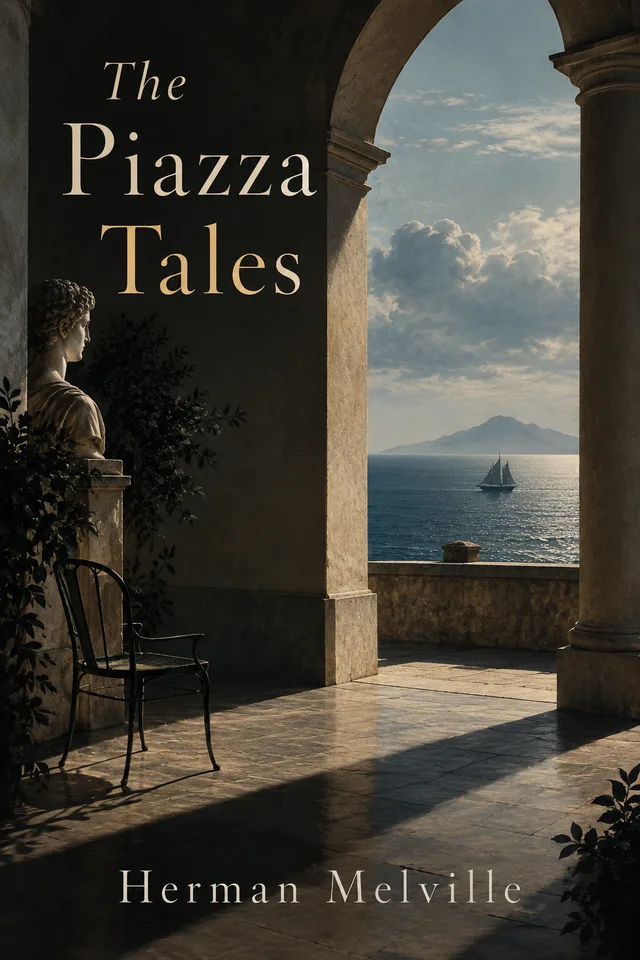
The Piazza Tales
Édition BooksWhale en anglais par Herman Melville
A collection of Melville’s most atmospheric short fiction, from quiet pastoral mystery to the moral darkness of “Benito Cereno.”
- Aperçu
- Extrait du texte préparé
- Formats
- Lecteur en ligne, EPUB, PDF
- Accès
- Claim Bibliothèque
Introduction du livre
The Piazza Tales
These stories move from the secluded mountain wall of “The Piazza” to the sea, the courtroom of conscience, and the bewildering theatre of human motives. Together they show Melville’s range as a short-story writer: symbolic, comic, suspenseful, and psychologically unsettling.
Édition BooksWhale
Préparation de cette édition
Cette édition repose sur un texte du domaine public et a été préparée par BooksWhale pour la lecture numérique.
Base du domaine public
Pourquoi cette édition peut être partagée
Published in 1856; Melville died in 1891. The original English text is public domain under the United States term and life-plus-70 rules.
Lire l'aperçu
Extrait du texte préparé
Aperçu sélectionné depuis le texte de lecture préparé.
Chapitre d'aperçuFull textLire l'aperçu
The Piazza Tales
Herman Melville
Chapitre d'aperçuTHE PIAZZA.Aperçu
“With fairest flowers, Whilst summer lasts, and I live here, Fidele—”
When I removed into the country, it was to occupy an old-fashioned farm-house, which had no piazza—a deficiency the more regretted, because not only did I like piazzas, as somehow combining the coziness of in-doors with the freedom of out-doors, and it is so pleasant to inspect your thermometer there, but the country round about was such a picture, that in berry time no boy climbs hill or crosses vale without coming upon easels planted in every nook, and sun-burnt painters painting there. A very paradise of painters. The circle of the stars cut by the circle of the mountains. At least, so looks it from the house; though, once upon the mountains, no circle of them can you see. Had the site been chosen five rods off, this charmed ring would not have been.
The house is old. Seventy years since, from the heart of the Hearth Stone Hills, they quarried the Kaaba, or Holy Stone, to which, each Thanksgiving, the social pilgrims used to come. So long ago, that, in digging for the foundation, the workmen used both spade and axe, fighting the Troglodytes of those subterranean parts—sturdy roots of a sturdy wood, encamped upon what is now a long land-slide of sleeping meadow, sloping away off from my poppy-bed. Of that knit wood, but one survivor stands—an elm, lonely through steadfastness.
Whoever built the house, he builded better than he knew; or else Orion in the zenith flashed down his Damocles’ sword to him some starry night, and said, “Build there.” For how, otherwise, could it have entered the builder’s mind, that, upon the clearing being made, such a purple prospect would be his?—nothing less than Greylock, with all his hills about him, like Charlemagne among his peers.
Now, for a house, so situated in such a country, to have no piazza for the convenience of those who might desire to feast upon the view, and take their time and ease about it, seemed as much of an omission as if a picture-gallery should have no bench; for what but picture-galleries are the marble halls of these same limestone hills?—galleries hung, month after month anew, with pictures ever fading into pictures ever fresh. And beauty is like piety—you cannot run and read it; tranquillity and constancy, with, now-a-days, an easy chair, are needed. For though, of old, when reverence was in vogue, and indolence was not, the devotees of Nature, doubtless, used to stand and adore—just as, in the cathedrals of those ages, the worshipers of a higher Power did—yet, in these times of failing faith and feeble knees, we have the piazza and the pew.
During the first year of my residence, the more leisurely to witness the coronation of Charlemagne (weather permitting, they crown him every sunrise and sunset), I chose me, on the hill-side bank near by, a royal lounge of turf—a green velvet lounge, with long, moss-padded back; while at the head, strangely enough, there grew (but, I suppose, for heraldry) three tufts of blue violets in a field-argent of wild strawberries; and a trellis, with honeysuckle, I set for canopy. Very majestical lounge, indeed. So much so, that here, as with the reclining majesty of Denmark in his orchard, a sly ear-ache invaded me. But, if damps abound at times in Westminster Abbey, because it is so old, why not within this monastery of mountains, which is older?
A piazza must be had.
The house was wide—my fortune narrow; so that, to build a panoramic piazza, one round and round, it could not be—although, indeed, considering the matter by rule and square, the carpenters, in the kindest way, were anxious to gratify my furthest wishes, at I’ve forgotten how much a foot.
Upon but one of the four sides would prudence grant me what I wanted. Now, which side?
Chapitre d'aperçuBARTLEBY.Aperçu
I am a rather elderly man. The nature of my avocations, for the last thirty years, has brought me into more than ordinary contact with what would seem an interesting and somewhat singular set of men, of whom, as yet, nothing, that I know of, has ever been written—I mean, the law-copyists, or scriveners. I have known very many of them, professionally and privately, and, if I pleased, could relate divers histories, at which good-natured gentlemen might smile, and sentimental souls might weep. But I waive the biographies of all other scriveners, for a few passages in the life of Bartleby, who was a scrivener, the strangest I ever saw, or heard of. While, of other law-copyists, I might write the complete life, of Bartleby nothing of that sort can be done. I believe that no materials exist, for a full and satisfactory biography of this man. It is an irreparable loss to literature. Bartleby was one of those beings of whom nothing is ascertainable, except from the original sources, and, in his case, those are very small. What my own astonished eyes saw of Bartleby, that is all I know of him, except, indeed, one vague report, which will appear in the sequel.
Ere introducing the scrivener, as he first appeared to me, it is fit I make some mention of myself, my employés, my business, my chambers, and general surroundings; because some such description is indispensable to an adequate understanding of the chief character about to be presented. Imprimis: I am a man who, from his youth upwards, has been filled with a profound conviction that the easiest way of life is the best. Hence, though I belong to a profession proverbially energetic and nervous, even to turbulence, at times, yet nothing of that sort have I ever suffered to invade my peace. I am one of those unambitious lawyers who never addresses a jury, or in any way draws down public applause; but, in the cool tranquillity of a snug retreat, do a snug business among rich men’s bonds, and mortgages, and title-deeds. All who know me, consider me an eminently safe man. The late John Jacob Astor, a personage little given to poetic enthusiasm, had no hesitation in pronouncing my first grand point to be prudence; my next, method. I do not speak it in vanity, but simply record the fact, that I was not unemployed in my profession by the late John Jacob Astor; a name which, I admit, I love to repeat; for it hath a rounded and orbicular sound to it, and rings like unto bullion. I will freely add, that I was not insensible to the late John Jacob Astor’s good opinion.
Some time prior to the period at which this little history begins, my avocations had been largely increased. The good old office, now extinct in the State of New York, of a Master in Chancery, had been conferred upon me. It was not a very arduous office, but very pleasantly remunerative. I seldom lose my temper; much more seldom indulge in dangerous indignation at wrongs and outrages; but, I must be permitted to be rash here, and declare, that I consider the sudden and violent abrogation of the office of Master in Chancery, by the new Constitution, as a —— premature act; inasmuch as I had counted upon a life-lease of the profits, whereas I only received those of a few short years. But this is by the way.
My chambers were up stairs, at No. —— Wall street. At one end, they looked upon the white wall of the interior of a spacious skylight shaft, penetrating the building from top to bottom.
This view might have been considered rather tame than otherwise, deficient in what landscape painters call “life.” But, if so, the view from the other end of my chambers offered, at least, a contrast, if nothing more. In that direction, my windows commanded an unobstructed view of a lofty brick wall, black by age and everlasting shade; which wall required no spy-glass to bring out its lurking beauties, but, for the benefit of all near-sighted spectators, was pushed up to within ten feet of my window panes. Owing to the great height of the surrounding buildings, and my chambers being on the second floor, the interval between this wall and mine not a little resembled a huge square cistern.
Table des matières
Dans cette édition
- 01Full text
- 02THE PIAZZA.
- 03BARTLEBY.
- 04I threw open the folding-doors near by, and, turning upon Turkey and Nippers, exclaimed:
- 05I re-entered, with my hand in my pocket—and—and my heart in my mouth.
- 06I motioned him into the lawyer’s room, who then left us.
- 07BENITO CERENO.
- 08BENITO CERENO.
- 09I will cheer up my poor friend, this time, thought he.
- 10BENITO CERENO.
- 11BENITO CERENO.
- 12DOCTOR ROZAS.
- 13THE LIGHTNING-ROD MAN.
- 14I gave him one; while the hooded mountains seemed closing and tumbling into the cottage.
- 15THE ENCANTADAS; OR, ENCHANTED ISLES
- 16SKETCH FIRST. THE ISLES AT LARGE.
- 17SKETCH SECOND. TWO SIDES TO A TORTOISE.
- 18SKETCH THIRD. ROCK RODONDO.
- 19SKETCH FOURTH. A PISGAH VIEW FROM THE ROCK.
- 20SKETCH FIFTH. THE FRIGATE, AND SHIP FLYAWAY.
- 21SKETCH SIXTH. BARRINGTON ISLE AND THE BUCCANEERS.
- 22SKETCH SEVENTH. CHARLES’S ISLE AND THE DOG-KING.
- 23SKETCH EIGHTH. NORFOLK ISLE AND THE CHOLA WIDOW.
- 24I forgot to mention the most singular sight of all, though the first that greeted us after landing.
- 25SKETCH NINTH. HOOD’S ISLE AND THE HERMIT OBERLUS.
- 26“FATHERLESS OBERLUS.
- 27SKETCH TENTH. RUNAWAYS, CASTAWAYS, SOLITARIES, GRAVE-STONES, ETC.
- 28THE BELL-TOWER.
Disponibilité linguistique
Autres langues
Aucune autre édition linguistique n'est encore publiée. Cette section les reliera lorsqu'elles seront disponibles.
Demander une autre langue