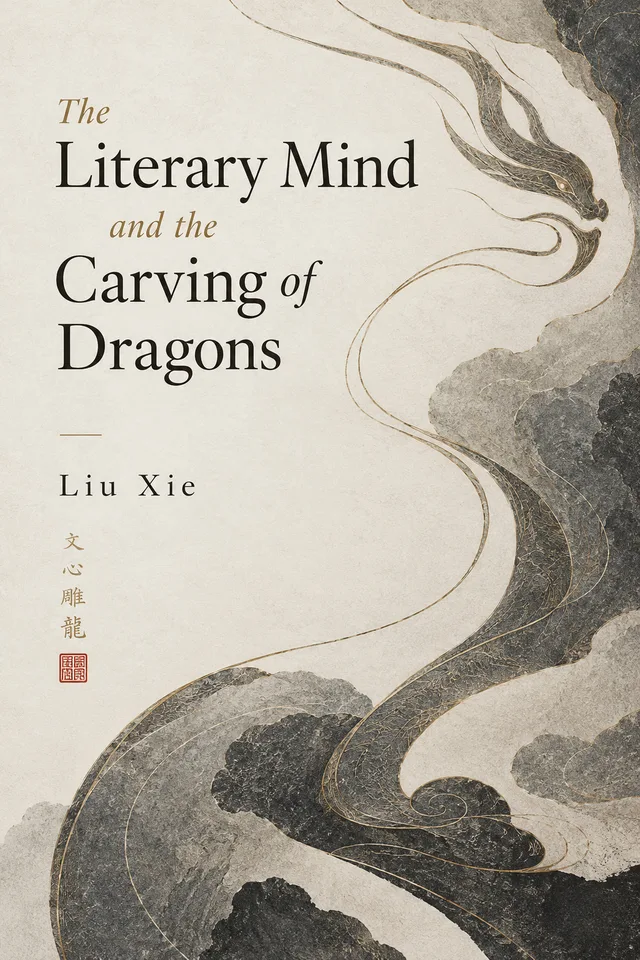
inglese Edizione
Letteratura
The Literary Mind and the Carving of Dragons
Edizione BooksWhale in inglese di Liu Xie
Titolo originale: 文心雕龙
A foundational Chinese treatise on literary form, rhetoric, style, emotion, genre, and the moral responsibilities of writing.
- Anteprima
- Estratto dal testo preparato
- Formati
- Lettore online, EPUB, PDF
- Accesso
- Claim Libreria
Introduzione al libro
The Literary Mind and the Carving of Dragons
The Literary Mind and the Carving of Dragons is one of the most ambitious works of classical Chinese literary criticism. Liu Xie discusses the origins of writing, the discipline of style, the demands of genre, and the relationship between literary beauty and ethical purpose.
Edizione BooksWhale
Come è stata preparata
Questa edizione è una traduzione assistita da IA e revisionata da persone, preparata da BooksWhale per leggibilità, formattazione e coerenza.
Base di pubblico dominio
Perché può essere condivisa
The Literary Mind and the Carving of Dragons was written by Liu Xie around the early sixth century. This English text is a newly prepared, human-reviewed AI-assisted translation of the public-domain classical Chinese work and does not reproduce a modern copyrighted translation.
Leggi anteprima
Estratto dal testo preparato
Anteprima selezionata dal testo preparato per la lettura.
Capitolo in anteprimaFull textLeggi anteprima
The Literary Mind and the Carving of Dragons
Liu Xie
Capitolo in anteprimaChapter 1: The Origin of the WayAnteprima
How profound and far-reaching are the origins of wen, the patterns and forms manifested in all things! Consider what came into being together with heaven and earth. In the universe, the dark and yellow colors intertwine; between heaven and earth, square and round forms are distinguished. The sun and moon, like overlapping jade discs, reveal the magnificent appearance of the heavenly bodies. Mountains and rivers, radiant and beautiful, display the embroidered patterns of the earth. All these are the wen of nature, born together with heaven and earth. Looking upward, we see the sun, moon, and stars shining brilliantly; looking downward, we behold the mountains and rivers adorned with splendid patterns. Once the positions of above and below in the universe were established, heaven and earth came into being. Only human beings can stand alongside heaven and earth, for they concentrate within themselves the spiritual essence of both. This is what is called the Three Powers: heaven, earth, and humanity. Humanity, gathering the finest vital essence of the Five Elements, was born as the heart of heaven and earth. Once the mind arose, language was established; once language was established, literary expression manifested itself. This is the natural course of things.
Extending this principle to all creation, animals and plants also possess their own wen. Dragons and phoenixes reveal auspiciousness through the brilliance of their scales and feathers, while tigers and leopards display their majestic bearing through the variegated patterns of their fur. The colors of clouds and rosy mists are more marvelous than anything a painter could apply. Flowers bloom among grasses and trees without requiring the ingenious craftsmanship of embroiderers. These are not ornaments imposed from without, but forms arising naturally. Likewise, when wind passes through forests, the resulting sounds harmonize like the playing of mouth organs and zithers; when spring water strikes stones, its rhythms resemble the harmonious ringing of stone chimes and bells. Thus, wherever things possess form, patterns naturally emerge; wherever sounds are produced, rhythm follows. If even unconscious creatures and objects possess such abundant patterns, how could human beings, endowed with minds, lack their own wen?
The origin of human literary expression begins with the Supreme Ultimate. The earliest and most profound explanation of its mysterious and subtle principles is found in the hexagrams of the Book of Changes. Fuxi inaugurated the Book of Changes by drawing the eight trigrams, while Confucius subsequently composed the Ten Wings to explain them. He also wrote the Wenyan commentaries specifically interpreting the hexagrams Qian and Kun. The literary beauty of language is therefore a manifestation of the inner nature of heaven and earth.
As for the eight trigrams supposedly contained in the River Chart, the Nine Categories concealed within the Luo Writing, the authentic golden diagrams engraved upon jade tablets, and the magnificent red characters inscribed upon green bamboo slips—who directed their creation? They arose from nothing other than the mysterious principles of nature. After written characters were invented by imitating the traces of birds and beasts, replacing the practice of recording events with knotted cords, writing began to shine forth.
The deeds of the Flame Emperor Shennong and the Great Radiant Fuxi were recorded in the Three Ancient Records. Yet those ages are so remote and obscure that their sounds, rhythms, and literary beauty can no longer be recovered. In the age of Yao and Shun, literary expression began to flourish brilliantly. The songs composed by Shun already expressed his personal feelings and aspirations. The proposals submitted by Boyi and Houji established a tradition of presenting advice and arguments to rulers.
When Yu the Great of the Xia dynasty rose to prominence, his achievements were vast and his accomplishments extraordinary. His undertakings proceeded in orderly fashion and were celebrated in songs of praise, while writings extolling virtue and achievement became increasingly elaborate. By the Shang and Zhou dynasties, literary embellishment had begun to surpass primitive simplicity. Under the influence of the Elegantiae and Hymns, refined language and splendid expression grew ever more innovative.
Capitolo in anteprimaChapter 2: Taking the Sages as ModelsAnteprima
Those who create in accordance with the natural Way are called sages; those who understand and expound the writings of sages are called enlightened scholars. Cultivating human character and emotions according to the natural Way was the achievement of the wise philosophers of antiquity. Since “the writings of Master Confucius can be seen,” the thoughts and feelings of the sages must be manifested in the language of their works.
The influential teachings of the ancient sage-kings were recorded separately on bamboo slips and in books, while the spiritual bearing and moral character of Confucius permeate his celebrated sayings. We may therefore observe that when Confucius praised the distant age of Yao, he described its culture as brilliant and flourishing; when he commended the more recent Western Zhou, he considered its prosperous culture worthy of imitation. These are clear examples of the importance attached to literary refinement in political education and the transformation of social customs.
When Duke Jian of Zheng raised an army against the state of Chen, Zichan, a minister of Zheng, achieved success through the power of language. When Duke Ping of Song received distinguished guests with the ceremonial offering of carved meat, the literary refinement displayed by both hosts and guests was recorded by disciples of Confucius. These examples demonstrate the importance of cultivated expression in affairs of state.
Confucius praised Zichan by saying that “his language fully expressed his intentions, and literary refinement fully adorned his language.” When discussing gentlemen of talent and virtue, Confucius maintained that “their feelings should be genuine and their words skillfully expressed.” These statements demonstrate the importance of literary refinement in personal cultivation.
From this we may understand that thoughts should be expressed fully and language should possess literary beauty, while feelings should be sincere and words skillfully fashioned. These are the fundamental rules of literary composition.
The sages comprehensively observed heaven, earth, and the universe, penetrating deeply into their mysterious and subtle secrets. Their writings became models because their reasoning and literary form corresponded as perfectly as the matching halves of a tally. Sometimes they expressed their central purpose in concise language; sometimes they elaborated feelings and principles through abundant words. At times they established literary structure by presenting principles clearly; at other times they concealed profound meanings within subtle and indirect language.
Thus, the Spring and Autumn Annals frequently uses a single character to convey praise or condemnation, while the Book of Rites may describe the activities of people wearing lighter mourning garments in order to encompass those wearing heavier mourning attire. These exemplify the principle of expressing one's purpose through concise language.
The poem “Seventh Month” in the Airs of Bin section of the Book of Songs joins numerous stanzas and lines into a complete composition, while the chapter “Conduct of the Confucian Scholar” in the Book of Rites employs elaborate explanations and abundant language. These illustrate the method of using extensive expression to encompass feelings fully.
Written documents take their model from the hexagram Guai because decisions must resolve affairs; literary compositions imitate the hexagram Li because they must clarify principles. These exemplify the establishment of literary form through clear reasoning.
The four kinds of hexagram meanings in the Book of Changes are profound, intricate, and implicit, while the five interpretive conventions of the Spring and Autumn Annals express weighty principles through subtle and indirect language. These illustrate the concealment of practical significance within hidden meanings.
Thus, literary compositions differ in length and structure, just as their methods of explicit and implicit expression differ. Writers must apply these methods according to circumstances, adapting them flexibly to the needs of the moment. By examining the works of the Duke of Zhou and Confucius, authors can find reliable models for literary composition.
Consequently, discussions of literary writing must always be tested against the sages, and investigations into the intentions and practices of the sages must take their classical works as authoritative models. The Book of Changes states: “Distinguish things clearly and express them in correct and elegant language, and judgments will be appropriate and complete.” The Book of Documents says: “Language should be practical and concise rather than merely seeking novelty.”
Indice
In questa edizione
- 01Full text
- 02Chapter 1: The Origin of the Way
- 03Chapter 2: Taking the Sages as Models
- 04Chapter 3: Honoring the Classics
- 05Chapter 4: Correcting the Apocryphal Writings
- 06Chapter 5: Distinguishing the Poetry of Chu
- 07Chapter 6: Understanding Poetry
- 08Chapter 7: Music Bureau Poetry
- 09Chapter 8: Explaining the Rhapsody
- 10Chapter 9: Hymns and Encomia
- 11Chapter 10: Prayers and Covenants
- 12Chapter 11: Inscriptions and Admonitions
- 13Chapter 12: Funeral Eulogies and Monumental Inscriptions
- 14Chapter 13: Laments and Condolences
- 15Chapter 14: Miscellaneous Literary Forms
- 16Chapter 15: Humor and Riddles
- 17Chapter 16: History and Biography
- 18Chapter 17: The Writings of the Philosophers
- 19Chapter 18: Treatises and Persuasive Discourses
- 20Chapter 19: Imperial Edicts and Decrees
- 21Chapter 20: Military Proclamations and Public Circulars
- 22Chapter 20: The Feng and Shan Sacrifices
- 23Chapter 21: Memorials of Gratitude and Formal Petitions
- 24Chapter 23: Memorials and Written Submissions
- 25Chapter 24: Deliberations and Responses
- 26Chapter 25: Letters and Administrative Documents
- 27Chapter 26: Spiritual Imagination
- 28Chapter 27: Literary Style and Individual Character
- 29Chapter 28: Vital Force and Structural Strength
- 30Chapter 29: Continuity and Transformation
- 31Chapter 30: Establishing Literary Momentum
- 32Chapter 31: Emotion and Literary Beauty
- 33Chapter 32: Shaping and Editing
- 34Chapter 33: Sound and Rhythm
- 35Chapter 34: Chapters and Sentences
- 36Chapter 35: Parallel Expression
- 37Chapter 36: Comparison and Evocation
- 38Chapter 37: Hyperbole and Ornamentation
- 39Chapter 38: Allusions and Historical Examples
- 40Chapter 39: The Refinement of Written Characters
- 41Chapter 40: Subtle Meaning and Outstanding Expression
- 42Chapter 41: Identifying Literary Defects
- 43Chapter 42: Nourishing Vital Energy
- 44Chapter 43: Unity and Coherence
- 45Chapter 44: General Principles of Literary Composition
- 46Chapter 45: The Influence of Historical Periods
- 47Chapter 46: The Appearance of Natural Things
- 48Chapter 47: The Talents and Achievements of Writers
- 49Chapter 48: Understanding Literary Excellence
- 50Chapter 49: The Character and Practical Abilities of Writers
- 51Chapter 50: Explaining My Purpose
Disponibilità lingue
Altre lingue
cinese
cinese Edizione
文心雕龙
Liu Xie · Arte
刘勰系统论文章体、文采、创作与批评,是中国古代文学理论的高峰之作。
italiano
italiano Edizione
La mente letteraria e l’arte di scolpire i draghi
Liu Xie · Arte
Un trattato cinese classico sull’arte della scrittura, della critica e della forma letteraria.